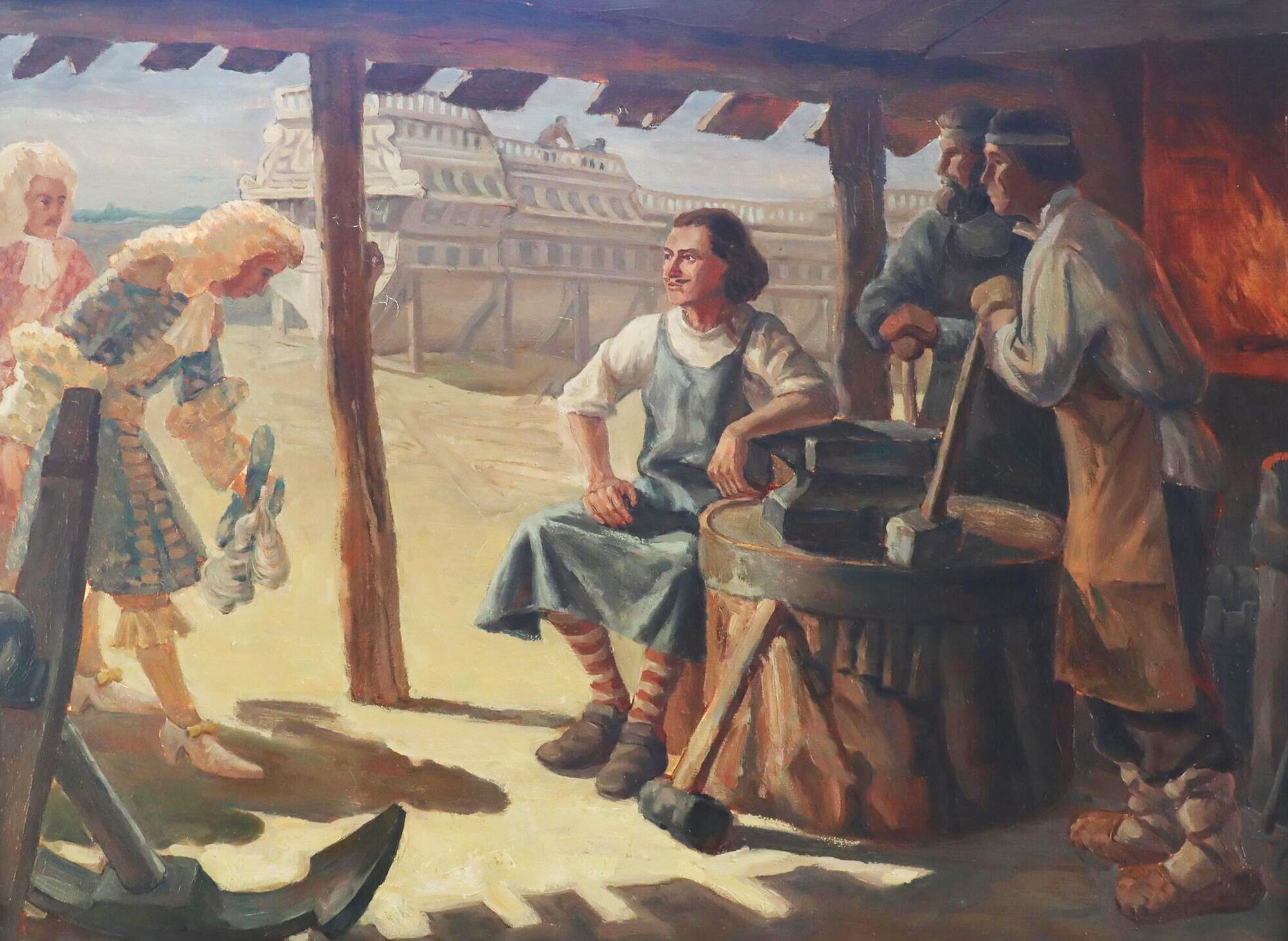


The painting ‘Peter the Great in a Forge’ by painter Oleg Lebedev is a wonderful example of historical painting. His work was presented to the Varnavino Museum by the Nizhny Novgorod School of Arts. Unfortunately, the painter himself or the circumstances of the creation of the painting are virtually unknown. The painting itself clearly refers to one of the most famous periods in the history of Russia: the reign of Peter the Great and his era of great transformations.
The center of the picture shows the emperor sitting on a bench in work clothes. On the right, next to him, two blacksmiths are painted, and on the left there are two men who have the so-called ‘German dress’ on, the fashion for which the tsar himself started. With different clothes, Lebedev marked the contrast between the nobility and Peter: it is known that the tsar took an active part in the construction of the first Russian fleet and turned Russia into the leading naval empire in Europe.
Peter I marked a place for himself in the history as the first Russian emperor, reformer, military leader, but above all as the creator of the Russian fleet. That is why Lebedev depicted him against the background of a ship under construction, and placed a massive anchor in the left corner of the foreground. Even in his youth, Peter realized that, without the fleet, Russia would not be able to become a world power, and started to do his best to correct this situation. At the very end of the 17th century, the Azov fleet appeared, and, as early as 1703, the Baltic Fleet was created, which is still the strongest sea formation of modern Russia.
At the same time, it is wrong to say that before Peter the Great, there was not a single Russian ruler who tried to create a national fleet. For example, in the 16th century, Ivan the Terrible actively used the river fleet in his military campaigns against the Kazan and Astrakhan khanates. Later, in the middle of the 17th century, during the war with the Swedes the rulers of Moscow engaged in building a full-fledged fleet in the Baltic waters, but the terms of the peace treaty signed in 1661 forced Russians to burn all their ships and shipyards.
Having failed in the north, the Russian rulers thought about creating a southern fleet. In 1668, in the village of Dedinovo near Moscow, the three-masted sailing ship Oryol was launched, which was the first Russian ship of the Western European type that Peter himself called the ‘great-grandfather’ of the Russian fleet. In the summer of the following year, the Oryol made its first three-month voyage to Astrakhan.
The ship’s fate was tragic. It served little, and in 1670, according to one of the versions, the ship was burned down by the rioters who were on the side of Stepan Razin. According to another version, it fell into disrepair due to years of inactivity. Nevertheless, the Oryol became the most important starting point in the history of the creation of the Russian fleet, and Peter the Great himself steered the ship to different waters, including Pereyaslavskoe (Pleshcheevo) Lake. Here he founded a shipyard, and, as early as 1692, two small frigates and three yachts sailed on the lake. It was the moment of building a ship on Lake Pereyaslavskoe that Lebedev portrayed in his painting “Peter the Great in a Forge”.
The center of the picture shows the emperor sitting on a bench in work clothes. On the right, next to him, two blacksmiths are painted, and on the left there are two men who have the so-called ‘German dress’ on, the fashion for which the tsar himself started. With different clothes, Lebedev marked the contrast between the nobility and Peter: it is known that the tsar took an active part in the construction of the first Russian fleet and turned Russia into the leading naval empire in Europe.
Peter I marked a place for himself in the history as the first Russian emperor, reformer, military leader, but above all as the creator of the Russian fleet. That is why Lebedev depicted him against the background of a ship under construction, and placed a massive anchor in the left corner of the foreground. Even in his youth, Peter realized that, without the fleet, Russia would not be able to become a world power, and started to do his best to correct this situation. At the very end of the 17th century, the Azov fleet appeared, and, as early as 1703, the Baltic Fleet was created, which is still the strongest sea formation of modern Russia.
At the same time, it is wrong to say that before Peter the Great, there was not a single Russian ruler who tried to create a national fleet. For example, in the 16th century, Ivan the Terrible actively used the river fleet in his military campaigns against the Kazan and Astrakhan khanates. Later, in the middle of the 17th century, during the war with the Swedes the rulers of Moscow engaged in building a full-fledged fleet in the Baltic waters, but the terms of the peace treaty signed in 1661 forced Russians to burn all their ships and shipyards.
Having failed in the north, the Russian rulers thought about creating a southern fleet. In 1668, in the village of Dedinovo near Moscow, the three-masted sailing ship Oryol was launched, which was the first Russian ship of the Western European type that Peter himself called the ‘great-grandfather’ of the Russian fleet. In the summer of the following year, the Oryol made its first three-month voyage to Astrakhan.
The ship’s fate was tragic. It served little, and in 1670, according to one of the versions, the ship was burned down by the rioters who were on the side of Stepan Razin. According to another version, it fell into disrepair due to years of inactivity. Nevertheless, the Oryol became the most important starting point in the history of the creation of the Russian fleet, and Peter the Great himself steered the ship to different waters, including Pereyaslavskoe (Pleshcheevo) Lake. Here he founded a shipyard, and, as early as 1692, two small frigates and three yachts sailed on the lake. It was the moment of building a ship on Lake Pereyaslavskoe that Lebedev portrayed in his painting “Peter the Great in a Forge”.