The Sami people paid special attention to footwear. A lot depended on the quality of footwear, as they had to travel long distances during migrations and hunting.
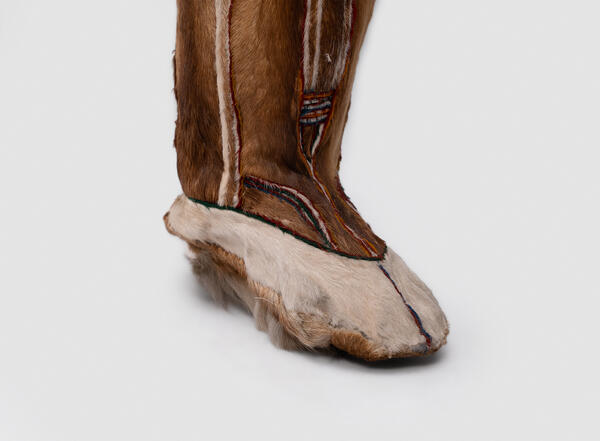
Pimy are considered to be smart footwear with long bootlegs. They were borrowed from the tradition of the Komi people in the late 19th — early 20th centuries. Later, pimy gradually replaced yary and kanga boots. As early as the first half of the 20th century, pimy became the usual winter footwear of the Sami people, both men’s and women’s.
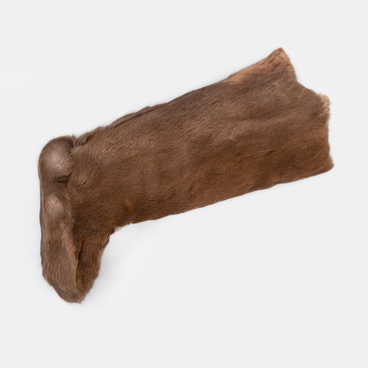
Pimy are groin-high boots made of reindeer skins with fur on the outside, soft soles and round blunt toes. Men’s pimy were made of dark koyba (skin from deer’s legs), women’s — of alternating dark and white koyba. To prevent the pimy from coming down the legs, they were fastened to the belt with special straps sewn to the front, to the upper edges of the pimy, or tied to the belt with narrow obory leather straps, and tied under the knees with knitted, woven of sheep’s wool garters. The Sami people, like the Komi, wore lipty, fur boot liners sewn from reindeer skins with fur inside, that were above the knees in length.
Reindeer sinew was used as a material for stitching parts. Sinew threads were made from reindeer back and leg tendons. They were used in sewing leather and fur garments, in decorative trims and beadwork.
A narrow edging of green, red or yellow cloth was made along the seams, and multicolored cloth was used in the front as decoration. The sole was made of reindeer feathers, which are characterized by great thickness and durability. Reindeer feathers are the coarse white wool on reindeer feet from underneath the hooves.
Fur dressing and the sewing of hats, malitsas and
pimy take place in August — “poarryk mānn”. At the same time the Sami people
gather firewood, fix harnesses and nets. In the second half of August herders
look for new reindeer lichen pastures. At this time the reindeer lichen is well
moistened by the rains and the animals begin to feed heavily on it. At the end
of August, Sami women and children go mushroom and berry picking and fishing.
In her book “Life, Сustoms and Myths of the Kola Sami in the Past and Present”
Nadezhda Bolshakova wrote about this time,