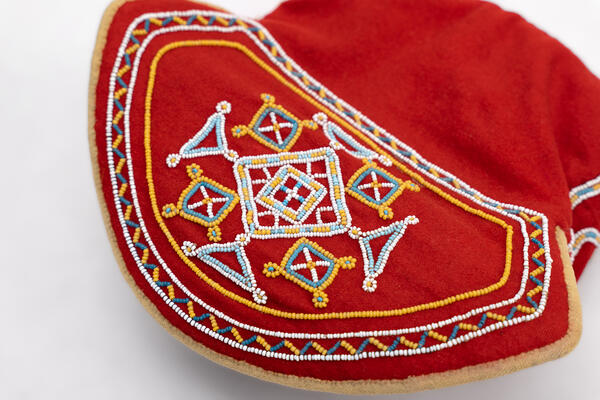
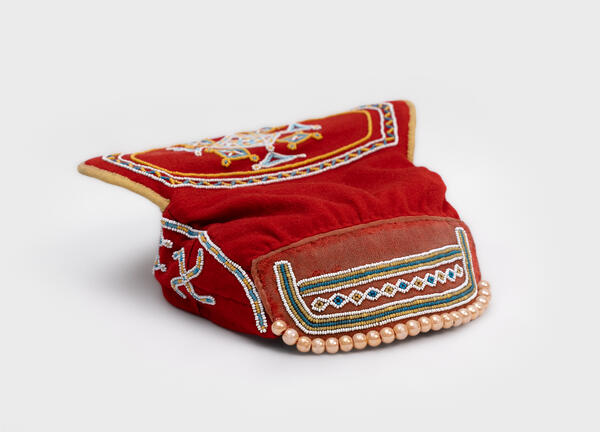
A shamshura is a summer headdress of a married Sami woman. This headdress was prepared as part of dowry before the wedding.
A shamshura has a distinctive complex shape. It consists of a low cylinder, smoothly passing into a semi-elliptical elevation, sloping forward. The rear lower part has a counterweight visor, or “pozatylnik”. It had lead pendants or beads sewn to its edge, and was decorated with beads and pearls.
A kerchief folded in a triangle was tied on top of the shamshura. The corners of the kerchief were tied under the chin.
A red cloth shamshura was decorated with geometric patterns of beads, gold or silver braid, and pearls. A shamshura was made as follows: the cloth was stretched on birch bark or a cardboard frame. The base of this garment was a povoynik (a soft cap, under which the hair was tucked), with a cross ridge curved above the forehead and a back part covering the neck. As a rule, seven- or six-color beaded patterns of stylized geometric character were applied on the red surface of the shamshura.
The term “shamshura” was understood not only as a Sami headdress. It was widespread throughout the north of the western part of Russia, as well as in Siberia in different variations. Thus, in the school dictionary “Vologda Word” a shamshura is defined as “an ancient headdress of a married woman — a shawl attached to a headband and tied at the back”. The word “shamshura” in relation to the headdress is found in documents of the 17th century. At the end of the 18th — early 20th century several variants of women’s headdresses were known by this term. In the Vyatka and Perm governorates, and in the north-east of Nizhny Novgorod governorate, a shamshura was a headdress with a hard flat top of round, oval, or trapezoidal shape, and with a narrow soft headband, which was tied at the back of the head with straps.
In Shenkursky uyezd of the Archangelsk governorate,
Velsky uyezd of the Vologda governorate, and Slobodsky uyezd of the Vyatka
governorate, a samshura was a headdress made of brocade with a wide headband
and a cone-shaped elevation on the top of the head, laid in vertical roll
folds. In other places of the Russian North it was known by the terms
“morshen”, “borchatka”, “sbornik”.