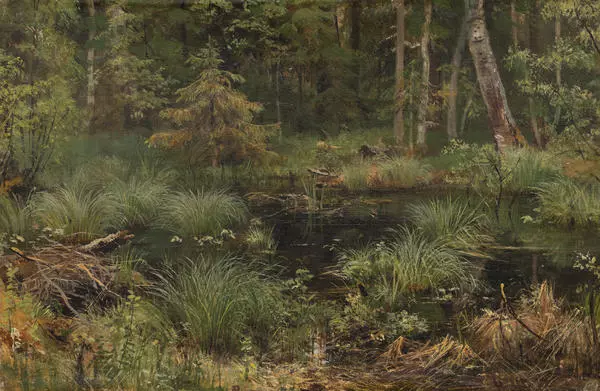
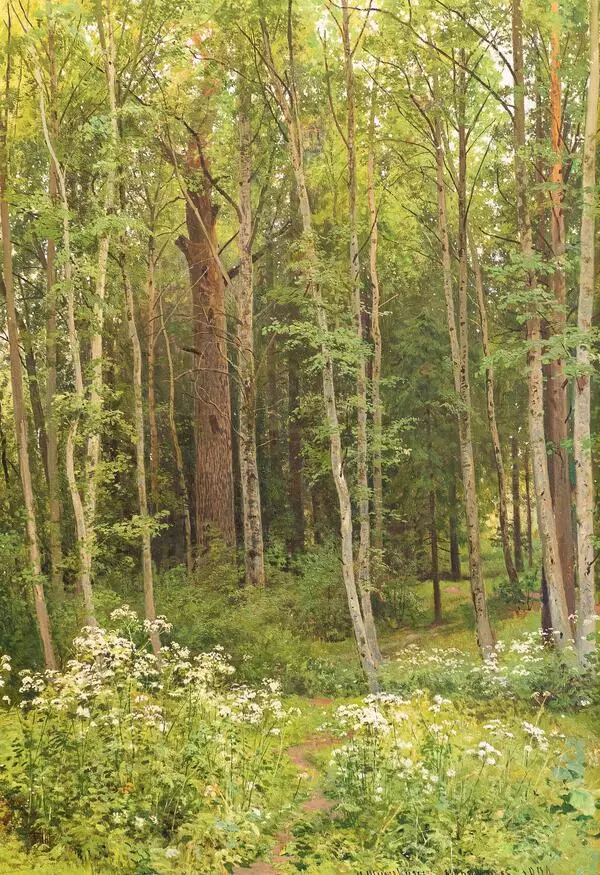
The Irbit Museum of Fine Arts presents an etching by Ivan Ivanovich Shishkin titled “Ai-Petri Landscape”. The artist was inspired by his journey to Crimea in the summer of 1879. During this trip, Shishkin produced numerous sketches, including studies of the ascent to Mount Ai-Petri. The subject of this etching remained relatively obscure during Shishkin’s lifetime and was never included in any published album of his works. The etching bears the artist’s fingerprints within the image area — a testament to his direct involvement in the printing process — and features his signature and the date in the lower right corner.
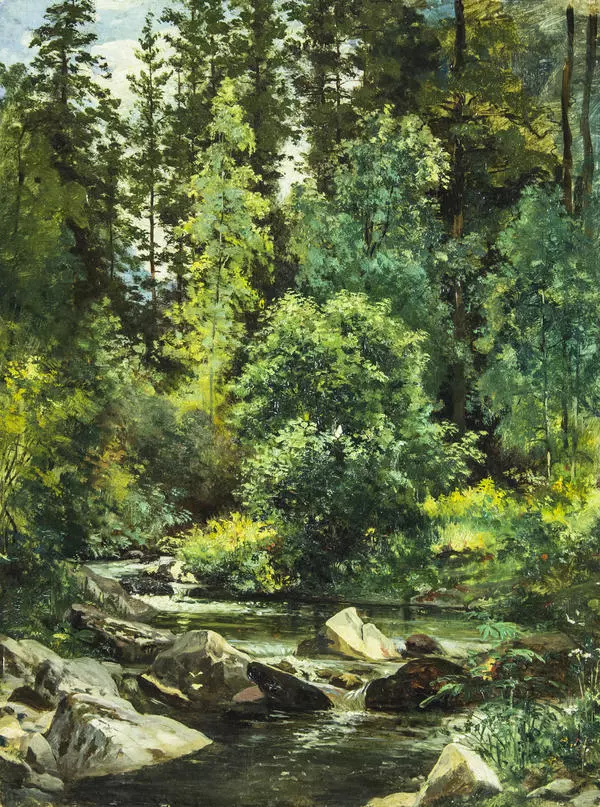
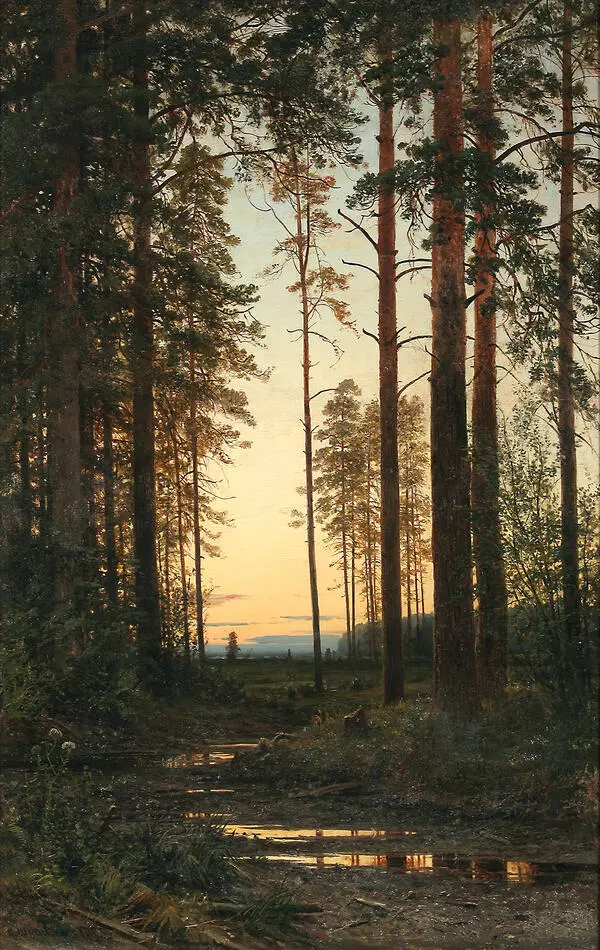
The composition presents a meticulously executed, picturesque forest landscape that evokes a profound sense of harmony and tranquility. At its center flows a small mountain stream; its clear waters mirroring the surrounding trees, sky, and delicate clouds. These reflections lend the scene both realism and gentle dynamism. The water’s surface is rendered with fine, precise lines and subtle strokes that capture its transparency and soft highlights, while the reflections faithfully replicate the forms of the surrounding elements.
The banks are scattered with large, rounded boulders and rocks, some tilted or forming natural ledges that introduce a subtle sense of movement. Each stone is carefully modeled: contrasts of light and shadow define their volume and texture — whether smooth or rugged — and some are partially covered with moss or low-growing vegetation, enhancing the impression of age and untouched nature.
In the foreground, dense thickets of shrubs, ferns, mosses, and young saplings flank both sides of the composition, evoking a sense of wild, pristine wilderness. Rendered with short, interwoven strokes and lines, these elements possess a tactile, organic texture. They frame the scene intimately, drawing the viewer into a secluded forest glade while adding depth and layered complexity to the image.
Rising in the background are slender pine trees with tall, straight trunks and full, rounded crowns. Their silhouettes are suggested with soft, airy strokes that convey lightness and distance, while the trunks are defined by clean vertical lines. The interplay of light and shadow emphasizes their form. These pines appear as silent guardians of the forest’s solitude, reinforcing the overall impression of an untouched, serene natural sanctuary.