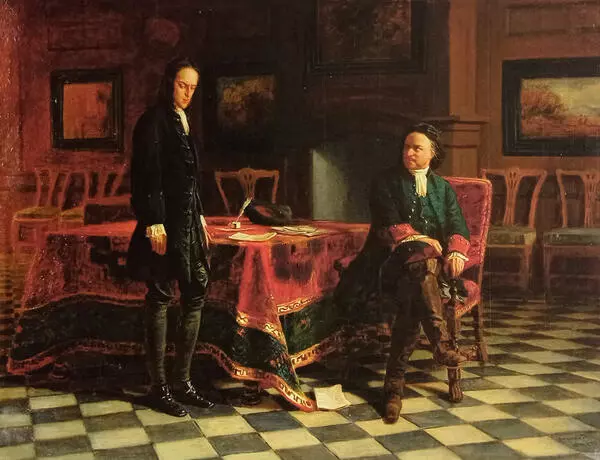
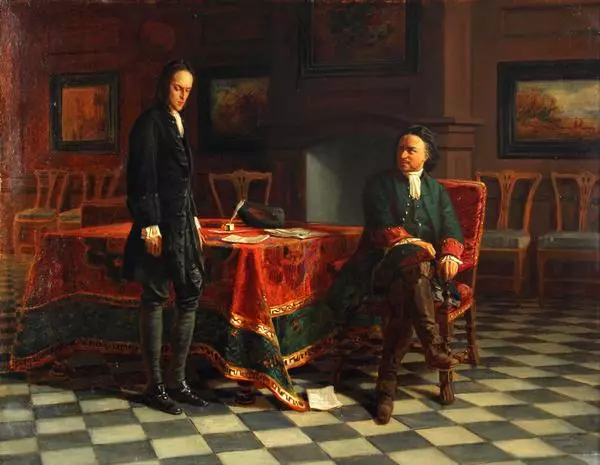
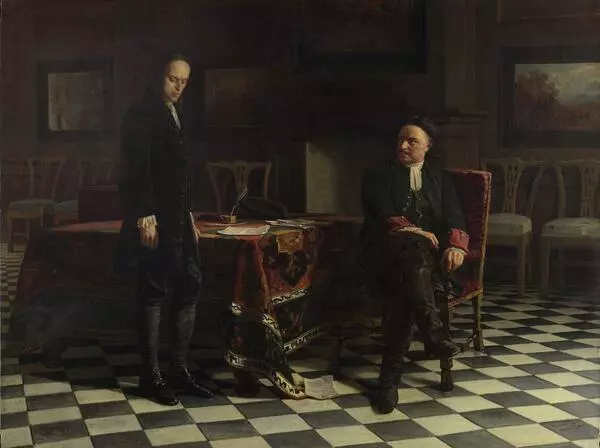
The Irbit Museum of Fine Arts presents an etching by Nikolai Ge, created in 1872 after his celebrated 1871 painting of the same title. Rather than merely replicating the original, the print intensifies its emotional drama through the stark contrasts of black and white inherent to the etching technique.
Etching is a labor-intensive process that sometimes takes months to complete: the artist draws onto a metal plate coated with an acid-resistant ground, then submerges it in acid, which bites into the exposed lines. These incised grooves are later filled with ink to produce the final impression. Ge worked on this engraving in St. Petersburg, home to Russia’s finest printmaking workshops at the time. The result preserves — and even amplifies — the psychological tension and emotional power of the painted composition.
The scene transports the viewer to 1718, when Peter the Great, the architect of Russia’s modernization, interrogates his son Alexei, accused of treason. This is not merely a familial conflict but a collision of two eras. Peter, embodying progress and autocratic will, demands his son’s allegiance; Alexei, aligned with conservative factions, becomes the symbol of resistance. Ge chose this moment deliberately: the tsarevich’s fate hangs in the balance, and Peter I faces a harrowing inner dilemma — whether to condemn his own son to imprisonment and torture for the sake of the state.
The setting is dark: the walls of the Monplaisir Palace in Peterhof close in around the figures, isolating them in a space charged with moral and historical weight. Ge masterfully employs chiaroscuro. A sharp beam of light falls across their faces, revealing every wrinkle, every strained gesture. Behind Peter, the shadows deepen, as if foreshadowing impending tragedy. Alexei, by contrast, recedes into semi-darkness — his fate already sealed.
Ge offers no easy answers. On one hand, Peter appears as a reformer sacrificing his son for the “good of the Fatherland”; on the other, Alexei’s vulnerability becomes a symbol of human frailty in the face of implacable power. Like his fellow Wanderers (a group of Russian realist artists who formed an artists’ cooperative), Ge invites the viewer to reflect: Where lies the boundary between progress and cruelty? Can great ends ever justify terrible means?
Nikolai Ge’s etching is far more than a historical illustration — it is a psychological drama in which every compositional element serves the central idea, and the incisive lines of the etching technique heighten the sense of tension. Contemporary critics, including Vladimir Stasov, recognized its power, remarking: “No one before Ge had brought this story so close to the viewer”.