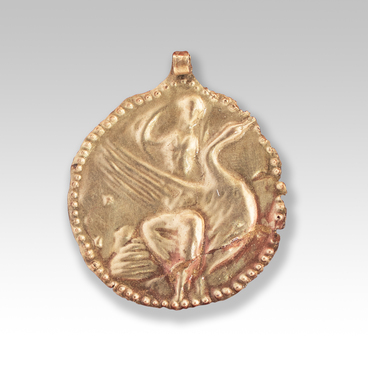
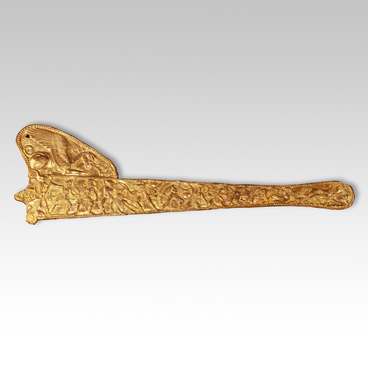
The collection of the Rostov Regional Museum of Local Lore contains artifacts from the kurgan complex “Five Brothers”, specifically kurgan No. 8, which was excavated in 1959. A significant number of objects made of gold and silver have been discovered at this site, including jewelry, parts of horse harnesses, weapons, and ceremonial silver vessels.
Among the various pieces of jewelry, there was a gold signet ring with an inscribed design on the shield that was located near the phalanges of the left hand of the deceased individual.
The shield shows a scene of a griffin tearing into a ram’s head. The griffin is a mythological creature with a bird’s head, a long neck, and five sharp spikes on its back. Its beak is wide open, with its tongue clearly visible. Its eyes are oval and both ears are pointed. The griffin has raised wings. The back of the body resembles that of a lion. The creature is depicted sitting with its tail raised and curved, clutching the ram’s head in its paws. The muscles, claws, and wings of the griffin are depicted with great detail and realism.
Animal style is a term used to describe a specific artistic trend that was very popular in ancient times. It is distinguished by the depiction of both real animals and fantastic creatures, as well as their body parts. Often, artifacts made in this style feature complex images of various animals.
The image of the griffin combines the characteristics of the eagle, representing speed and agility, and the lion, symbolizing strength and courage. This combination illustrates the nature of the creature: the griffin was said to personify the sun, strength, alertness, and retribution.
In ancient Greece, the griffin was a symbol of power, confidence in one’s strength, as well as perceptiveness and alertness. It was also associated with the ancient Greek deity Apollo, the god of the sun and wisdom, as well as the patron of the arts. Griffins also pulled the chariot of Nemesis, the Greek goddess of retribution, symbolizing the swiftness of retribution for wrongdoing. The griffin served as the embodiment of Nemesis and turned the Wheel of Fate.
The earliest recorded mention of griffins that has been preserved can be attributed to the ancient Greek historian and geographer, Herodotus. In the 5th century BCE, he wrote about these mythological creatures with the body of a lion and the wings and talons of an eagle, which lived in the far north of Asia, specifically in a region known as Hyperborea. According to his account, these griffins guarded gold deposits against the one-eyed inhabitants of the region known as Arimaspians.