The collection of the Rostov Regional Museum of Local Lore includes items from the kurgan complex “Five Brothers”. These artifacts were discovered in kurgan No. 8, which was excavated in 1959 near the village (stanitsa) of Yelizavetovskaya. Over a thousand objects made of gold and silver, including jewelry, parts of horse harnesses, weapons, and ceremonial vessels, were found in this burial.
The nature of the grave goods indicated the high status of the deceased individual. In popular scientific literature, this burial has been referred to as the “tomb of a Scythian King”.
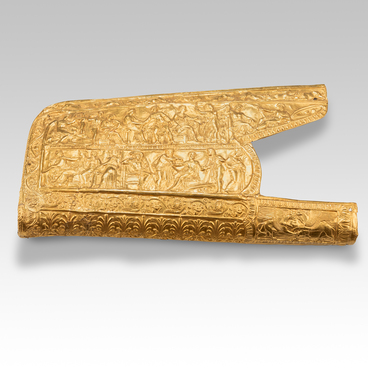
The scabbard for a sword on display has a gold overlay decoration featuring relief depictions of fights between Greek warriors and nomads.
On the side of the scabbard, there is an image of a doe being torn apart by a griffin. The scabbard also illustrates battle scenes between Greek warriors and nomads. The first image is of a Greek military leader, a strategos, with his arm extended. Behind him is the figure of a nomadic warrior, preparing to strike with his sword. In the next scene, a bearded Greek soldier attempts to fight off a nomad’s attack with a spear while simultaneously supporting a wounded young Greek man who lies on the ground. In the third image, a Greek warrior shields himself and attempts to strike a kneeling nomad with an ax. Behind this latter figure, there is a cavalry nomadic soldier standing, as his horse has fallen on its forelegs. The fourth scene shows a Greek man attempting to remove an arrow from his comrade’s thigh. The fifth image depicts a horse racing full speed, dragging a wounded nomadic warrior behind it. He grips the horse’s reins with his left hand. The final scene features a Corinthian helmet. According to experts, the nomads were victorious in this battle.
The overlay decoration was attached to the base of
the scabbard with small gold nails. During the restoration conducted by the
laboratory of scientific restoration of monuments of applied art at the State
Hermitage Museum, fragments of wood were found on the sword. As a result, it
was determined that the sword’s sheath was made from cherry wood. During
excavations in 1959, traces of a mastic filling — a gypsum-based gasket — were
found on the inner surface of the overlay piece in its relief recesses. The
same mastic was present on the gold decorations for a gorytos.