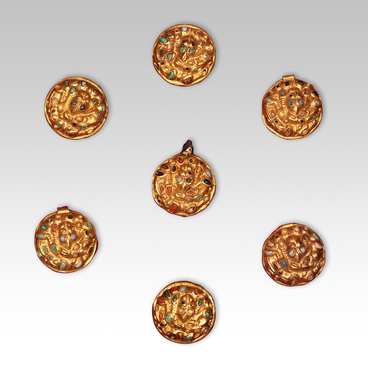
The object on display was found at the site of the Yelizavetovskoye settlement, during the excavation of the structural remains of the central area of the Greek city.
The Yelizavetovskoye settlement is an archaeological site from the Scythian period. It is located in the Don River Delta. At the time, it was the largest center for handicrafts, wholesale international, and inter-tribal trade in the southeastern region of Eastern Europe.
The pendant medallion is made from a thin sheet of gold foil. It has an eyelet at the top. The image was created using the technique of embossing on a die. The pendant depicts a female figure, who is shown facing the observer. Her right hand is raised towards her head, touching her hair.
The female figure is seated between the wings of a swan or goose that flies to the right. The right wing of the bird partially obscures the figure. Its neck is curved. The beak rests on an ornament consisting of convex dots that frame the entire composition. The body of the bird is massive, with long flight feathers and tail feathers rendered by long, convex stripes. The connection between the image and the celestial realm is emphasized by three four-rayed stars located under the bird’s wing in the lower left corner of the medallion, which depicts Aphrodite Urania.
The cult of Aphrodite emerged in the Black Sea region around the 4th century BCE as a result of the resettlement of colonists from Greek cities. It merged Phoenician, Asian, and Phrygian influences. The Scythians also worshiped Aphrodite, probably associating her with the mother goddess. Hellenic settlers popularized the worship of Aphrodite and other deities in order to economically and politically assimilate with the local population.
Aphrodite Urania is an epithet of the ancient Greek goddess Aphrodite, signifying a “heavenly” or “spiritual” aspect to distinguish her from her more mundane epithet, Aphrodite Pandemos — Aphrodite for all the people. This epithet was used primarily in literature to differentiate the more “celestial” love of body and spirit from the purely physical lust.
According to the ancient Greek historian Herodotus and other sources, the ancient Arabs and Sumerians called this aspect Alitta or Alilat, which was the name of a goddess associated with the heavens and rain. In Western Asia, the most common title used for the Greek goddess Aphrodite was Urania. It was interpreted as a Semitic term meaning “queen of the heavens”. This association with the moon may have contributed to the interpretation, but it is more likely that the term simply refers to the idea that her domain was in the heavens, from which she could influence the world below, including the earth, sea, and air.