

Pen wipers were used to remove paper lint or the excess of ink from the nib of a dip or fountain pen. They were essential in the 19th century and the first half of the 20th century, helping to keep pens in perfect working order.
Pen wipers could be very simple and were often made by hand. Some craftsmen produced bronze and porcelain pen wipers, creating valuable artworks.
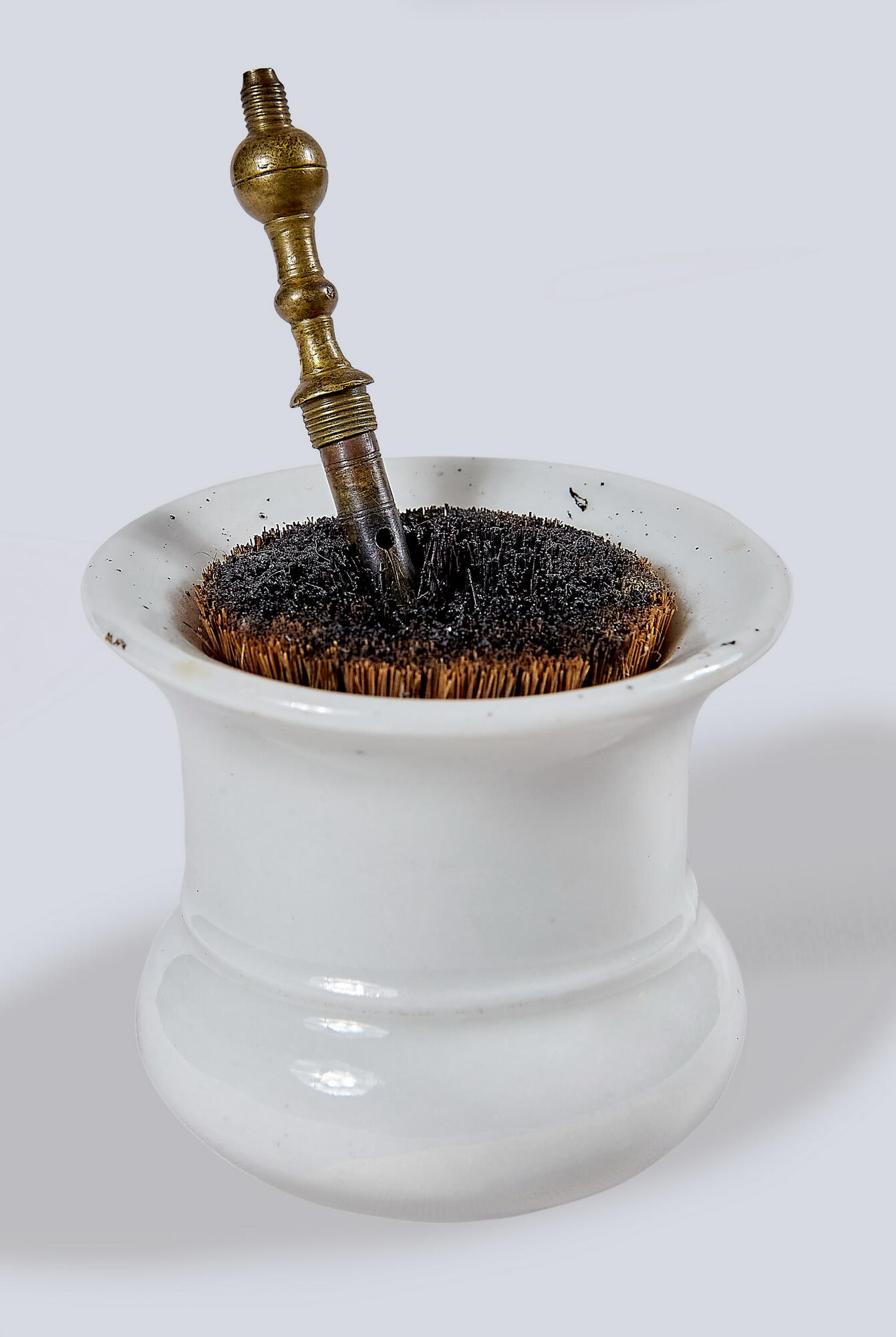
The pen wiper from the museum’s collection was made of porcelain. It has a simple rounded shape with a slightly curved edge. The reservoir contains a dense bundle of stiff bristles. The pen was wiped over the edge of the bristles, and in this manner, it was cleaned and could be used for writing again. This pen wiper is rather utilitarian, decorated only with a golden border around the edge that faded almost completely over time.
Originally, pen wipers were made of pieces of felt, scraps of fabric or leather. Details of necessary shapes, either square or round, were cut out of such materials. Then they were stacked in several layers and fastened in the center with a button or a metal rivet.
The top of such pen wipers could be decorated with pieces of leather, thread embroidery, or beads. Sometimes, pen wipers were even crocheted or knitted. In the mid-19th century, women’s handicraft magazines started publishing sketches and detailed instructions for making pen wipers at home.
There were also factory-made porcelain, faience, and bronze pen wipers. Very often, they were shaped like small figurines of animals or birds, attached to a reservoir with bristles or horsehair behind them.
By the end of the 19th century, pen wipers of more complex shapes appeared. Some of them resembled Japanese fans, bird nests, and butterflies. These devices were so popular, practical, and useful that they remained in demand until the mid-20th century.
Pen wipers could be very simple and were often made by hand. Some craftsmen produced bronze and porcelain pen wipers, creating valuable artworks.
The pen wiper from the museum’s collection was made of porcelain. It has a simple rounded shape with a slightly curved edge. The reservoir contains a dense bundle of stiff bristles. The pen was wiped over the edge of the bristles, and in this manner, it was cleaned and could be used for writing again. This pen wiper is rather utilitarian, decorated only with a golden border around the edge that faded almost completely over time.
Originally, pen wipers were made of pieces of felt, scraps of fabric or leather. Details of necessary shapes, either square or round, were cut out of such materials. Then they were stacked in several layers and fastened in the center with a button or a metal rivet.
The top of such pen wipers could be decorated with pieces of leather, thread embroidery, or beads. Sometimes, pen wipers were even crocheted or knitted. In the mid-19th century, women’s handicraft magazines started publishing sketches and detailed instructions for making pen wipers at home.
There were also factory-made porcelain, faience, and bronze pen wipers. Very often, they were shaped like small figurines of animals or birds, attached to a reservoir with bristles or horsehair behind them.
By the end of the 19th century, pen wipers of more complex shapes appeared. Some of them resembled Japanese fans, bird nests, and butterflies. These devices were so popular, practical, and useful that they remained in demand until the mid-20th century.