Until the early 20th century, all urban buildings were heated with stoves. The stoves in churches, public buildings, and houses of wealthy citizens were decorated with fired ceramic tiles featuring beautiful images.
For a long time, tiles were made by hand. Being very expensive, they were only affordable to the rich. The city of Kaluga was one of the major centers of tile production. Private tile factories were established there as early as the beginning of the 18th century.
The tiles featured biblical scenes, morality paintings, and ornamental motifs. After the Patriotic War of 1812, hussars and other soldiers were also depicted on tiles. Along with such scenes, the favorite motifs of Kaluga tile art included lemons, as well as flowers and vases against a blue and white background.
In the 19th century, the number of private ceramics factories in Kaluga gradually began to decrease. By the end of the century, there was an industrial boom in Russia, and large capitalist monopolies started to appear. This environment made it increasingly difficult for small ceramics enterprises to survive.
One of the largest monopolies in the Russian Empire of that period was the Matvey Kuznetsov Partnership for the Production of Porcelain, Earthenware and Majolica Products. In addition to a variety of tableware, which enjoyed great demand, some of the partnership’s enterprises also produced sets of stove tiles.
They were distinguished by a high quality and a variety of decorations to suit even the most demanding tastes. A wide range of techniques was used in decorating tiles: some of them featured a sophisticated relief composition, the use of modern dyes, and gilding.
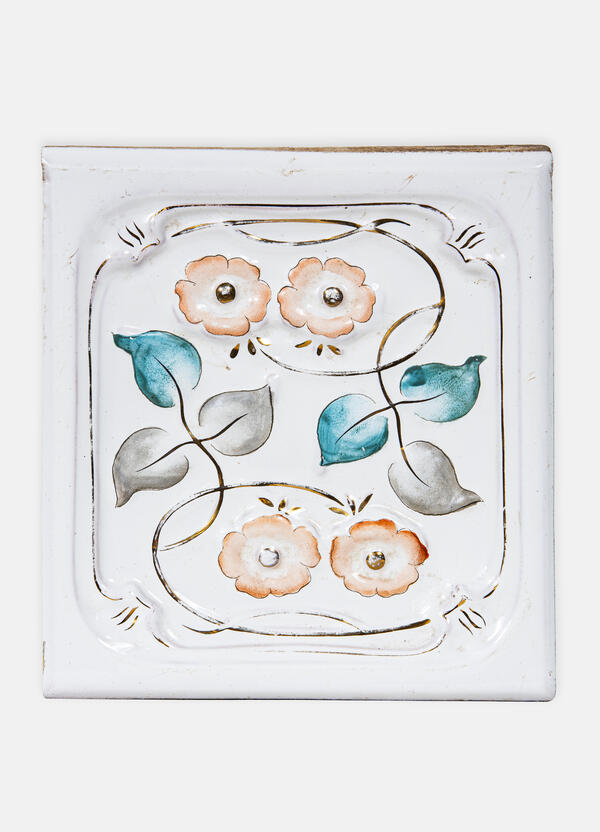
The museum houses a white tiled stove with a relief floral pattern. It is likely to have been made at one of the Kuznetsov factories. The stove’s decoration shows the influence of Art Nouveau, a style that was dominant in the architecture and art of the turn of the 20th century. This is also evidenced by the abundant use of curved wavy lines in the relief composition and painting, as well as the soft and pale color palette with shades of pink, blue, and green.
The exhibition also features a brown fireplace with gilding in the style of historicism. Its décor combines elements from different historical styles. Earlier, such works were described as eclectic, but now eclecticism is considered one of the components of historicism. The back side of the tiles features an imprinted stamp of the Matvey Kuznetsov Factory. It indicates that the fireplace was made at one of the enterprises before the establishment of the Partnership in 1889.
For a long time, tiles were made by hand. Being very expensive, they were only affordable to the rich. The city of Kaluga was one of the major centers of tile production. Private tile factories were established there as early as the beginning of the 18th century.
The tiles featured biblical scenes, morality paintings, and ornamental motifs. After the Patriotic War of 1812, hussars and other soldiers were also depicted on tiles. Along with such scenes, the favorite motifs of Kaluga tile art included lemons, as well as flowers and vases against a blue and white background.
In the 19th century, the number of private ceramics factories in Kaluga gradually began to decrease. By the end of the century, there was an industrial boom in Russia, and large capitalist monopolies started to appear. This environment made it increasingly difficult for small ceramics enterprises to survive.
One of the largest monopolies in the Russian Empire of that period was the Matvey Kuznetsov Partnership for the Production of Porcelain, Earthenware and Majolica Products. In addition to a variety of tableware, which enjoyed great demand, some of the partnership’s enterprises also produced sets of stove tiles.
They were distinguished by a high quality and a variety of decorations to suit even the most demanding tastes. A wide range of techniques was used in decorating tiles: some of them featured a sophisticated relief composition, the use of modern dyes, and gilding.
The museum houses a white tiled stove with a relief floral pattern. It is likely to have been made at one of the Kuznetsov factories. The stove’s decoration shows the influence of Art Nouveau, a style that was dominant in the architecture and art of the turn of the 20th century. This is also evidenced by the abundant use of curved wavy lines in the relief composition and painting, as well as the soft and pale color palette with shades of pink, blue, and green.
The exhibition also features a brown fireplace with gilding in the style of historicism. Its décor combines elements from different historical styles. Earlier, such works were described as eclectic, but now eclecticism is considered one of the components of historicism. The back side of the tiles features an imprinted stamp of the Matvey Kuznetsov Factory. It indicates that the fireplace was made at one of the enterprises before the establishment of the Partnership in 1889.