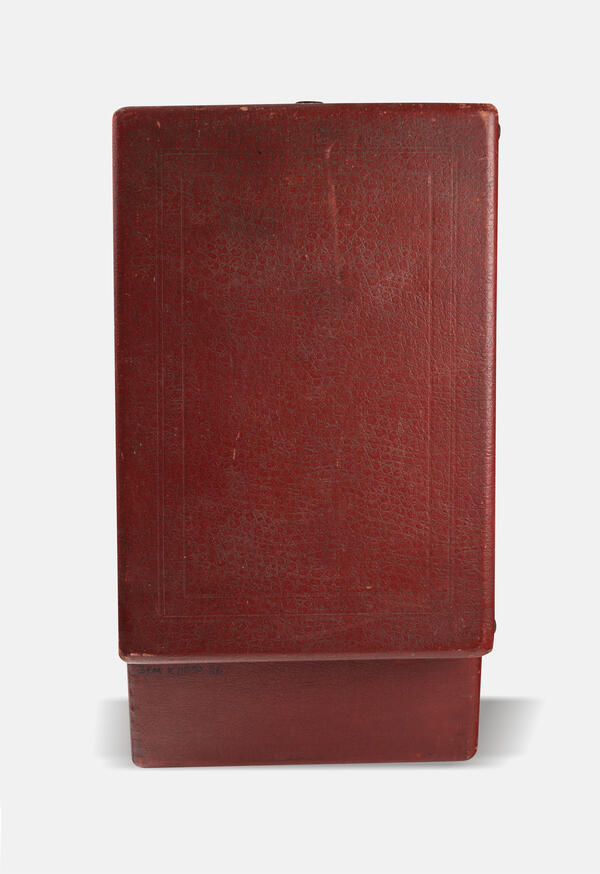
The PT-3 pathephone was produced in 1935–1937 at the Kolomna Pathephone Factory managed by the Gramplasttrest of the People’s Commissariat of Heavy Industry of the USSR. The PT-3 was based on His Master’s Voice gramophone model 102 manufactured in the United Kingdom. The production of the Soviet pathephone was launched in 1935. The pathephone is a mechanical device for playing gramophone records, a portable version of the gramophone. Unlike the latter, the pathephone had a small horn built into the case. The device itself was made in the form of a suitcase and was carried by a special handle when folded. It was equipped with a manual brake lever to stop the rotation of the record. The membrane vibrated, reproducing the recorded sound, and the horn amplified the sound. A full winding of the mechanism required 30–35 turns of the handle. The record rotated at 78 rpm. Usually, the volume could not be adjusted and reached up to 100 dB at the horn.
The word “pathephone” was used to refer to a portable gramophone, mainly in the Russian Empire and later the USSR. It was derived from the name of the Pathé company, which became the first supplier of such devices to Russia. Brothers Charles and Emile Pathé planned to master a different profession, eager to follow in the footsteps of their father who was a sausage dealer. For a long time, they successfully developed their father’s business. However, both their lives and the future of music history changed the day they saw Edison’s phonograph. Charles and Emile decided to design an equally functional, but more compact and convenient device. In 1898, they already founded their own phonograph company. In 1907, they produced the world’s first portable gramophone which became a real breakthrough for the company and an important milestone for the history of music in general.
The pathephone was widespread in the first half of the 20th century. In the mid-1950s, it began to be superseded by the electric gramophone. Interestingly, the original “portable gramophone” was used by the British armed forces in the field. In Imperial Russia, many entrepreneurs organized small-scale production of pathephones and gramophones. In the Soviet Union, pathephones were produced by 13 plants and factories.
In the 1930s and 1950s, dances were often organized where the music was played by a pathephone. The record player was placed near the window of an apartment, and people
gathered in the communal area to dance.