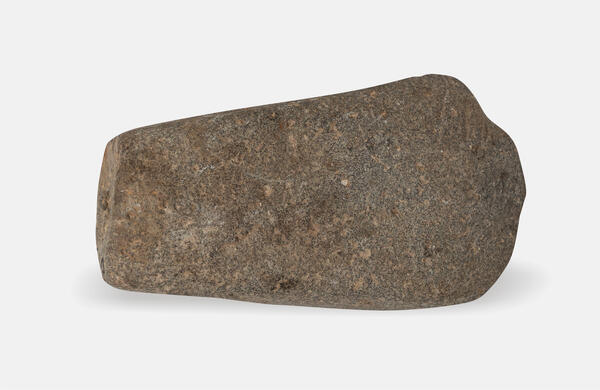
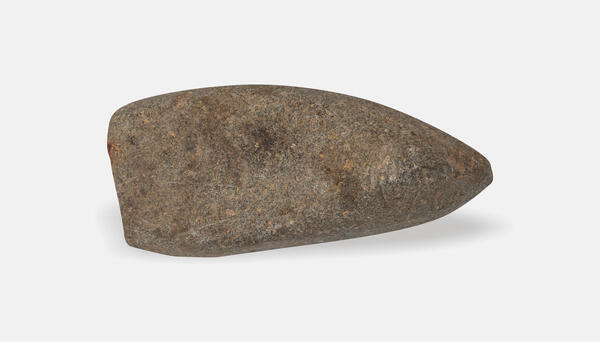
Some of the oldest artifacts in the museum’s collection are Neolithic stone axes.
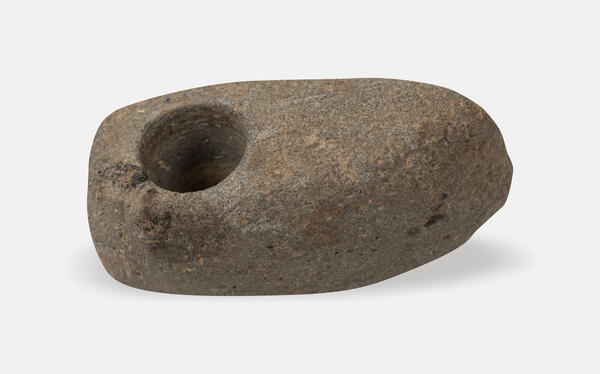
Polished stone axes are among the most common finds belonging to the New Stone Age or the Neolithic. The exhibition of the Zelenogradsk Museum of Local Lore features three stone axes of different shapes and sizes. Unfortunately, since it is unclear under which circumstances they were discovered, it is impossible to analyze the chronological context of each ax. It can only be assumed that the largest well-polished ax was transported to the coast from somewhere outside the South-Eastern Baltic region. Its territory is poor in minerals, including rock: there is simply not enough material for making such a stone ax here.
The other two axes in the museum’s collection are smaller and were probably made in the nearby territories from the soft sedimentary rocks found on the Baltic Sea coast. One of the axes is of particular interest: the drilling was unfinished, and there are signs that the ax was drilled using a tubular bone with sand poured underneath it. The bone was wrapped with a bowstring and clamped together with the stone in an improvised lathe made of tied sticks.
Polished stone axes were regarded as an indicator of
reputation and social hierarchy. In the South-Eastern Baltic region, on the historical
territory of Prussia, this tradition turned out surprisingly persistent and can
be traced in the local archaeological material up to the 14th century. For example, in 1990–2001, near the village of Znamensk, Gvardeysk District,
Kaliningrad Region, a stone hammer with an iron nail for attaching the handle
was discovered in a 14th-century burial. The placement of the hammer
within the burial indicated clearly that it was used as a rod. Hammer axes are typical
of the Late Neolithic and Early Bronze Age, and their presence in 14th-century
burials is a testament to how long ancient pagan traditions were preserved by
the local population.