Font
Color
Graphics
Изображение точки

To see AR mode in action:

1. Install ARTEFACT app for iOS or Android;

2. Find the exhibition «Along the River of Time»

3. Push the «Augmented reality» button and point your phone's camera at the exhibit;

Скрыть точки интересаПоказать точки интереса
Показать в высоком качестве

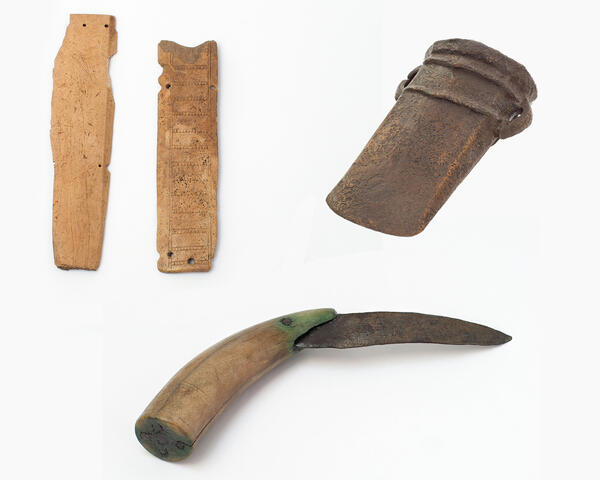
A bone armor plate, Bronze celt, Knife

Collection
0
Open in app
#1
A bone armor plate, Bronze celt, Knife
#2
A bone armor plate
#3
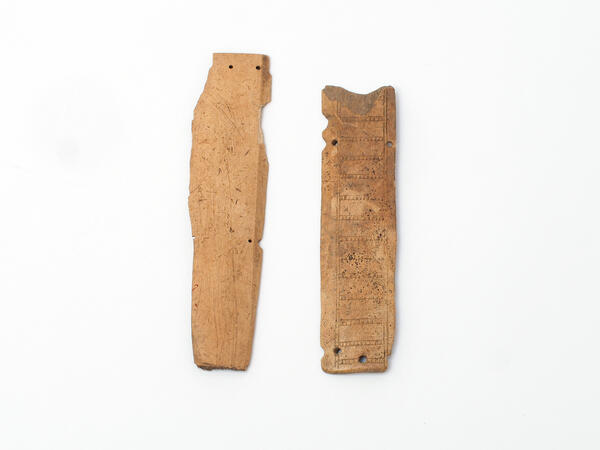
A bone armor plate was found in the cultural layer of the Chekist settlement. It is located on the bank of the Bolshaya Kirgizka River, not far from the place where it joins the Tom River. The exhibit belongs to the Irmen archaeological culture and dates back to the first centuries of the first millennium BC.

The object is a narrow rectangular plate with holes; this plate was a part of the military armor. Such armor was called lamellar or plate: they consisted of many bone or horn plates that were tightly placed to each other. A special groove on one side and a pointed edge on the other provided a tight fit of the armor elements. The fragment was made from the rib bone of a large mammal.

The full armor consisted of several dozen, and sometimes hundreds of plates. They were placed in rows and fastened with straps or tendon threads.

Similar armor appeared in Western Siberia in the Late Bronze Age, in the 12th-7th centuries BC. It was a period of active migrations and military clashes. In the southern regions, large fortresses with complex defensive structures were built. Early chiefdoms appeared: the culture became militarized, a special role was assigned to the leader, property and social stratification appeared. Metal consumption was growing. Masters began to make special offensive weapons from ‘ruthless’ bronze: three-bladed arrowheads, daggers and even swords. At this time, protective armor was also improved, the main type of which was a lamellar plate armor.

The exhibit from the museum is considered rare: the craftsman applied an ornament to it. He decorated the plate with a geometric composition resembling a ladder and then polished its outer surface. The drawing consists of thin and straight engraved lines. Researchers claim that the decorated armor plate was a part of the ceremonial armor. Such armors were expensive and valuable; they could only belong to a representative of the military elite.

The bone armor was designed to protect against the main weapon of the Bronze Age — arrows. If the bow was powerful, the arrow could pierce through a person’s body. However, the lamellar armor distributed the impact force along the plate, so it was quite difficult to pierce it through. The effectiveness of bone armor is also confirmed by experiments and ethnographic descriptions.
#4
Полное наименование: A bone armor plate
Размеры: 12×3 cm; 11×2.8 cm
Техника: bone carving
Дата создания: the 5th–8th centuries BC
#5
Bronze celt
#6
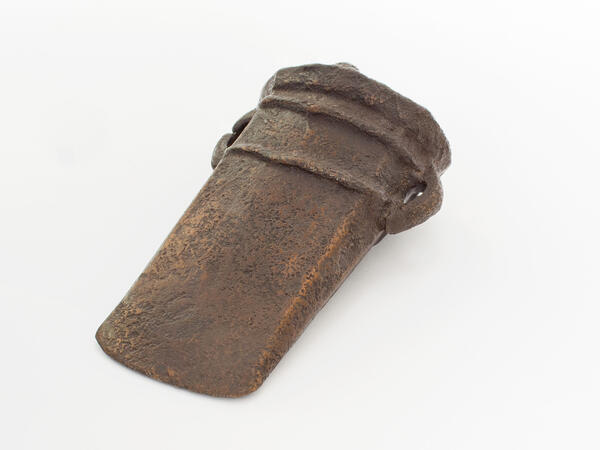
A bronze celt was found during excavations of the Chekist settlement, which was located on the banks of the Bolshaya Kirgizka River, not far from the place of its confluence with the Tom. The Irmen tribe lived on this territory; therefore, the finding is attributed to the Irmen archaeological culture. It dates back to the first centuries of the 1st millennium BC — the late Bronze Age. The expedition was organized by the Seversk Museum and led by the historian and archaeologist Evgeny Vasiliev.

Archaeologists use the term ‘celt’ to describe a chopping tool that has a special hole in the blunt side. It was possible to insert a straight or curved handle into it. If the handle was straight, the celt was used as a shovel, and if it was curved, as an ax. If necessary, it was used not only as a tool, but also as a military weapon.

The body of the celt has a hexagonal shape, which tapers downward. With the help of eyelets and rollers, the ax was attached to a wooden handle. Fragments of a leather strap have been preserved on it since the Bronze Age.

Compared to other similar goods, the celt from the Bolshaya Kirghizka is larger and heavier. Researchers believe that it was made by local craftsmen. They used arsenic bronze, an artificial alloy of copper and arsenic. At that time, it was delivered from afar, presumably from Rudny Altai. Therefore, such weapons were considered valuable and sought after.

The Bronze Age came to Western Siberia rather late: in the 2nd millennium BC. In Anatolia and the Caucasus, the earliest arsenic bronze items appeared at the turn of the 4th–3rd millennia BC.

But one of the most advanced methods of metalworking was born in Siberia (including the Altai foothills) on the eastern outskirts of the Eurasian Metallurgical Province. The Eurasian Metallurgical Province covered vast territories of Europe and Asia, except for the northeastern edge of Asia. According to this technique, thin-walled tools were cast here in stone or ceramic bivalve molds. A special core was used to make the bushing in the tool immediately. This technique helped to save expensive metal and provided more durable fastening of the thing to the shafts and handles.
#7
Полное наименование: Bronze celt
Размеры: length 11.5 cm, width (with eyelets) 7 cm
Техника: casting
Дата создания: 5th–8th centuries BC
#8
Composite elbow-shaped knife
#9
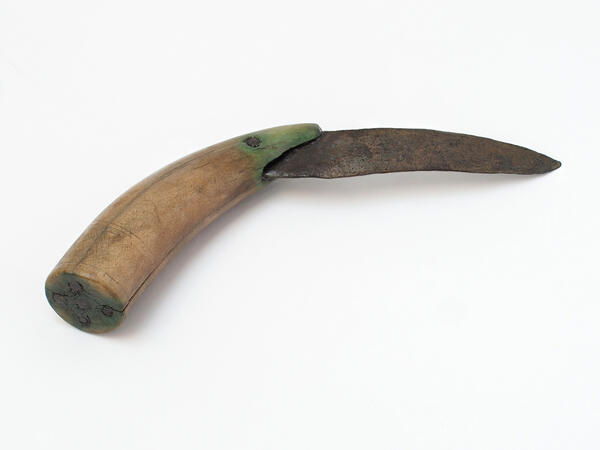
An elbow-shaped knife with an unusual design was found during the excavations of the Chekist settlement on the bank of the Bolshaya Kirgizka River, near the place, where it joins the Tom River. The artifact belongs to the Irmen archaeological culture and dates back to the first centuries of the first millennium BC — the period of the Late Bronze Age.

Bronze elbow-shaped knives were an important part of the Karasuk archaeological culture. They were mainly produced on the territory of the modern Minusinsk basin. The fashion for Karasuk tools and jewelry spread both to the East (up to China) and to the West — to the territory of the Ob region near Tomsk and Novosibirsk.

The researchers classified the artifact found in the settlement as a composite single-edged elbow-shaped knife. In archeology, elbow-shaped knives are products with the blade located at an obtuse angle to the handle.

The thin blade is made of bronze and is firmly fixed in a special hole, which the master carefully made in the handle. The slightly curved handle is made of a horn and is carefully polished to a shine. The precisely cut end part (the back of the handle) is decorated with four rivets. They did not have any practical function and only served as an additional decoration: their position resembles the image of a cross. The craftsman decorated the handle surface with engraved lines — they form geometric pattern in the form of a grid of diamonds.

Such knives were considered prestigious and had a high value. Researchers suggested that this knife was brought as a sacrificial gift during a funeral or memorial ceremony.

There are all-metal and composite tools. The latter have a handle made of organic material (for example, bones or horns) and it was necessarily combined with a metal blade. All-metal knives were made entirely of metal.

The cultural layer of the Chekist settlement has a special soil, where organic materials have been preserved intact since ancient times. Thanks to this, the knife from the banks of the Bolshaya Kirgizka River has completely preserved its original appearance. It is considered as a reference copy, so it can be used to study how ancient people created such products.
#10
Полное наименование: Composite elbow-shaped knife
Размеры: blade length-9.3 cm, max blade width-2 cm, handle length-9 cm, the front — end part diameter-2.3 cm
Техника: bone carving, casting
Дата создания: the 1st centuries of the 1st millennium BC
#11
read morehide
00:00
00:00
1x

A bone armor plate, Bronze celt, Knife

Collection
0
Point your smartphone camera to open in the app
Share
VkontakteOdnoklassnikiTelegram
Share on my website
Copy linkCopied
Copy
Open in app
To see AR mode in action:
  1. Install ARTEFACT app for 
  2. iOS or Android;
  3. Find and download the «Paintings in Details» exhibition
  4. Push the «Augmented reality» button and point your phone's camera at the painting;
  5. Watch what happens on your phone screen whilst you flip through the pictures.
 
We use Cookies
Cookies on the Artefact Website. We use cookies to ensure that we give you the best experience on our website. If you continue without changing your settings, we'll assume that you are happy to receive all cookies on the Artefact website. However, if you would like to, you can change your cookie settings at any time.
Learn more about cookie useHide
Content is available only in Russian

X

Нашли опечатку?...

%title%%type%