The first greeting cards appeared in Europe in the second half of the 18th century, and their mass production started in 1800.
Postcards called “open letters” were introduced in the Russian Empire on March 26, 1872. In 1874, the World Postal Congress in Bern, Switzerland, established a unified postcard format — 9 by 14 centimeters. The format was updated to 10.5 by 14.8 centimeters in 1925. Both options are still used these days.
An image was placed on one side of the postcard, and the message, recipient and sender addresses, a postage stamp — on the other side. Often, the stamp was not put but printed directly on the postcard.
The Russian Post set a new standard for postcard formatting in 1904. The address side was divided by a vertical line into two parts — one for a written message and the other for an address with a stamp. The name “open letter” was officially replaced by the “postcard” in 1909.
Illustrated postcards were first produced in Russia in 1895. The first batches were printed with photographs of Moscow landscapes. The most famous of the early issues was a series of five postcards with the inscription “Censored. Moscow. November 18, 1895.”
Urban sceneries became one of the most popular illustrated postcard types. Researchers tally roughly a thousand pre-revolutionary postcards with landscapes of the Oryol city. Both local printing offices and large Russian and foreign publishing houses produced such postcards, namely the St. Eugenia Community, the contracting agency of Alexey Suvorin, and the publishing house Granberg in Stockholm.
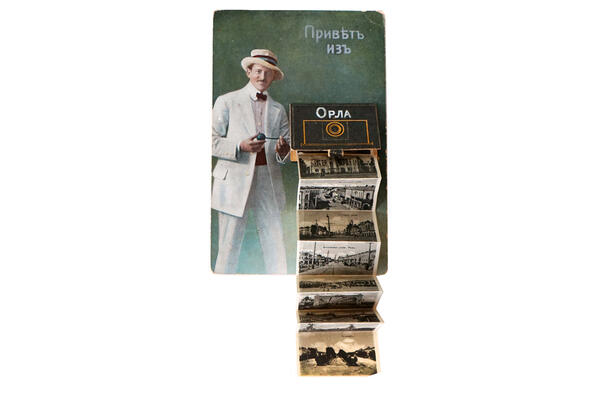
The permanent exhibition of the Oryol Museum of Local History houses the illustrated postcard “Greetings from Oryol.” It depicts a photographer in a white suit and a hat with a camera on a tripod on a green background. A paper Leporello with small images of city landscapes, which are seem to be taken by a drawn camera, is glued to a postcard. The art of photography became popular in Oryol in the 1860s, and the first local stationary photo studio opened on Bolkhovskaya street in 1870.
Postcards called “open letters” were introduced in the Russian Empire on March 26, 1872. In 1874, the World Postal Congress in Bern, Switzerland, established a unified postcard format — 9 by 14 centimeters. The format was updated to 10.5 by 14.8 centimeters in 1925. Both options are still used these days.
An image was placed on one side of the postcard, and the message, recipient and sender addresses, a postage stamp — on the other side. Often, the stamp was not put but printed directly on the postcard.
The Russian Post set a new standard for postcard formatting in 1904. The address side was divided by a vertical line into two parts — one for a written message and the other for an address with a stamp. The name “open letter” was officially replaced by the “postcard” in 1909.
Illustrated postcards were first produced in Russia in 1895. The first batches were printed with photographs of Moscow landscapes. The most famous of the early issues was a series of five postcards with the inscription “Censored. Moscow. November 18, 1895.”
Urban sceneries became one of the most popular illustrated postcard types. Researchers tally roughly a thousand pre-revolutionary postcards with landscapes of the Oryol city. Both local printing offices and large Russian and foreign publishing houses produced such postcards, namely the St. Eugenia Community, the contracting agency of Alexey Suvorin, and the publishing house Granberg in Stockholm.
The permanent exhibition of the Oryol Museum of Local History houses the illustrated postcard “Greetings from Oryol.” It depicts a photographer in a white suit and a hat with a camera on a tripod on a green background. A paper Leporello with small images of city landscapes, which are seem to be taken by a drawn camera, is glued to a postcard. The art of photography became popular in Oryol in the 1860s, and the first local stationary photo studio opened on Bolkhovskaya street in 1870.