

The first sables appeared in the East and became widespread among nomadic peoples in the 7th-8th centuries.
Different types of sables were used in East Europe and Asia from the 9th to the 20th century as the main cold weapon of cavalry and partly of infantry. In Western Europe, the sables were adopted quite late, in the 14th-19th centuries. The sables with average curvature blades and plain hilt were used in European armies of the 18-19th century.
First of all, the sables were designed as cavalry weapons, that is why their blades were rather long. It was adjusted to cutting blows from above. The sable balance point was in the center of the blade to increase attack power. As a rule, European sables had a slight blade curve which made it possible to strike forward.
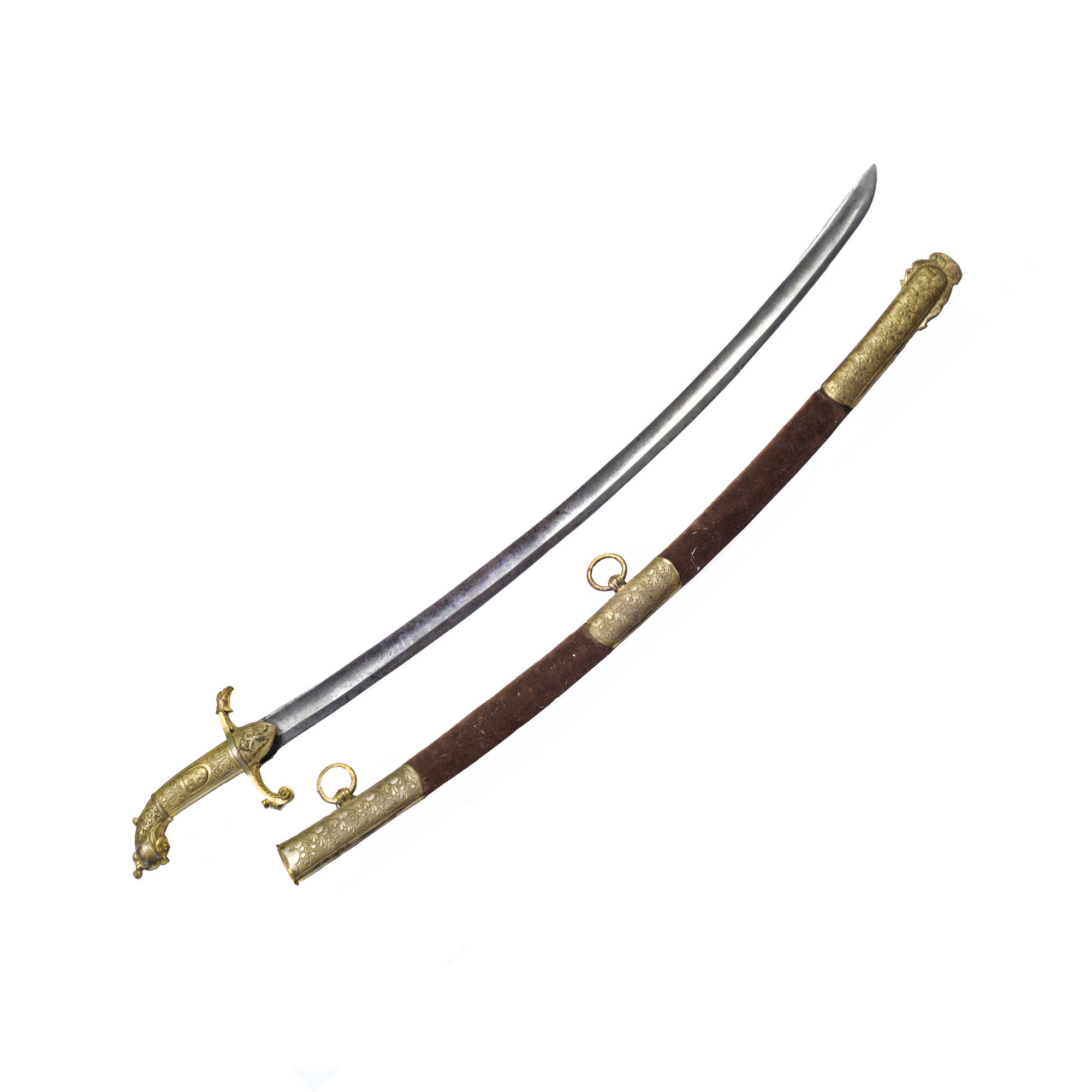
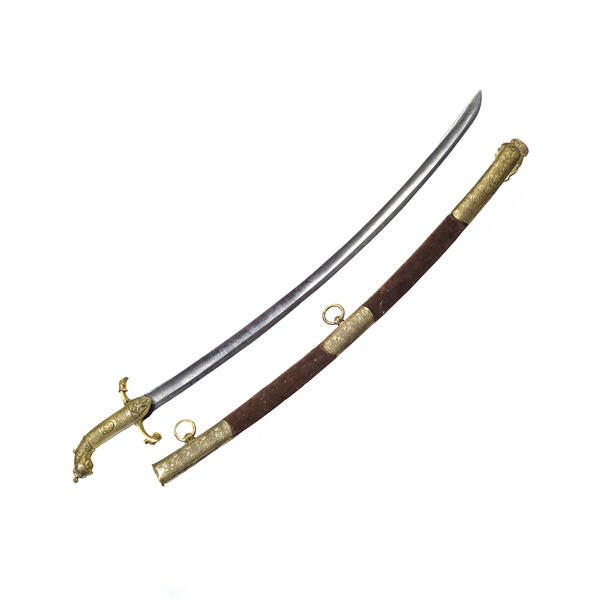
The exhibition exposes the Austrian cavalry sable, an example of an officer customized weapon of the first half of the 19th century. The FI monogram under the crown placed on the hilt proves it. It was impossible to state the exact time of the sable forging according to the monogram since two emperors (Franz I and Ferdinand I) might have had it reigned in Austria at different times.
The blade is forged of damask steel. This metal had outstanding strength, elasticity, and recognizable pattern, which appears on the surface of the blade during forging, because of the special manufacturing technology.
The brass hilt of the sable consists of a handle and a sizable quillon. The shield in the form of the emperor monogram under the crown is depicted on one side of the handle, and, on the other one, there is the coat with a single-headed eagle. The hilt is crowned with a depiction of the head of an ancient warrior in a helmet with a sphinx on top. A brass chain was attached to the front of the helmet and was connected to the quillon. The sculptural image of an eagle’s head remains in its upper part. The wooden scabbard of the sable is covered with red velvet and decorated with a relief floral pattern.
Senior Lieutenant Vladimir Kondratiev donated the sable to the Oryol Local History Museum in 1950. Experts assume that the sable was seized as war indemnity from Altenburg Castle, Thuringia, and German when the Second World War finished.
Different types of sables were used in East Europe and Asia from the 9th to the 20th century as the main cold weapon of cavalry and partly of infantry. In Western Europe, the sables were adopted quite late, in the 14th-19th centuries. The sables with average curvature blades and plain hilt were used in European armies of the 18-19th century.
First of all, the sables were designed as cavalry weapons, that is why their blades were rather long. It was adjusted to cutting blows from above. The sable balance point was in the center of the blade to increase attack power. As a rule, European sables had a slight blade curve which made it possible to strike forward.
The exhibition exposes the Austrian cavalry sable, an example of an officer customized weapon of the first half of the 19th century. The FI monogram under the crown placed on the hilt proves it. It was impossible to state the exact time of the sable forging according to the monogram since two emperors (Franz I and Ferdinand I) might have had it reigned in Austria at different times.
The blade is forged of damask steel. This metal had outstanding strength, elasticity, and recognizable pattern, which appears on the surface of the blade during forging, because of the special manufacturing technology.
The brass hilt of the sable consists of a handle and a sizable quillon. The shield in the form of the emperor monogram under the crown is depicted on one side of the handle, and, on the other one, there is the coat with a single-headed eagle. The hilt is crowned with a depiction of the head of an ancient warrior in a helmet with a sphinx on top. A brass chain was attached to the front of the helmet and was connected to the quillon. The sculptural image of an eagle’s head remains in its upper part. The wooden scabbard of the sable is covered with red velvet and decorated with a relief floral pattern.
Senior Lieutenant Vladimir Kondratiev donated the sable to the Oryol Local History Museum in 1950. Experts assume that the sable was seized as war indemnity from Altenburg Castle, Thuringia, and German when the Second World War finished.