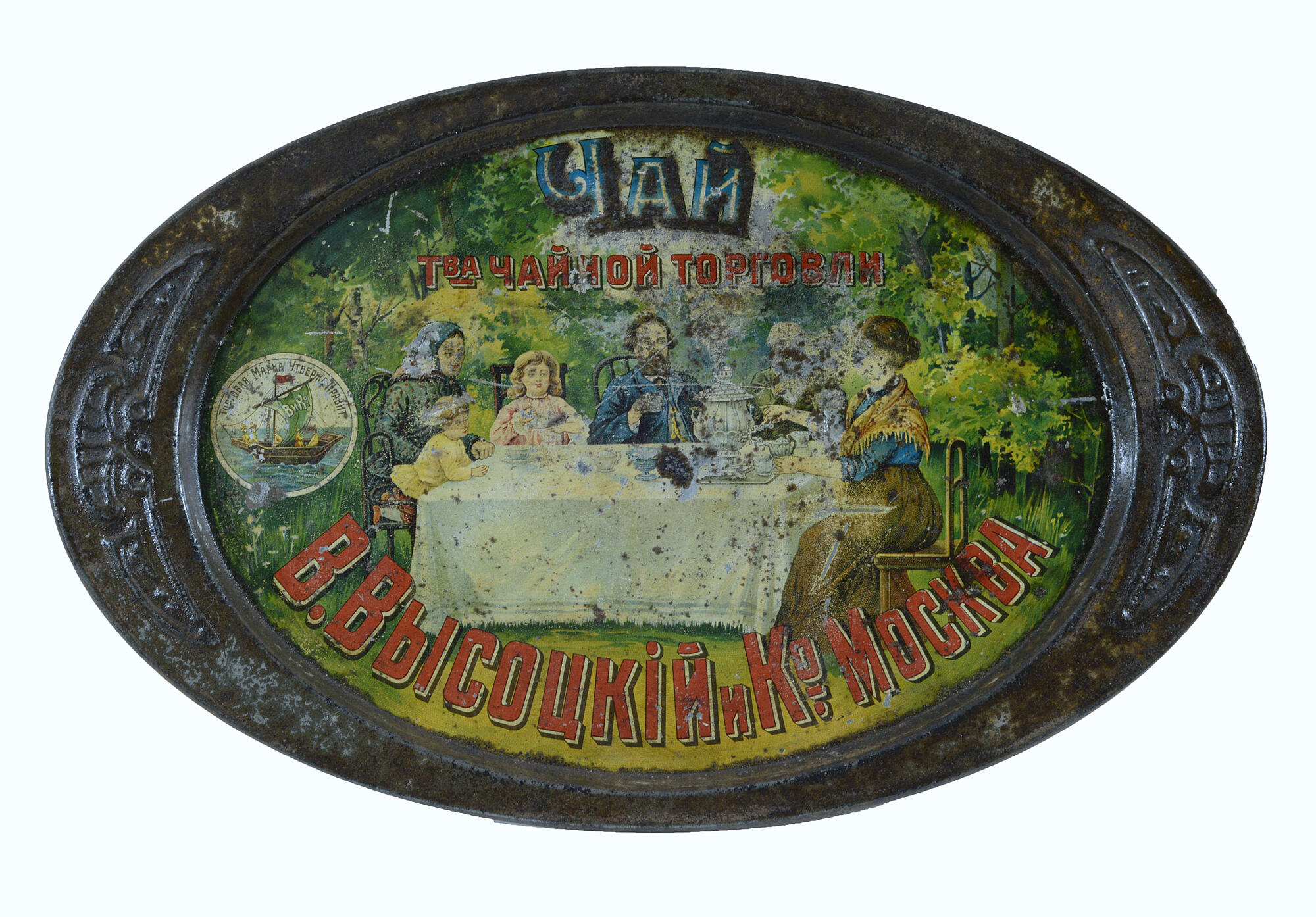


In the hall of petty-bourgeois life, there is a tray with an advertisement for the tea-trading partnership “Wissotzky and Co.”, which was found on Komsomolskaya Street, Oryol in one of the houses intended for demolition.
The bottom of the tin tray is decorated with a colored plot pattern. It depicts a scene of a traditional family tea party: a family led by the owner of the house gathered at the table, the hostess pours tea from a samovar. There is an image of the trademark to the left of the drawing. In the upper part of the center, there is an advertising inscription: “Tea of the tea trade partnership” and the name of the company is indicated at the bottom: “Wissotzky and Co. Moscow”.
The first advertising of tea in Russia was a “barker”. The “barker” tried to attract customers with words, jokes, and rhymes, and sometimes just grabbing a passerby by the coat. Shopkeepers, clerks, and assistant boys acted as barkers. There were also professional barkers, whose work was well paid.
The Russian tea market in the second half of the 19th century was created largely artificially, the drink was imposed on all segments of the population. Sellers and manufacturers inspired customers with the idea that tea is an indicator of prosperity, high social status.
Active advertising of tea began in the 1870s, and by the beginning of the 20th century, it could be seen in newspapers, on posters, and items with corporate symbols. Pre-revolutionary companies that sold tea and coffee produced various accessories for tea drinking: spoons, sugar scoops, trays, glasses, as well as any other items with their advertising, for example, mirrors. Such things, as a rule, were not thrown away and even inherited as family heirlooms, so the firms kept regular customers for several generations.
One of the largest Russian companies that were engaged in the wholesale trade of tea was the company “Wissotzky and Co.” The company was located in the Lubyansk-Ilyinsky retail premises in Moscow. Wolf Wissotzky, a native of the Lithuanian city of Zagare, founded it. In the late 1840s, Wissotzky moved to Moscow and began working for a major tea merchant, Pyotr Botkin. Soon he managed to open his own business. In 1881, he reorganized his tea trading company into the trading house “Wissotzky and his son”. In 1898, it was renamed the partnership “Wissotzky and Co.” The company bought tea in China, India, on the islands of Ceylon and Java. The company also actively conducted its activities outside of Russia: in Germany, France, the USA, and Canada.
The bottom of the tin tray is decorated with a colored plot pattern. It depicts a scene of a traditional family tea party: a family led by the owner of the house gathered at the table, the hostess pours tea from a samovar. There is an image of the trademark to the left of the drawing. In the upper part of the center, there is an advertising inscription: “Tea of the tea trade partnership” and the name of the company is indicated at the bottom: “Wissotzky and Co. Moscow”.
The first advertising of tea in Russia was a “barker”. The “barker” tried to attract customers with words, jokes, and rhymes, and sometimes just grabbing a passerby by the coat. Shopkeepers, clerks, and assistant boys acted as barkers. There were also professional barkers, whose work was well paid.
The Russian tea market in the second half of the 19th century was created largely artificially, the drink was imposed on all segments of the population. Sellers and manufacturers inspired customers with the idea that tea is an indicator of prosperity, high social status.
Active advertising of tea began in the 1870s, and by the beginning of the 20th century, it could be seen in newspapers, on posters, and items with corporate symbols. Pre-revolutionary companies that sold tea and coffee produced various accessories for tea drinking: spoons, sugar scoops, trays, glasses, as well as any other items with their advertising, for example, mirrors. Such things, as a rule, were not thrown away and even inherited as family heirlooms, so the firms kept regular customers for several generations.
One of the largest Russian companies that were engaged in the wholesale trade of tea was the company “Wissotzky and Co.” The company was located in the Lubyansk-Ilyinsky retail premises in Moscow. Wolf Wissotzky, a native of the Lithuanian city of Zagare, founded it. In the late 1840s, Wissotzky moved to Moscow and began working for a major tea merchant, Pyotr Botkin. Soon he managed to open his own business. In 1881, he reorganized his tea trading company into the trading house “Wissotzky and his son”. In 1898, it was renamed the partnership “Wissotzky and Co.” The company bought tea in China, India, on the islands of Ceylon and Java. The company also actively conducted its activities outside of Russia: in Germany, France, the USA, and Canada.