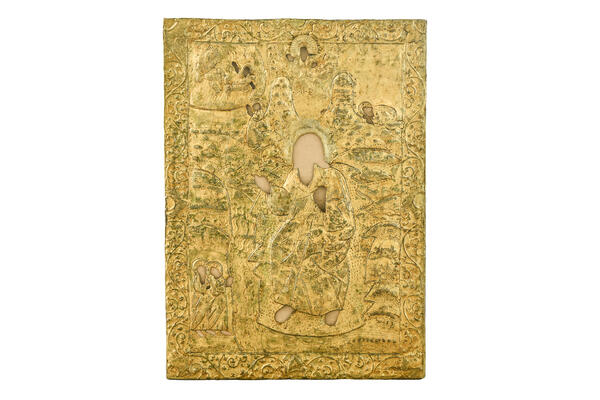
The revetment of the icon ‘The Fiery Ascent of the Prophet Elijah’ was donated to the museum by the administrator of the Intercession Cathedral of the Tobolsk Kremlin. The artwork was made in the 19th century in the technique of smooth-relief chasing. The central part, the so-called centerpiece, features a large figure of Elijah seated in the desert against a background of stony mountains. The prophet wears a long, broad vestment and holds a staff, which symbolizes spiritual guidance for the believers.
Several scenes from the prophet’s life are depicted along the edges. In the upper scene, Elijah ascends into heaven on a fiery chariot with winged horses. The Lord is in the clouds nearby: there is a nimbus attached on top of the revetment. The composition is framed by a floral pattern with vines and bunches of grapes.
The term “oklad” (frame) appeared in the Russian language in the 16th century, much later than the type of piece itself: in Rus, they had been known since at least the 12th century. In antiquity they were called “kruta”, “kuzny at icons”, “icon forging”. Such decorations are an integral part of the decoration of Orthodox churches in all countries. However, Catholic icons can also be found in metal cases, such as ancient Byzantine images in some churches in Italy.
Not only did the frame decorate the icons, it also protected them from humidity, temperature changes, and physical contact that could damage the paint. Such items were made of gold, silver or copper, and images were embossed or engraved. The most valuable versions were decorated with pearls, gems or colored enamel inlays. The back side of the frame was lined with velvet so the metal would not damage the icon’s surface. Often the congregation donated precious frames for icons, and sometimes the clergy themselves collected money for a revetment for a particularly valuable icon.
Some icon painters saved time and created inexpensive partially painted images specifically for the frame. They portrayed only the parts that would later remain uncovered: the faces of Christ, the Mother of God or saints, their hands and feet.
Several scenes from the prophet’s life are depicted along the edges. In the upper scene, Elijah ascends into heaven on a fiery chariot with winged horses. The Lord is in the clouds nearby: there is a nimbus attached on top of the revetment. The composition is framed by a floral pattern with vines and bunches of grapes.
The term “oklad” (frame) appeared in the Russian language in the 16th century, much later than the type of piece itself: in Rus, they had been known since at least the 12th century. In antiquity they were called “kruta”, “kuzny at icons”, “icon forging”. Such decorations are an integral part of the decoration of Orthodox churches in all countries. However, Catholic icons can also be found in metal cases, such as ancient Byzantine images in some churches in Italy.
Not only did the frame decorate the icons, it also protected them from humidity, temperature changes, and physical contact that could damage the paint. Such items were made of gold, silver or copper, and images were embossed or engraved. The most valuable versions were decorated with pearls, gems or colored enamel inlays. The back side of the frame was lined with velvet so the metal would not damage the icon’s surface. Often the congregation donated precious frames for icons, and sometimes the clergy themselves collected money for a revetment for a particularly valuable icon.
Some icon painters saved time and created inexpensive partially painted images specifically for the frame. They portrayed only the parts that would later remain uncovered: the faces of Christ, the Mother of God or saints, their hands and feet.