The historian and ethnographer Yelena Gennadievna Fyodorova identifies three types of traditional shoes worn by the Ugrians, Khanty and Mansi peoples. The first type is similar to ordinary boots, the second is reminiscent of carbatina shoes (consisting of a piece of rawhide pulled around the foot and then tied down) and the third type — unty shoes (fur boots).
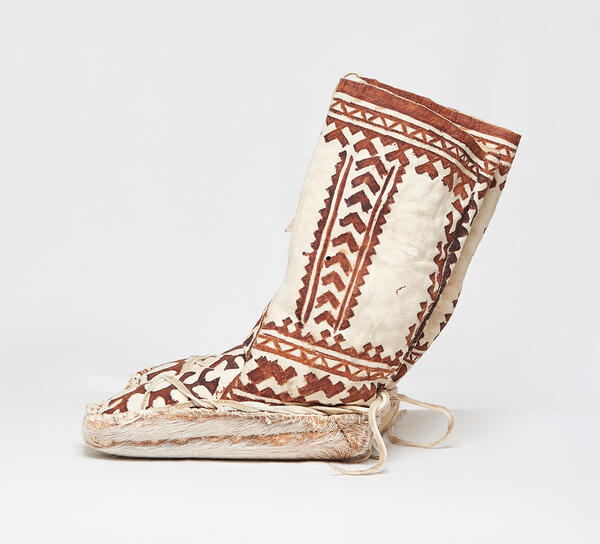
The carbatina-type shoes include summer boots, or “rovduga stockings” called nyuki vey. To make rovduga (suede), deer skin is cleaned of loose hairs and dressed. Then it is used to make high bootlegs and an insert for the instep and toes, which is wedged with its sharp end into the boot near the toes. The front part of the boot is longer than the back. The sole is made from the skin of a deer, cow or elk.
Rovduga ties and loops are used to hold the boot in place: men tie their nyuki vey around the knee, and women tie them to the belt.
The high bootlegs protect against insects, and the material does not get wet or irritate the skin. Straw insoles create a kind of air cushion and help prevent flat feet.
It is customary to dye the rovduga by hand using natural dyes, usually based on a decoction of birch bark, and decorate the boots with ornaments. The loops, insert and stripes on the lower and upper parts of the boot were traditionally painted red with berry juice. The natural dye firmly sat in the hide and did not wear off.
The ethnographer and museologist Olga Mikhailovna Ryndina, in a study devoted to the northern ornament, identifies two compositionally significant areas on the surface of the nyuki vey boots (the wedge).
The wedge was decorated with a zigzag line with appendages, sometimes there were so many branches that they covered the “trunk” — the zigzag line itself. The bootleg was decorated with “a simple ribbon ornament, so the pattern on the finished item went around the leg from above and below.” The rectilinear vertical patterns sometimes completely covered the areas along the edges.
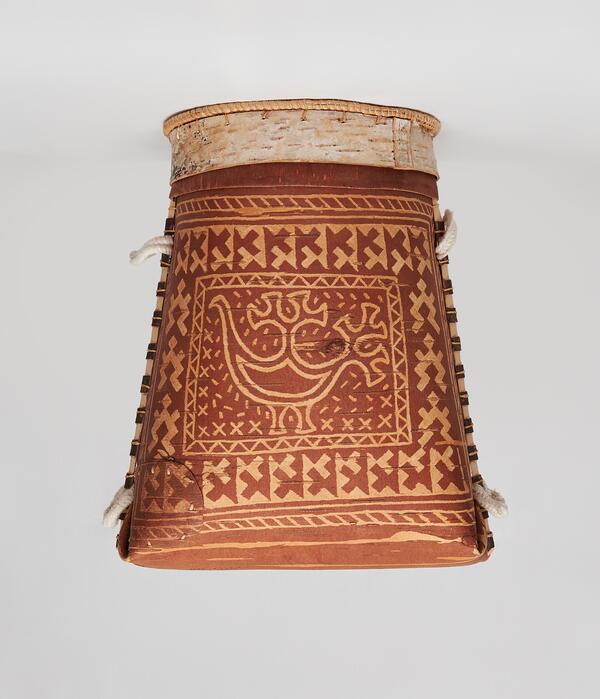
For the Khanty people, the traditional ornament serves as an amulet and protects from evil spirits that live in the Lower World and bring diseases. That is why both clothes and shoes are richly ornamented. As a rule, they feature geometric shapes or stylized images of birds and animals.
The exhibited nyuki vey with national ornaments were donated to the museum by Agafya Alexandrovna Voldina, a resident of the village of Bolshoy Atlym, People’s Artist of Russia, and a specialist in national applied art.