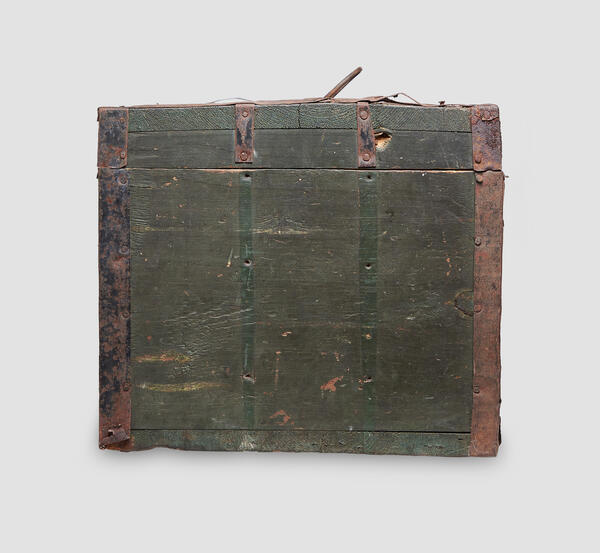
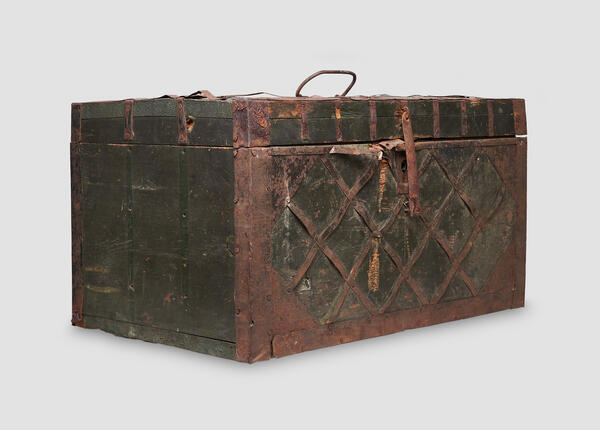
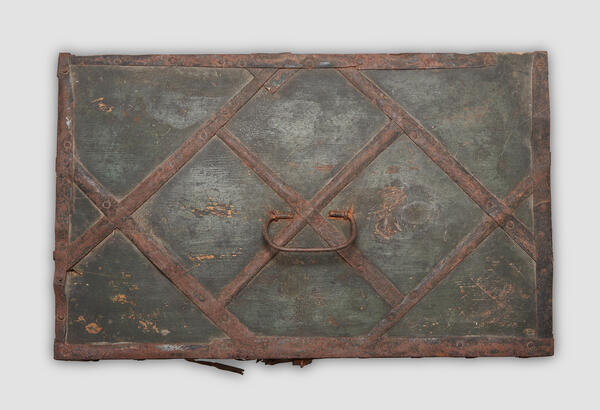
It has not been established when exactly chests appeared. It is known that they were used by the ancient Egyptians, Greeks and Romans. During the early Middle Ages, this household item came to Europe, Asia and Russia. For every Russian, whether a peasant or a well-off citizen, chests remained a universal interior item for a long time. It was used as a storage unit, and as a bench during the day and a bed at night. Dowry was also kept in a chest.
Depending on the region, different materials were used for chests: walrus bone, metal, and most often solid wood. Wooden boards were fitted back to back so tightly that chests were air-tight, therefore pests could not get in either. On the outside, chests were decorated with paintings, reinforced with strips of tin, and covered with cloth or sealskin. In the 18th century, Ural craftsmen offered unique locks “with a tune”: when one unlocked the chest, it began playing a tune.
The Khanty usually stored things in birch bark boxes, fur or leather bags and small chests made of wood. The arrangement of these items (as well as everything else in the Khanty dwelling) was subject to strict regulations. Women traditionally sat at the entrance; opposite the entrance, in the “red corner”, there were places for men, honored guests. Sacred chests were also placed there. “The area at the farthest end of the room from the entrance”, Vladislav Mikhailovich Kulemzin and Nadezhda Vasilyevna Lukina report, “is considered sacred. Traditionally, a chest with household spirits was kept there, but we saw a Christian icon that today performs the functions of the household spirit.”
There were also simpler chests — for dishes and a small supply of food. They were also kept at the back of the chum next to a low table. Kulemzin and Lukina write, “They eat there when alone [sitting on the floor or on low stools], and the table is pushed… to the hearth when several people eat together.”
The researchers also saw old chests of different sizes reinforced with strips of tin (“Even to an inexperienced person it is clear that [they are] made by Russian masters”). In the 20th century, for those Khanty who followed traditions, such treasure-troves played the role of sacred storehouses that kept offerings for the idols — the owners of the place.