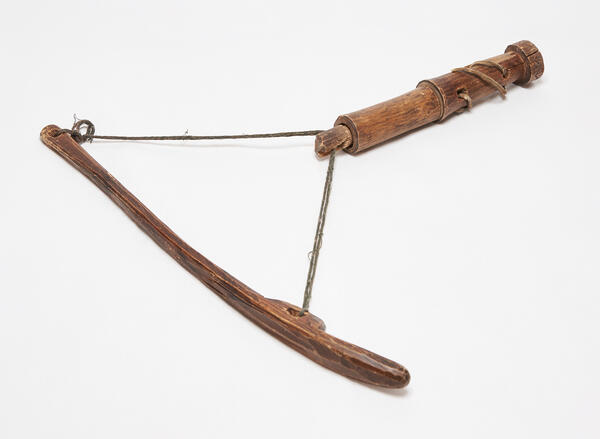
The indigenous inhabitants of the North made most household essentials by hand. For processing wood and other hard materials, any craftsman, and often even teenagers, had their own set of tools. The bow drill called pur (por) was one of them.
A pur consists of a bow and a spindle connected by a leather cord. The handle with a metal tip (the one of the exhibit was lost) is mounted on the spindle with a rounded end. There are protrusions at both ends and in the middle part of the handle: one of them serves as a stop for the tip, the other two — for the cylindrical spindle. When working, the craftsman holds the cylinder with his left hand, and with his right pushes the bow back and forth in a horizontal plane. Thus, the cord wraps around the shaft, and the drill begins to rotate.
For the base, it was prescribed to use larch, while the cylinder was cut from birch, spruce or alder wood. Tips were fashioned from hay rakes or broken pitchforks that were no longer in use. Metal parts were heated, shaped into a groove, semi-oval in cross-section, and then immediately cooled in ice water to increase its strength.
The bow drill was used for making fishing equipment. Vladislav Mikhailovich Kulemzin and Nadezhda Vasilyevna Lukina in their book “Meet the Khanty” describe how the tool was used in the construction of a boat — an oblas. After the log was shaped into a boat with an ax and a drawing knife, the inside was hollowed out. In order for the vessel to maintain balance on the water, it was important to make the sides of the boat the same thickness. To do this, “a bow drill is [used to make holes] on the outside of the entire boat and short pegs [are driven] into the holes — they are as thick as the index finger of the one who will use this boat.” Other holes — according to the number of pegs — are made with a bow drill in a blank, sticks are driven into them, and then they are cut to the width of the blank and covered with soot from one end. The painted side of the pegs is hammered into the sides of the boat and these “beacons” are used as guides when hollowing out the inside.
The eastern Khanty actively used bow drills in the late 19th — 20th century.