Font
Color
Graphics
Изображение точки

To see AR mode in action:

1. Install ARTEFACT app for iOS or Android;

2. Find the exhibition «Orthodox Icons from across the Don Region»

3. Push the «Augmented reality» button and point your phone's camera at the exhibit;

Скрыть точки интересаПоказать точки интереса
Показать в высоком качестве

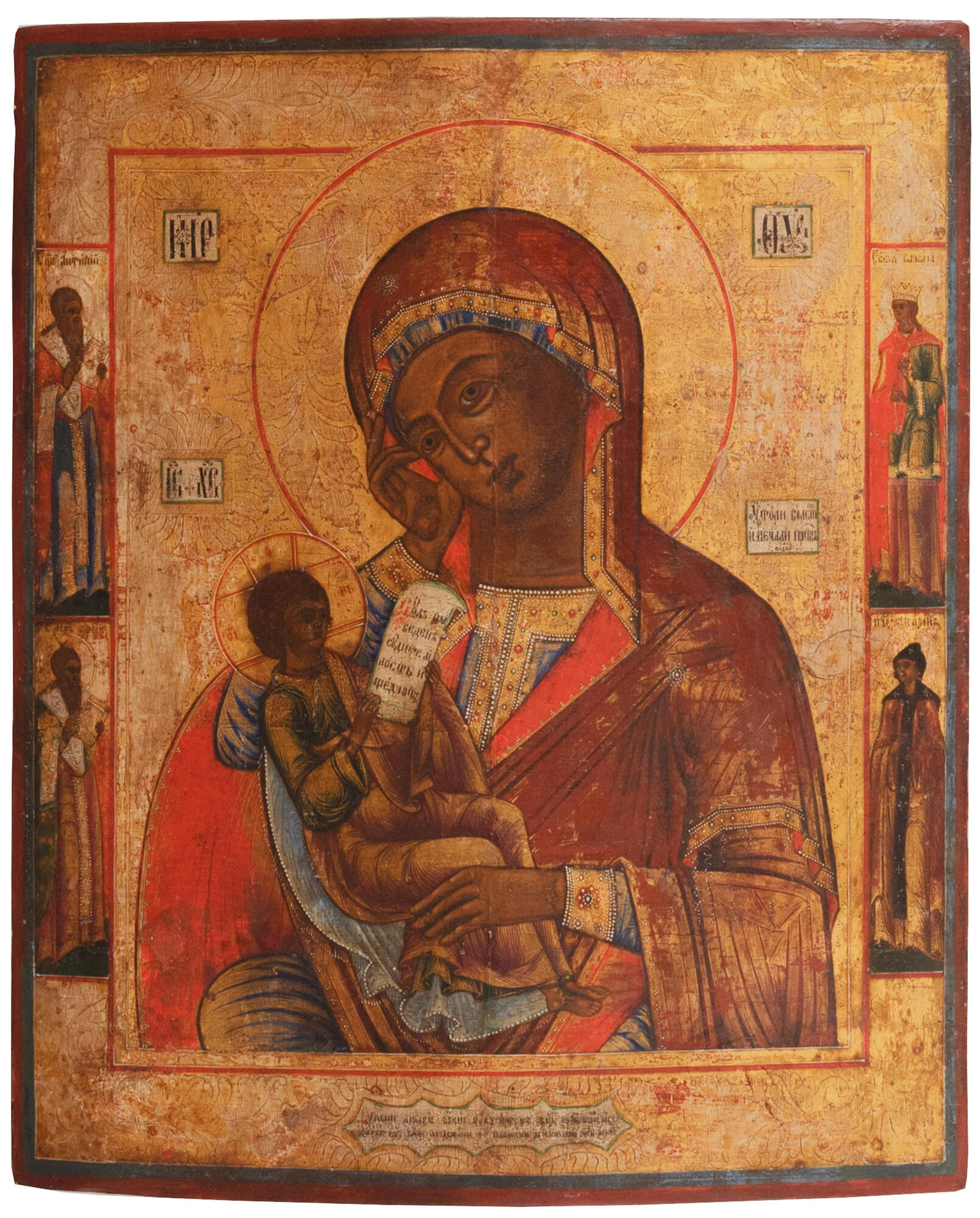
Icon of the Virgin Mary “Soothe My Sorrows”

Creation period
the late 18th century
Place of сreation
the Russian Empire
Dimensions
31x25,5 cm
Technique
wood, tempera, gilding
0
Open in app
#6
The icon of the Virgin Mary “Soothe My Sorrows” belongs to the iconographic type known as Hodegetria or Our Lady of the Way. Legend has it that the first image of this type was discovered in an ancient Christian church in the Hodegon monastery in Greece, which is where the name of the icon came from.

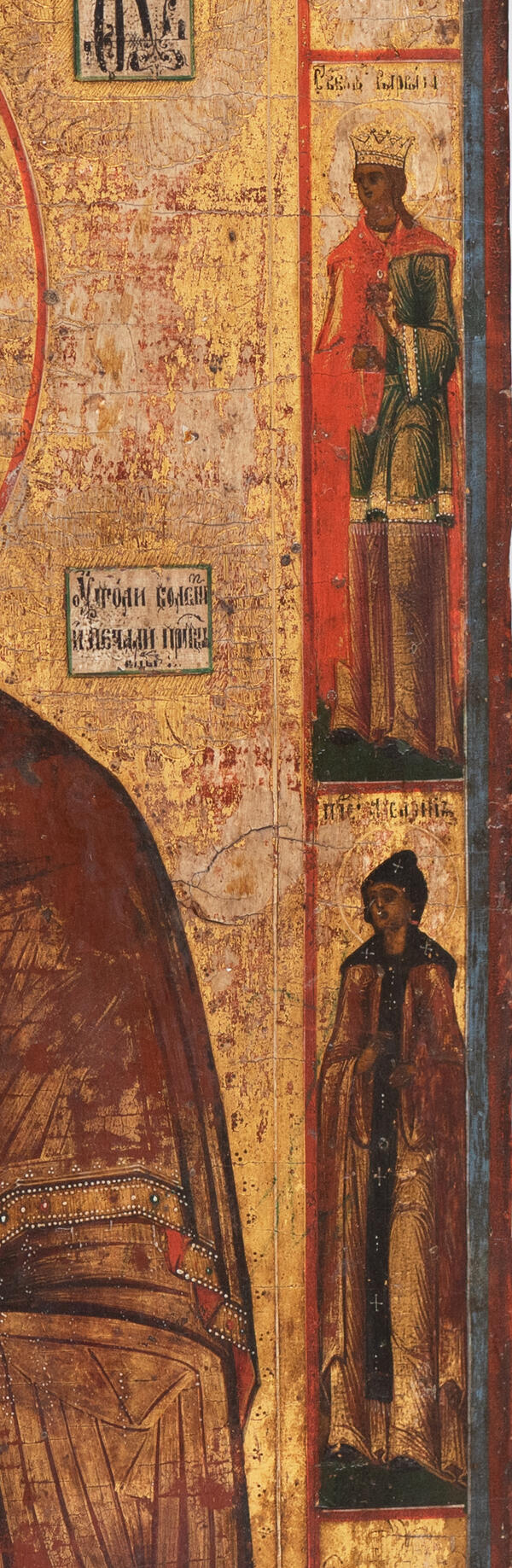
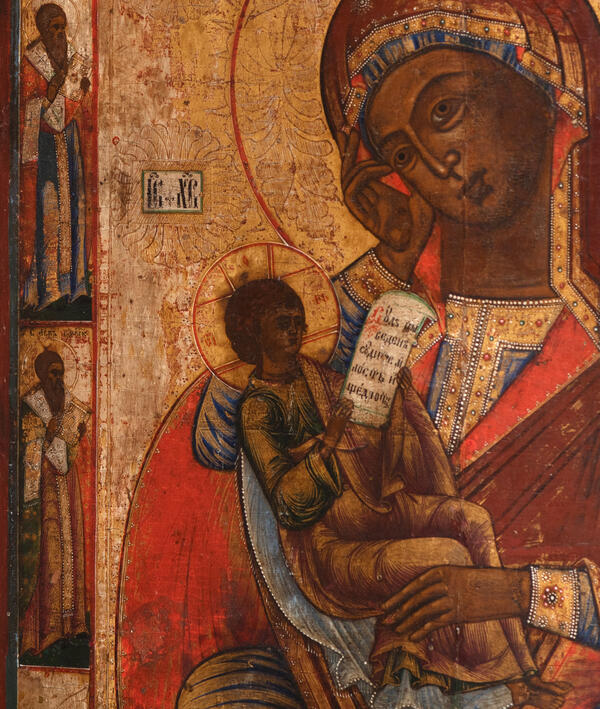
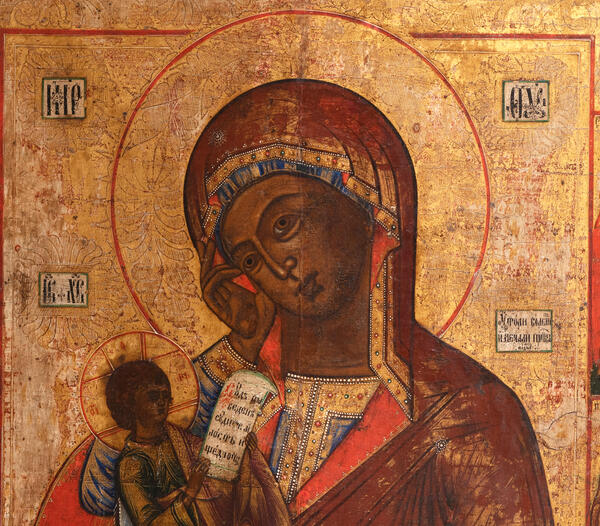
In this icon, the Virgin Mary holds Her right hand against the side of Her head, inclining Her head slightly. This position symbolizes that the Queen of Heaven listens to the prayers and crying of all believers who seek Her help in times of need and sorrow. With Her left hand, She holds the legs of her Child, lying on a white cloth. With His head, Christ touches Her right hand, and His feet rest on the lap of His Mother. He also holds an unfolded scroll. In the borders, there are full-length images of saints standing on dark green platforms. These include the Holy Martyr Antipas, the Great Martyr Barbara, and Saint Leo of Catania.
#4
Icon of the Virgin Mary “Soothe My Sorrows”
#2

Legend has it that the icon “Soothe My Sorrows” is based on the ancient image from Shklow, Mogilev Governorate (now part of Belarus). “Our Lady of Shklow” was the main shrine of the Resurrection Convent. It was celebrated as a miracle-working icon with healing powers. The icon was brought to Moscow in the 17th century. For a long time, it was kept in the Church of St. Nicholas in Sadovniki, Zamoskvorechye District. Later, the icon “Soothe My Sorrows” was moved to a bell tower, and for some time, it was forgotten.


The veneration of this icon dates back to the second half of the 18th century. Legend has it that many miracles happened thanks to this icon during the plague of 1771. Documentary evidence of these miracles was kept in a church, but it was destroyed in a fire. One of the most famous legends is about a noble woman who was completely paralyzed. However, when she saw the icon, she made the sign of the cross, touched the shrine, and got up, being completely healthy. This led to the veneration of the icon as a miracle-working image.

Now, the icon “Soothe My Ills and Sorrows” is kept in the Church of St. Nicholas in Kuznetskaya Sloboda, Moscow. Venerated copies of this icon can be found in many churches in Moscow and other cities. People pray in front of the icon for help in times of sorrow, grief, and despair, as well as for deliverance from illnesses, pain, and sinful passions.

#5
Icon of the Virgin Mary “Soothe My Sorrows”
#3
View in the State Catalogue
read morehide
00:00
00:00
1x

Icon of the Virgin Mary “Soothe My Sorrows”

Creation period
the late 18th century
Place of сreation
the Russian Empire
Dimensions
31x25,5 cm
Technique
wood, tempera, gilding
0
Point your smartphone camera to open in the app
Share
VkontakteOdnoklassnikiTelegram
Share on my website
Copy linkCopied
Copy
Open in app
To see AR mode in action:
  1. Install ARTEFACT app for 
  2. iOS or Android;
  3. Find and download the «Paintings in Details» exhibition
  4. Push the «Augmented reality» button and point your phone's camera at the painting;
  5. Watch what happens on your phone screen whilst you flip through the pictures.
 
We use Cookies
Cookies on the Artefact Website. We use cookies to ensure that we give you the best experience on our website. If you continue without changing your settings, we'll assume that you are happy to receive all cookies on the Artefact website. However, if you would like to, you can change your cookie settings at any time.
Learn more about useHide
Content is available only in Russian

X

Нашли опечатку?...

%title%%type%