

“New Testament Trinity” is one of the non-canonical images of the Holy Trinity. It appeared in Russian iconography in the mid-18th century under the influence of Catholicism.
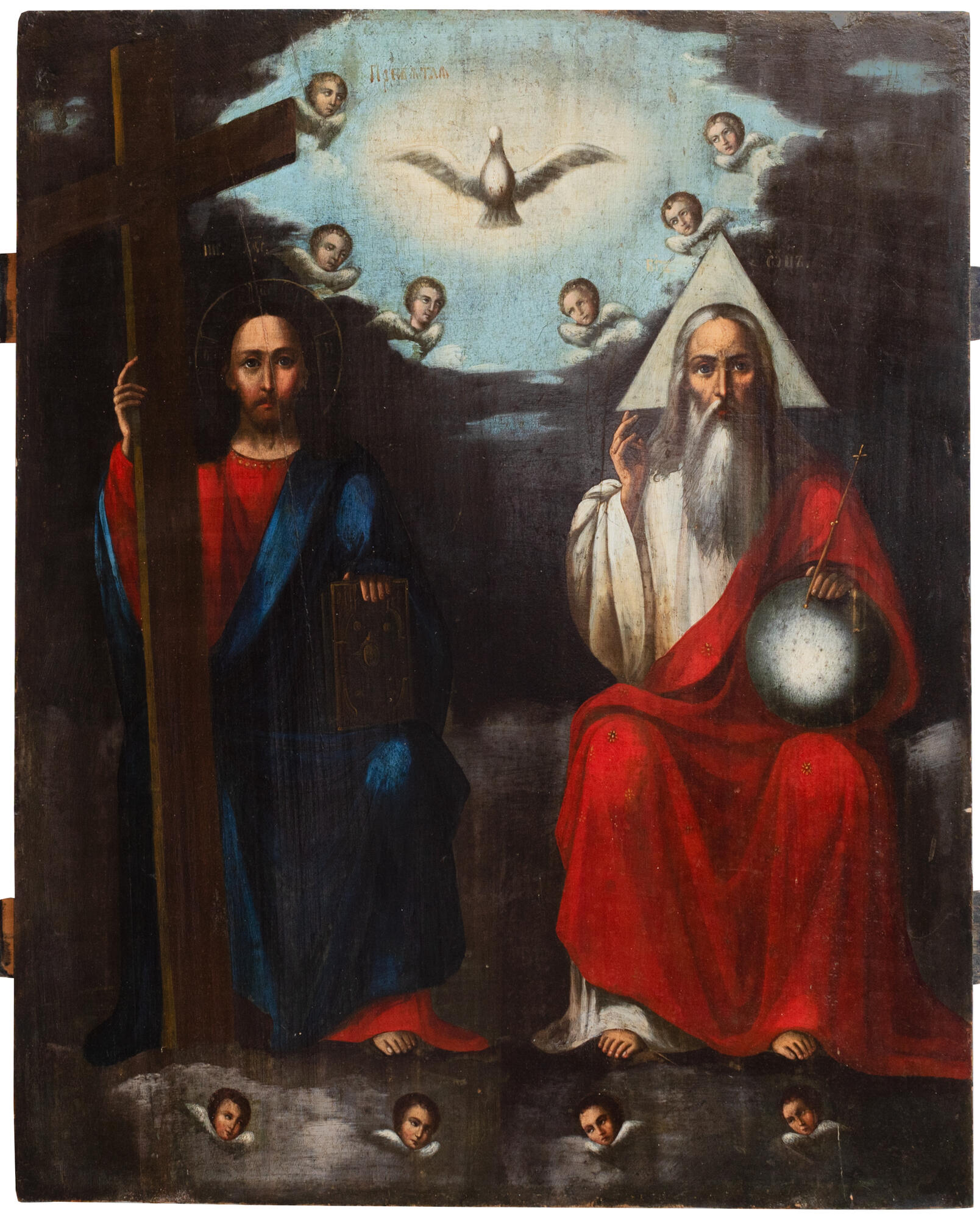
In this icon, the three faces of the Trinity are presented not in the form of the traditional three angels, but in the images of the Savior, God the Father, and the Holy Spirit hovering between them in the guise of a dove. Depending on the arrangement of the figures, there are several iconographic variants of the New Testament Trinity. This particular icon depicts the composition known in Russian as “Soprestolie” (Synthronon), which contains a frontal image of two figures on clouds, instead of the more common “Otechestvo” (Paternity) type.
The image of God the Father is located on the right side of the icon. He is represented as an elder in a white chiton and a red himation. God the Father makes a gesture of blessing with His right hand while holding an orb with His left hand. The left side of the icon depicts Jesus Christ in a red chiton and a blue himation. With His right hand, He is holding a standing large wooden cross, and with His left hand, a closed Book of the Gospels. The halo of Jesus Christ is cruciform, with a thin yellow outline. The Holy Spirit is interpreted here as the embodiment of love between God the Father and God the Son.
The image of the dove as the embodiment of the Holy Spirit was formalized by the Church Fathers at the Council of Constantinople in 536. The Gospel says that the Holy Spirit appeared in the form of a dove and pointed to Christ. The Holy Spirit descends on Jesus after Baptism in the form of a dove. The Savior called his disciples to be humble and meek like doves. It was a dove that brought Noah the news of the end of the flood into the ark, holding an olive branch in its beak.
Among the many variants depicting this plot, the
Taganrog “Trinity” stands out for its clarity, rigor, and minimalism. Here, the
color palette comprises predominantly cold and restrained tones. Such coloring,
combined with a special painting technique, distinguishes the icon from other
works in the collection. The icon of the New Testament Trinity is revered by
the people and decorates many churches. The icon seems to “humanize” the
Divinity, bringing God closer to people, and showing Him in human flesh.