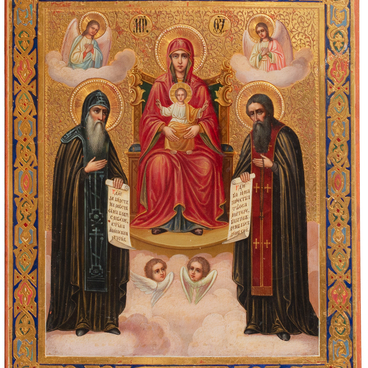
The icon of “Our Lady of Smolensk” belongs to the Hodegetria type — one of the oldest iconographic types that was brought from Byzantium soon after the Christianization of Rus. In this icon, the Virgin Mary gestures toward the Christ Child with Her right hand. Her face is also turned toward the Savior. Christ raises His right hand in a blessing gesture and puts His left hand on His knee. He wears a light-yellow chiton with a golden border and a golden-orange himation. The Virgin Mary is dressed in a red-brown maphorion with a gold border and stars on the veil and shoulders.
Hodegetria icons were brought to Rus from Byzantium and were named after the place where they were created, placed, or miraculously discovered — Smolensk, Tikhvin, Iveron, Jerusalem, Kazan, and others. The museum houses the icon of “Our Lady of Smolensk.”
Legend has it that the first icon of the Hodegetria type was painted by Luke the Apostle. The icon is believed to have been brought to Rus from Constantinople, although there is no concrete evidence of this. The spiritual writer Yevgeny Poselyanin referred to a legend that indicated that the icon arrived in Rus in the mid-11th century. The Greek emperor, Constantine IX Monomachos, sent his daughter, Princess Anna, to marry Vsevolod, Prince of Chernigov and son of Yaroslav the Wise. He blessed her with the Hodegetria icon on her journey. The icon, also known as “Our Lady of the Way” was supposed to show the way to the princess. The son of Prince Vsevolod, Vladimir Monomakh, later moved the icon from Chernigov to Smolensk, and since then, it has been known as “Our Lady of Smolensk.”
“Our Lady of Smolensk” is venerated greatly in the Orthodox world. It is seen as the ancestral shrine of Russian princes, symbolizing the connection between Constantinople and Rus.
According to church tradition, the icon helped protect Smolensk from an invasion by Batu Khan’s army in 1239. Later, it was taken to Moscow and returned several times. In 1812, Mikhail Kutuzov, Field Marshal of the Russian Empire, prayed before this icon on the eve of the Battle of Borodino. On the same day, the miracle-working icons of Our Lady of Iveron and Our Lady of Vladimir were also brought to protect Moscow. They were carried around Bely Gorod and the Kremlin. Before the French army entered Moscow, the icon of Our Lady of Smolensk was taken to Yaroslavl.