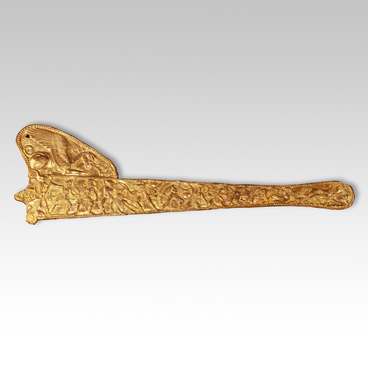
The museum’s collection features a decoration for a gorytos with ornamented relief friezes. A gorytos is a case for a bow and arrows that was primarily used by the Scythians in the period from the late 6th to early 2nd century BCE.
The artifact on display consists of two parts — the case and the sidewall. The upper frieze features images of animals: a lioness and a bull, a boar and lion, a panther attacking a deer, and a lion attacking a goatlet. The two central friezes depict scenes from the life of Achilles, a character from ancient Greek mythology who participated in the Trojan War and is one of the protagonists in Homer’s “Iliad”.
The first scene depicts young Achilles learning to shoot a bow. There are also scenes of his life at the palace of Lycomedes, a mythical king of the island of Skyros. Peleus hid his young son, Achilles, at the court of Lycomedes, disguised as one of the king’s daughters.
The central image shows Achilles, taking off his woman’s chiton. His right hand is resting on the hilt of his sword. To his left, a maid is holding his wife, Deidamia, by her clothing.
On the right side of the upper frieze and the left side of the lower frieze, there is a scene showing the send-off of Achilles, with King Lycomedes sitting in an armchair. Achilles, in his traveling cloak, is depicted in a reclining pose, holding a sword in his right hand. In the gynaeceum, the part of a house reserved for women, the queen mother sits on a throne, with her daughters on either side of her, and a maid standing behind one of them.
The next scene illustrates the episode of the reconciliation between Achilles and Agamemnon, the king of Mycenae, and Achilles donning his armor. Agamemnon is seated on the throne on the left, while Diomedes, the king of Argos, is positioned to the right of Achilles, with Odysseus, the king of Ithaca, on his left. There is also a mournful image of Thetis holding an urn with the ashes of her son, Achilles. The two friezes are framed by stylized acanthus branches and bordered by rows of palmette.
The lower right corner features a scene with a panther being attacked by griffins. The sidewall has an oval and elongated shape. The gold cover of the sidewall is adorned with images of horned griffins, standing on their hind legs and facing each other.