Back in the 17th century, livestock was used in exchange between the Shors and neighboring peoples. In her research, the linguist and Turkologist Nadezhda Petrovna Dyrenkova cites excerpts from the order to the Kuznetsk governor Yevdokim Baskakov: the author describes blacksmithing practiced by the Shors and then clarifies that “those armors… are sold to the Kolmatian people for horses and for cows and for sheep…”
The Shors started their own cattle breeding under the influence of the Russians. At the same time, the Soviet ethnographer Leonid Pavlovich Potapov emphasized that we are talking here specifically about the breeding of cows, sheep, and horses, but it is possible that “in times long before Russian colonization, some clans… had domesticated deer.”
In the early 1860s, the missionary and ethnographer Vasily Ivanovich Verbitsky noted in the north of Altai “cattle breeding and poultry farming [is] in a pitiful state” and is limited to the breeding of a few horses.
The Siberian educator and ethnographer of the 19th and early 20th centuries Alexander Vasilyevich Adrianov recalled that “he met large uluses along the Kondoma and in the Mrassu system, in which there was not a single cow, and children grew up without ever seeing milk.” A similar situation was described by the Russian ethnographer of German origin Vasily Vasilyevich (Friedrich Wilhelm) Radlov, who did not find a single cow in the Shor villages.
Among the skills the Shors borrowed from the Russians was poultry farming (breeding chicken and geese), as well as sheep breeding. There were no more than two or three of the latter on the farm. In the winter, open pens or simply sheds were set up for animals, and part of the hay was thrown onto the roof to keep them warm.
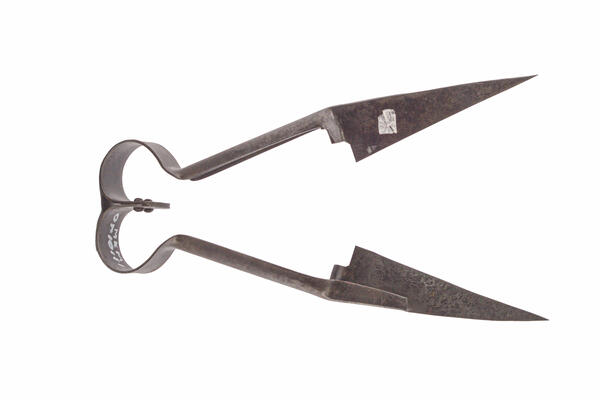
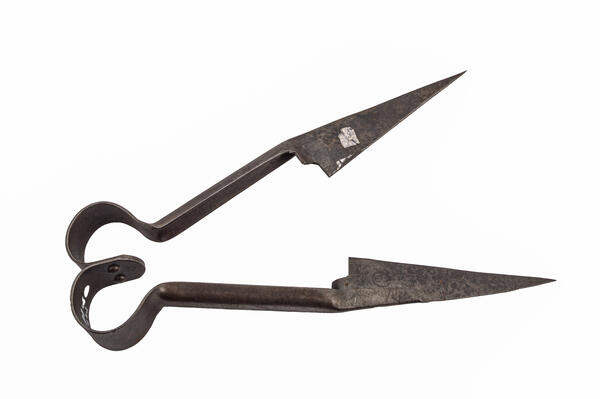
Twice a year, in spring and autumn, the sheep were sheared, and all the wool was left for internal use: the Shors made “pimy” (felt boots), mittens, and “shabur” outerwear. Only the wealthiest cattle owners could sometimes set aside surplus for sale. They also bred “fat-tailed” sheep, bred from long-tailed and curly-tailed sheep, whose coarse wool was only suitable for making felt carpets called “koshma” (“kochma”).
Sheep shears resemble two knives with a spring that
enables them to be opened and closed during the cutting process.