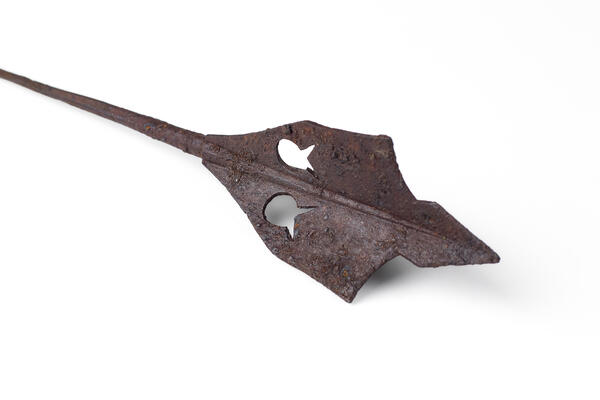
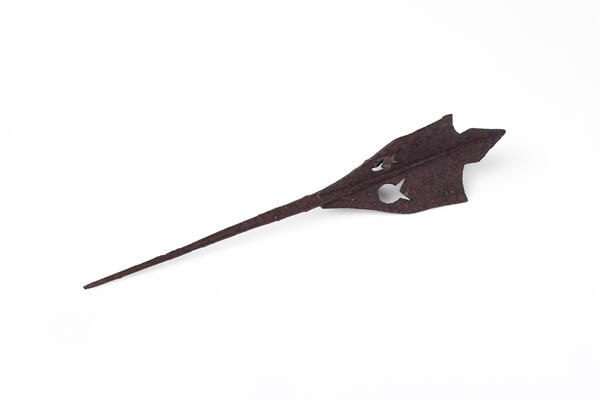
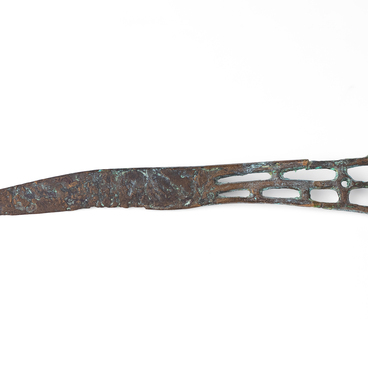
The master gave a three-bladed shape to the domed pointed iron arrowhead. Inside each blade, he made through holes in the shape of an animal’s head. Scientists dated the arrowhead from the 10th to the 14th century and attributed it to the era of the Kyrgyz Khaganate. It was found on the territory of the city of Sayanogorsk in a mountainous area.
During the early Middle Ages, the Yenisei Kyrgyz established their own state in the Middle Yenisey region. The bow was the main offensive weapon of the South Siberian nomads of this period. Its striking power was extremely great. An arrow released could penetrate even dense chain mail from a distance of 75–100 meters.
Such a variety of arrowhead shapes, which were in the arsenal of the Kyrgyz warrior, was not found in any other nomadic culture. Some researchers believe that on the territory of the Middle Yenisey was located the center for the manufacture of arrowheads, which were used in the period from the 6th to the 10th century in the wide expanses of the Sayano-Altai.
The researchers divided all the arrowheads of the Yenisei Kyrgyz into groups according to the shape of the cross section of the blade and into types according to the shape of the blade itself. The three-bladed feather provided the iron arrow with high ballistic qualities. Such arrows were the most stable in flight and caused painful lacerations when they hit the enemy, which led to his death. Three-bladed arrowheads made up the most numerous group. The researchers proposed to distinguish in it such types as diamond-shaped, trapezoidal, stepped and laurel-leaved.
Russian researchers
Yulij Sergeevich Khudyakov and Alisa Yuryevna Borisenko wrote,