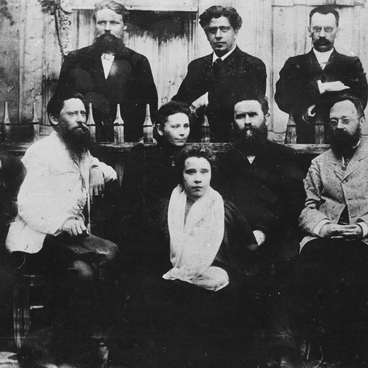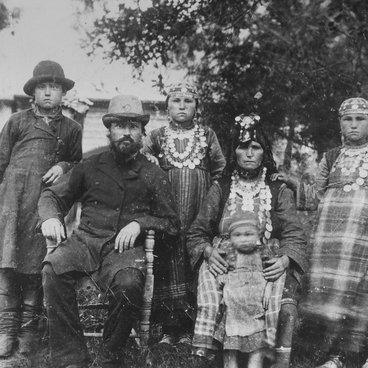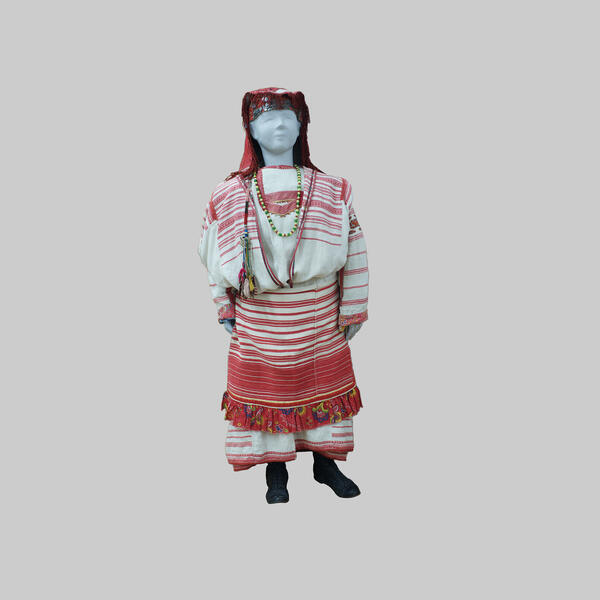
The national costume of northern Udmurts is one of the most ancient types of clothing. Summer clothes were manufactured from homespun fabric made with linen. A young Udmurt woman’s attire comprised an open caftan and a shirt. Special fabric was woven for a young woman’s costume where homespun fabric with red and white horizontal stripes was combined with the white monotone fabric. When cutting and sewing, the patterned part of homespun fabric was used on the chest, shoulders, collar edges and the hem of the open caftan and shirt. The shirt and caftan were of a tunic-like cut.
On the chest, the shirt was decorated with a triangle of red cotton fabric. The caftan with a fold-down quadrangular collar and short sleeves had a longitudinal slit on the shoulder through which the shirt sleeve was threaded. The suit was complemented by a quadrangular apron made of red and white homespun fabric with a frill at the bottom, but without breast. The way this attire was worn is peculiar — with a large slouch over the belt. Within any and all groups, Udmurt young women wore round canvas hats trimmed with red bunting, beads, and coins.
Northern Udmurts were under the strong influence of the Russian North, while southern Udmurts were mostly influenced by the steppe ways of the Turks. National costumes of Northern and Southern Udmurts have different color palettes and other different elements. Researchers have suggested that the Nizhnetsepetskaya group of northern Udmurts preserved white embroidered clothes and the variety of its design until the early 20th century.
The collection of the National Museum of the Udmurt Republic contains a copy of Yakov Vasiliev’s drawings; the original is in the collection of the Russian Ethnographic Museum in St. Petersburg. Yakov Vasiliev lived in the Sludka village, Slobodskoy Uyezd (administrative subdivision), Vyatka Governorate. In 1918–1919 he was drawing people of his village and the clothes they were wearing, providing thorough descriptions and tracking changes based on age. According to his drawings, one can determine the social status of a person and distinguish 13 costume pairs that were crafted by girls and women until the 1930s. In subsequent years, white embroidered clothes were replaced by urban clothing.
The territory of residence of the Kosinskaya group of Udmurts is in the former territory of Glazovsky and partly Slobodsky Uyezds of the Vyatka Governorate, that is, the basin of the Kosa river. These areas are now a part of the Kirov region.
The national Udmurt costume is a symbol of hard work and neatness. To accumulate an appropriate dowry for themselves, girls began to learn to spin at the age of 6 or 7, and at 13 or 14, they started working with the loom. By the age of 16 or 17, they were master craftswomen: they could make both a casual dress and a wedding outfit. The bride’s dowry also included gifts for the future husband and his relatives.
On the chest, the shirt was decorated with a triangle of red cotton fabric. The caftan with a fold-down quadrangular collar and short sleeves had a longitudinal slit on the shoulder through which the shirt sleeve was threaded. The suit was complemented by a quadrangular apron made of red and white homespun fabric with a frill at the bottom, but without breast. The way this attire was worn is peculiar — with a large slouch over the belt. Within any and all groups, Udmurt young women wore round canvas hats trimmed with red bunting, beads, and coins.
Northern Udmurts were under the strong influence of the Russian North, while southern Udmurts were mostly influenced by the steppe ways of the Turks. National costumes of Northern and Southern Udmurts have different color palettes and other different elements. Researchers have suggested that the Nizhnetsepetskaya group of northern Udmurts preserved white embroidered clothes and the variety of its design until the early 20th century.
The collection of the National Museum of the Udmurt Republic contains a copy of Yakov Vasiliev’s drawings; the original is in the collection of the Russian Ethnographic Museum in St. Petersburg. Yakov Vasiliev lived in the Sludka village, Slobodskoy Uyezd (administrative subdivision), Vyatka Governorate. In 1918–1919 he was drawing people of his village and the clothes they were wearing, providing thorough descriptions and tracking changes based on age. According to his drawings, one can determine the social status of a person and distinguish 13 costume pairs that were crafted by girls and women until the 1930s. In subsequent years, white embroidered clothes were replaced by urban clothing.
The territory of residence of the Kosinskaya group of Udmurts is in the former territory of Glazovsky and partly Slobodsky Uyezds of the Vyatka Governorate, that is, the basin of the Kosa river. These areas are now a part of the Kirov region.
The national Udmurt costume is a symbol of hard work and neatness. To accumulate an appropriate dowry for themselves, girls began to learn to spin at the age of 6 or 7, and at 13 or 14, they started working with the loom. By the age of 16 or 17, they were master craftswomen: they could make both a casual dress and a wedding outfit. The bride’s dowry also included gifts for the future husband and his relatives.