Pottery occupied a special place in the primitive cultures of Western Siberia. It appeared here in the Neolithic era: in the 6th — 4th millennia B.C.
Ancient people cooked and served food in ceramic tableware, they also stored food and small household items in it. Special sacred vessels played an important role in religious rituals.
A ceramic vessel from the museum collection was discovered during the excavations of the Cherdashnyi Log settlement. It is located on the bank of the Ishtan bayou of the Tom River, near the Nagorny Ishtan village.
View of the Nagorny Ishtan tract and the Tom River bayou. From records of the Department of Archeology and Ethnography of the museum
In the Neolithic era, people quickly settled in the area. Researchers have discovered various archaeological sites near Nagorny Ishtan: ancient settlements and hillforts, soil and burial mounds, as well as sacred sites.
The fragments of the vessel, different in shape and size, which are housed by the museum, were discovered quite deeply below the ground — in the layer of the New Stone Age. After the restoration, the fragments were joined together.
The vessel that was found turned out to be one of the most ancient ones: at the time when it was created, the pottery art in this region was just emerging. At the same time, as far as the level and quality of the manufacturing technique is concerned, it is not inferior to later items.
Primitive craftsmen knew how to use various impurities to make the clay dense and flexible. They were able to create vessels of different shapes and they succeeded in achieving the desired temperature in the process of firing.
The bottom, which tapered downwards, was one of the key features of the West Siberian Neolithic vessels. The vessels were made in coiling technique: a slab of clay was rolled out, then cut into strips; these pieces were made into coils, put around the mold and joined to each other with fingers.
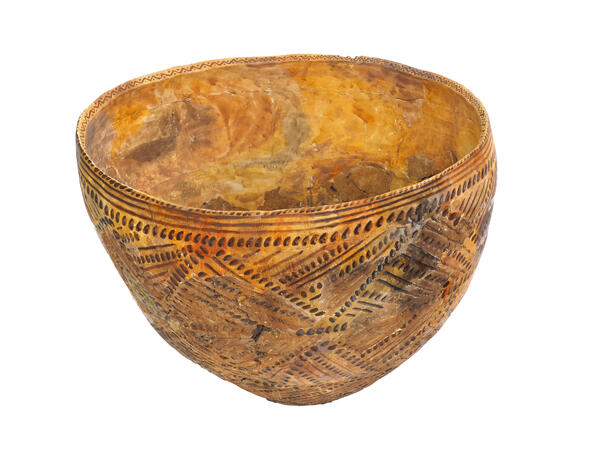
The ceramic vessel from the museum collection is quite large: it is 34 centimeters high, and the diameter of its upper, widest part (mouth) is 44.5 centimeters. The shape of the vessel resembles a half-cut egg. The thickened walls and rounded bottom are decorated with a triangular pattern — the triangles are shaded along one of the sides.
The pattern on such ceramic tableware was applied with special tools — narrow spatulas. They were used to draw long lines and used to make deep incisions — make small indentations on the items.
Fired pottery decorated with patterns was used throughout the territory of Western Siberia. It is the most common item found during archaeological excavations.
Ancient people cooked and served food in ceramic tableware, they also stored food and small household items in it. Special sacred vessels played an important role in religious rituals.
A ceramic vessel from the museum collection was discovered during the excavations of the Cherdashnyi Log settlement. It is located on the bank of the Ishtan bayou of the Tom River, near the Nagorny Ishtan village.
View of the Nagorny Ishtan tract and the Tom River bayou. From records of the Department of Archeology and Ethnography of the museum
In the Neolithic era, people quickly settled in the area. Researchers have discovered various archaeological sites near Nagorny Ishtan: ancient settlements and hillforts, soil and burial mounds, as well as sacred sites.
The fragments of the vessel, different in shape and size, which are housed by the museum, were discovered quite deeply below the ground — in the layer of the New Stone Age. After the restoration, the fragments were joined together.
The vessel that was found turned out to be one of the most ancient ones: at the time when it was created, the pottery art in this region was just emerging. At the same time, as far as the level and quality of the manufacturing technique is concerned, it is not inferior to later items.
Primitive craftsmen knew how to use various impurities to make the clay dense and flexible. They were able to create vessels of different shapes and they succeeded in achieving the desired temperature in the process of firing.
The bottom, which tapered downwards, was one of the key features of the West Siberian Neolithic vessels. The vessels were made in coiling technique: a slab of clay was rolled out, then cut into strips; these pieces were made into coils, put around the mold and joined to each other with fingers.
The ceramic vessel from the museum collection is quite large: it is 34 centimeters high, and the diameter of its upper, widest part (mouth) is 44.5 centimeters. The shape of the vessel resembles a half-cut egg. The thickened walls and rounded bottom are decorated with a triangular pattern — the triangles are shaded along one of the sides.
The pattern on such ceramic tableware was applied with special tools — narrow spatulas. They were used to draw long lines and used to make deep incisions — make small indentations on the items.
Fired pottery decorated with patterns was used throughout the territory of Western Siberia. It is the most common item found during archaeological excavations.