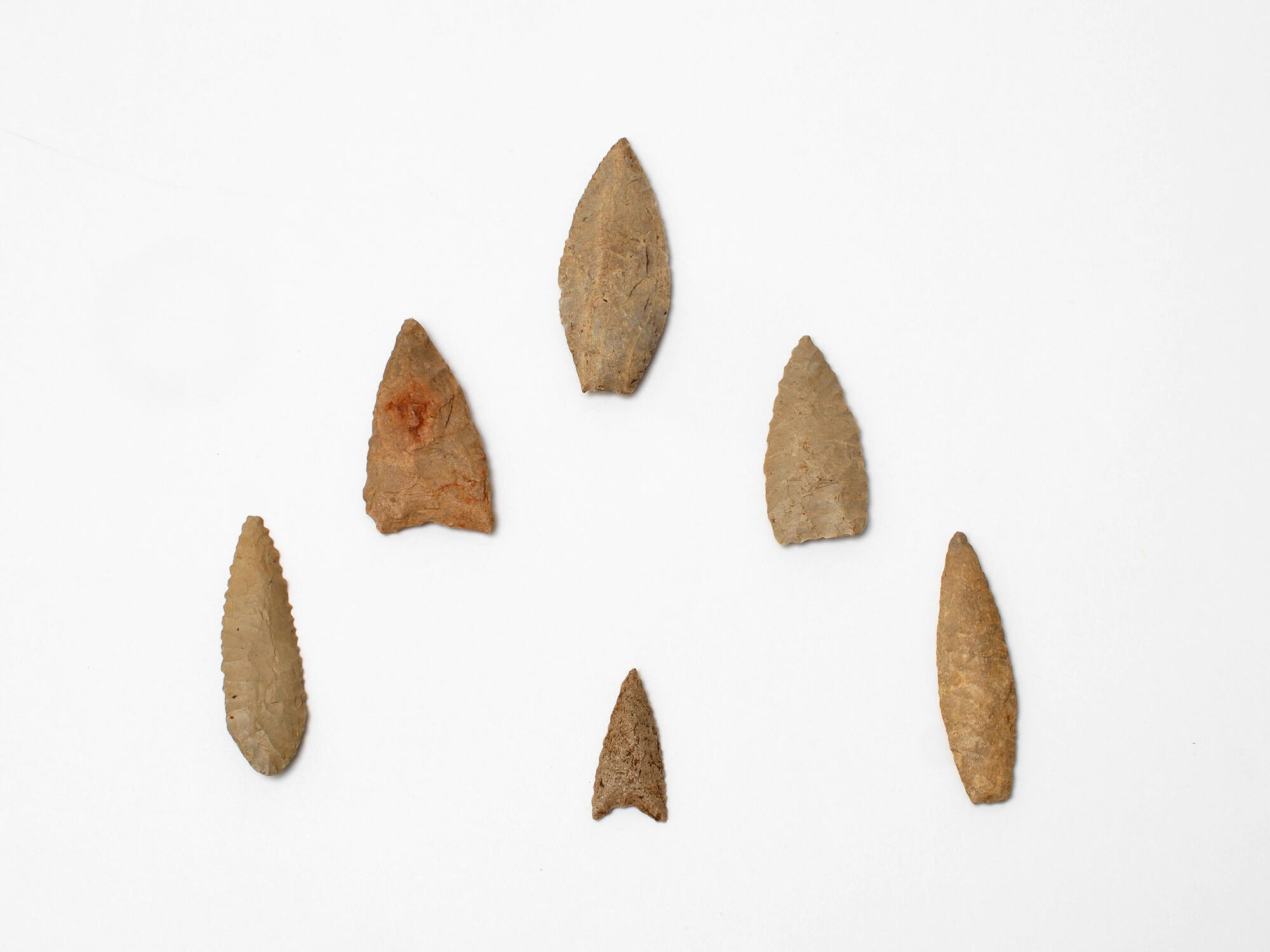


The museum houses many exhibits made of stone. They differ in shape and processing technique. A special place is occupied by arrowheads of the Neolithic era. They were found during excavations of the settlements Cherdashny Log and Ust-Poros, which are located in the lower reaches of the Tom River on the banks of the Ishtan channel and not far from the mouth of the small river Poros.
The researchers dated the products to the 4th millennium BC. These artifacts give an idea of what the ancient inhabitants of the Lower Ob region knew about nature, what technology they used and what their daily life was like.
Most arrowheads found in the excavations were made in the form of willow or laurel leaves. They differ in size and shape but the technique is the same.
The Neolithic craftsmen knew how to saw, drill and grind stone. However, the most durable arrowheads were made using the more ancient method of splitting and chopping. This technology required particularly hard raw materials: flint or similar rocks, which would easily split and form a special fracture, shaped like a bivalve shell.
In the lower Tomsk region, drain sandstones had similar properties. Ancient artisans found and mined them thanks to their knowledge of geology and mineralogy. As a rule, in the Neolithic era, people settled in places where they could live comfortably: near rivers, where they fished and hunted for birds. In addition, they most often collected raw materials on the surface, in river valleys — this was the easiest way.
The tools were made in this way: the sandstone nodules were transformed with a few blows into special cores — nuclei, from which thin and long plates, templates for future arrowheads were chopped off. The tool acquired its final appearance after retouching. Archaeologists use this word for the technique of chipping or squeezing small scales, which made it possible to give the product its final shape and sharpen the edges.
The Lower Tomsk population of the Neolithic period was mainly engaged in hunting, and used bows as the main tool — the numerous arrowheads found here are a proof. They differed in shape and size because each hunter’s quiver had arrows for different prey: birds, small and large animals, and even elk.
The researchers dated the products to the 4th millennium BC. These artifacts give an idea of what the ancient inhabitants of the Lower Ob region knew about nature, what technology they used and what their daily life was like.
Most arrowheads found in the excavations were made in the form of willow or laurel leaves. They differ in size and shape but the technique is the same.
The Neolithic craftsmen knew how to saw, drill and grind stone. However, the most durable arrowheads were made using the more ancient method of splitting and chopping. This technology required particularly hard raw materials: flint or similar rocks, which would easily split and form a special fracture, shaped like a bivalve shell.
In the lower Tomsk region, drain sandstones had similar properties. Ancient artisans found and mined them thanks to their knowledge of geology and mineralogy. As a rule, in the Neolithic era, people settled in places where they could live comfortably: near rivers, where they fished and hunted for birds. In addition, they most often collected raw materials on the surface, in river valleys — this was the easiest way.
The tools were made in this way: the sandstone nodules were transformed with a few blows into special cores — nuclei, from which thin and long plates, templates for future arrowheads were chopped off. The tool acquired its final appearance after retouching. Archaeologists use this word for the technique of chipping or squeezing small scales, which made it possible to give the product its final shape and sharpen the edges.
The Lower Tomsk population of the Neolithic period was mainly engaged in hunting, and used bows as the main tool — the numerous arrowheads found here are a proof. They differed in shape and size because each hunter’s quiver had arrows for different prey: birds, small and large animals, and even elk.