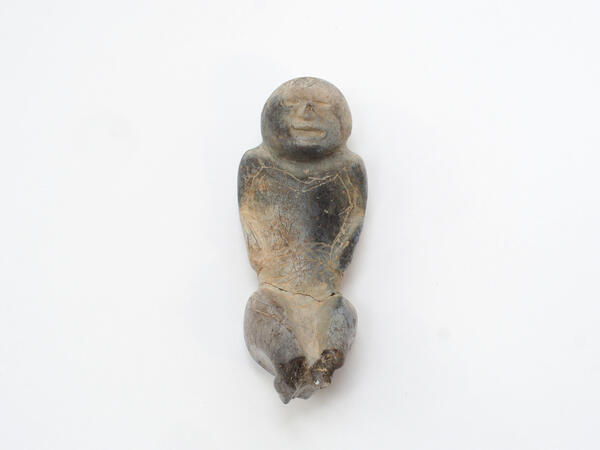
The anthropomorphic (humanlike) sculpture ‘Praying Person’ is an example of the primitive art of the Early Bronze period (the 17th–13th centuries BC). It was found during the excavations of the settlement Samus IV cultural layer. Now it is part of the closed administrative-territorial formation Seversk.
Samus IV is an original archaeological site of Northern Eurasia. It became famous thanks to the bronze casting center, which was discovered by archaeologists. The Bronze Age culture, which ‘Praying Person’ belongs to, was named after the settlement — Samus culture.
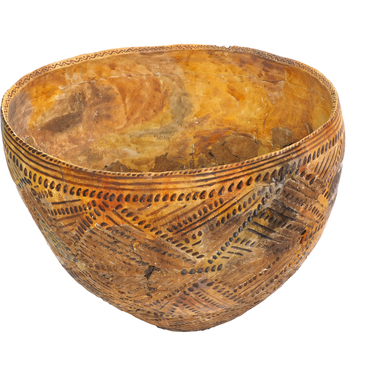
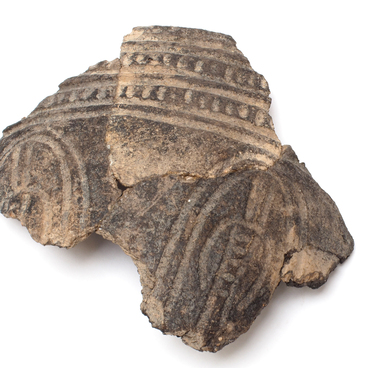
Samus IV was presumably not so much of a settlement, but rather a sacred center for representatives of different cultures and traditions. Traces of ritual procedures, rare cult ceramic dishes, as well as anthropomorphic sculptures made in different styles, were found here.
‘Praying Person’ was carved from a soft stone — agalmatolite. The artisan chose the round sculpture technique. It enabled to create three-dimensional images which could be viewed from all sides.
The height of the sculpture is only 6.6 centimeters. This is an image of a naked man in a typical pose. He is on his knees, his arms are pressed to his body, his back is bent, and his shoulders are slumped down. His body is made with the observance of proportions.
The craftsman accurately carved and polished all the details. The man has narrow or squinty eyes, pressed lips, and a small tattoo. His face is broad, with a low forehead and a slightly protruding chin. In ancient times, the item was used as a pendant — this can be concluded from a special hole under the man’s knees.
The art of the Samus culture is one of the brightest phenomena in the history of Northern Asia. It appeared in the Ob region when it had already developed. Researchers distinguish the Samus art as a separate and original culture with developed bronze and ceramic production, new forms of weapons, and complex ritual and mythological concepts.
Samus IV is an original archaeological site of Northern Eurasia. It became famous thanks to the bronze casting center, which was discovered by archaeologists. The Bronze Age culture, which ‘Praying Person’ belongs to, was named after the settlement — Samus culture.
Samus IV was presumably not so much of a settlement, but rather a sacred center for representatives of different cultures and traditions. Traces of ritual procedures, rare cult ceramic dishes, as well as anthropomorphic sculptures made in different styles, were found here.
‘Praying Person’ was carved from a soft stone — agalmatolite. The artisan chose the round sculpture technique. It enabled to create three-dimensional images which could be viewed from all sides.
The height of the sculpture is only 6.6 centimeters. This is an image of a naked man in a typical pose. He is on his knees, his arms are pressed to his body, his back is bent, and his shoulders are slumped down. His body is made with the observance of proportions.
The craftsman accurately carved and polished all the details. The man has narrow or squinty eyes, pressed lips, and a small tattoo. His face is broad, with a low forehead and a slightly protruding chin. In ancient times, the item was used as a pendant — this can be concluded from a special hole under the man’s knees.
The art of the Samus culture is one of the brightest phenomena in the history of Northern Asia. It appeared in the Ob region when it had already developed. Researchers distinguish the Samus art as a separate and original culture with developed bronze and ceramic production, new forms of weapons, and complex ritual and mythological concepts.