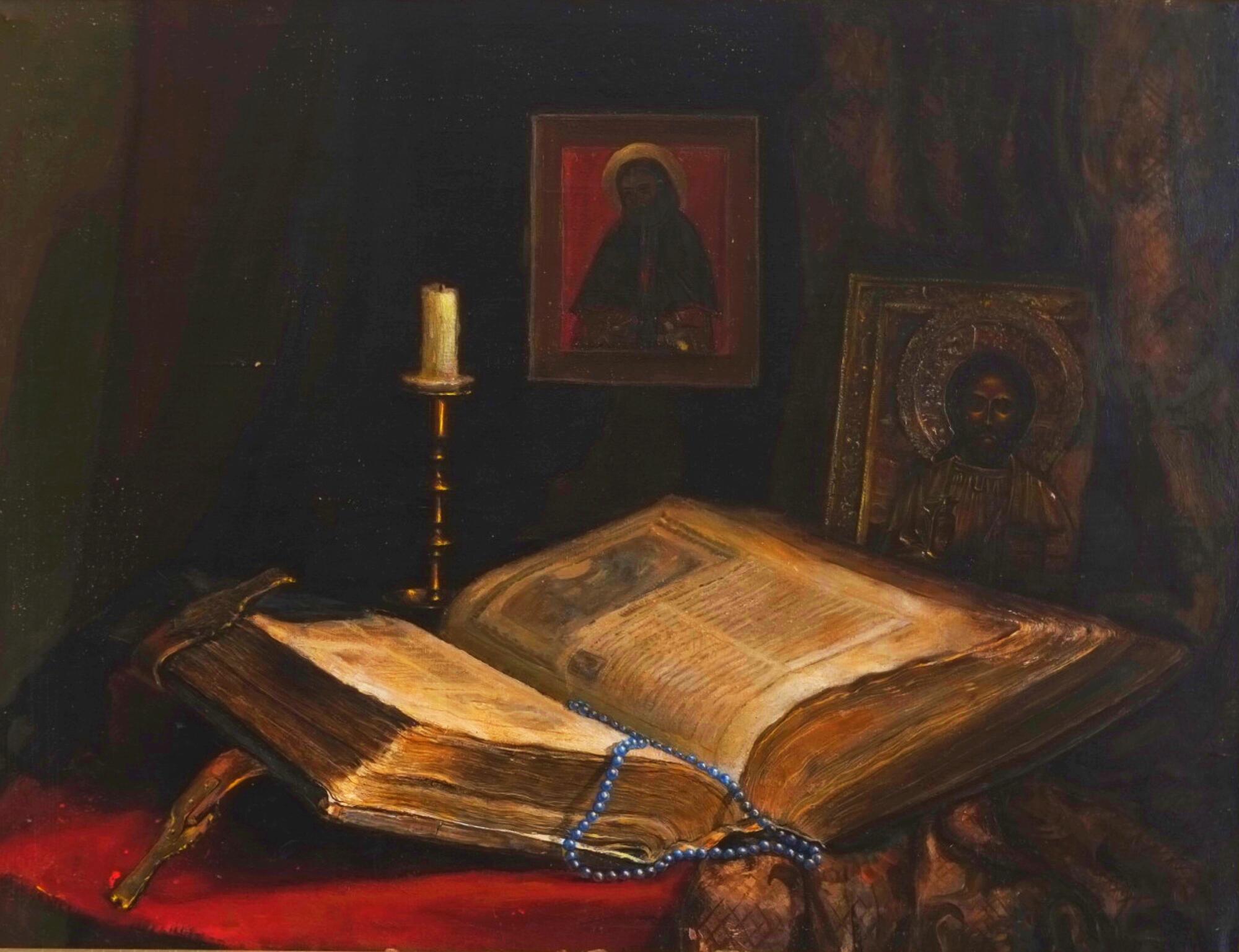


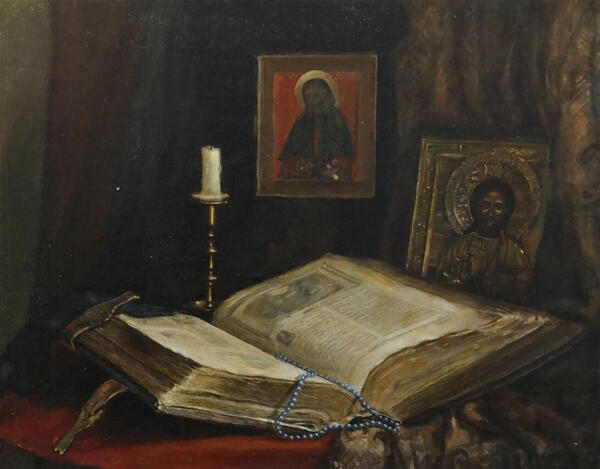
The painting ‘Still Life with a Book’ was donated to the Varnavino Museum of History and Art, along with other works, by the Nizhny Novgorod School of Arts in 1998. This work is the graduation project of M. Semenchuk, a college student. Unfortunately, apart from the surname, nothing is known about the author of the still life.
The ‘Still Life with a Book’ most certainly shows part of a monk’s cell. The foreground shows two sacred images and a book. In the center there is a sacred image of the holy Reverend Seraphim of Sarov, and on the right, in a metal cover, one can see the sacred image of Jesus Christ. There is a book on the table, probably the Gospel, and a bluish rosary is stacked on top of it.
The Holy Reverend Seraphim of Sarov was canonized by the Russian Orthodox Church in 1903. This means that the plot of this painting alludes to the beginning of the 20th century, or rather to the thundering calm before the revolutionary storm. The ancient Gospel and the graceful rosary lying on it tell the viewer that the inhabitant of this cell is most likely a scholar monk, and perhaps even the abbot of the monastery — Father Superior.
When he returns to his cell in the evening, the monk is not separated from the brotherhood. The cell is his personal space, however, it does not belong to a specific monk. Everything in it — furniture, icons, books, clothes — is located strictly by blessing. Whatever the monk does in his cell — resting, praying, reflecting on his life, preparing for confession and for Communion — all this has an organic connection to the daily life of the monastery.
Of course, the monk can also rest in his cell, though the cell is not a place for dalliance. In fact, it is an arena of ascetic confrontation and a place for the most intimate prayers and reflections. Some ancient monastic texts compare the cell with the Babylonian furnace, where a monk, like the three youths, is tested, purified and prepared to meet with God.
Semenchuk succeeded in showing the spectacular contrasts that accurately illustrate the complex ascetic life of a monk. With a combination of rich red, muted black and the polyphony of brown tones, the painter managed to give the picture both an intimate sound and a note of alarm, hinting that here the monk bears the cross of loneliness and of struggle with passions.
The ‘Still Life with a Book’ most certainly shows part of a monk’s cell. The foreground shows two sacred images and a book. In the center there is a sacred image of the holy Reverend Seraphim of Sarov, and on the right, in a metal cover, one can see the sacred image of Jesus Christ. There is a book on the table, probably the Gospel, and a bluish rosary is stacked on top of it.
The Holy Reverend Seraphim of Sarov was canonized by the Russian Orthodox Church in 1903. This means that the plot of this painting alludes to the beginning of the 20th century, or rather to the thundering calm before the revolutionary storm. The ancient Gospel and the graceful rosary lying on it tell the viewer that the inhabitant of this cell is most likely a scholar monk, and perhaps even the abbot of the monastery — Father Superior.
When he returns to his cell in the evening, the monk is not separated from the brotherhood. The cell is his personal space, however, it does not belong to a specific monk. Everything in it — furniture, icons, books, clothes — is located strictly by blessing. Whatever the monk does in his cell — resting, praying, reflecting on his life, preparing for confession and for Communion — all this has an organic connection to the daily life of the monastery.
Of course, the monk can also rest in his cell, though the cell is not a place for dalliance. In fact, it is an arena of ascetic confrontation and a place for the most intimate prayers and reflections. Some ancient monastic texts compare the cell with the Babylonian furnace, where a monk, like the three youths, is tested, purified and prepared to meet with God.
Semenchuk succeeded in showing the spectacular contrasts that accurately illustrate the complex ascetic life of a monk. With a combination of rich red, muted black and the polyphony of brown tones, the painter managed to give the picture both an intimate sound and a note of alarm, hinting that here the monk bears the cross of loneliness and of struggle with passions.