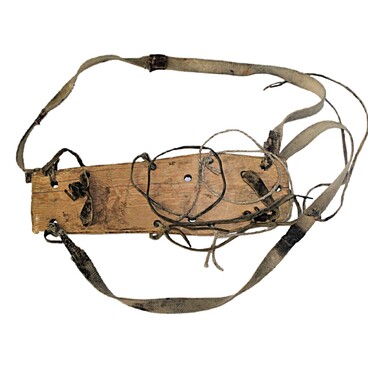
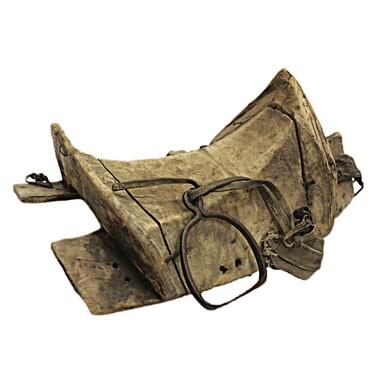
Natruska is a hunting sling, on which a powder horn, a capsule, and a powder measure were attached. Natruska is made of two birch, hollowed-out caps, fixed in the center with forged plates and a pin. Natruska is framed by a forged metal hoop with a “crane” lid in the upper part. A rawhide belt with additional attributes for natruski is tied to the rings:
1. Leather pouch with two compartments for shot, stitched with thick threads.
2. A measure for gunpowder made of animal horn with a wooden lid.
3. A shot gauge made of ½ cartridge.
4. A needle for piercing the holes of the natruski.
5. Leather bullet pouch.
6. The key for cocking the wheel lock on the bolt.
There were natruski from the end of the XV to the beginning of the XX century. It was made of horn, leather, wood, metal and was worn on a belt or belt belt. It was used in the army and hunting. Hunting powder flasks were beautifully finished and decorated. Military powder flasks fell out of use at the end of the XVII century. due to the appearance of paper cartridges. On hunting, the powder flasks continued to be used, pouring the powder first into the powder gauge, and then into the barrel. Gunpowder was also poured from the powder horn onto the seed shelf, if the shooter did not have a separate powder with fine powder for priming.
In the XVIII century. in the neck of hunting powder flasks (in the military — in the XVII century.), a dispenser appeared — a small chamber with a compartment that contained a supply of gunpowder for one shot. Thus, there was no need for a powder gauge.
Natrusok was abandoned with the advent of percussion caps, they were replaced by percussion caps. Powder flasks became unnecessary with the introduction of unitary cartridges at the end of the XIX century. In commercial areas where cartridges were expensive, powder flasks were used until the 1940s.Natruska is a hunting sling, on which a powder horn, a capsule, and a powder measure were attached. Natruska is made of two birch, hollowed-out caps, fixed in the center with forged plates and a pin. Natruska is framed by a forged metal hoop with a “crane” lid in the upper part. A rawhide belt with additional attributes for natruski is tied to the rings:
1. Leather pouch with two compartments for shot, stitched with thick threads.
2. A measure for gunpowder made of animal horn with a wooden lid.
3. A shot gauge made of ½ cartridge.
4. A needle for piercing the holes of the natruski.
5. Leather bullet pouch.
6. The key for cocking the wheel lock on the bolt.
There were natruski from the end of the XV to the beginning of the XX century. It was made of horn, leather, wood, metal and was worn on a belt or belt belt. It was used in the army and hunting. Hunting powder flasks were beautifully finished and decorated. Military powder flasks fell out of use at the end of the XVII century. due to the appearance of paper cartridges. On hunting, the powder flasks continued to be used, pouring the powder first into the powder gauge, and then into the barrel. Gunpowder was also poured from the powder horn onto the seed shelf, if the shooter did not have a separate powder with fine powder for priming.
In the XVIII century. in the neck of hunting powder flasks (in the military — in the XVII century.), a dispenser appeared — a small chamber with a compartment that contained a supply of gunpowder for one shot. Thus, there was no need for a powder gauge.
Natrusok was abandoned with the advent of percussion caps, they were replaced by percussion caps. Powder flasks became unnecessary with the introduction of unitary cartridges at the end of the XIX century. In commercial areas where cartridges were expensive, powder flasks were used until the 1940s.