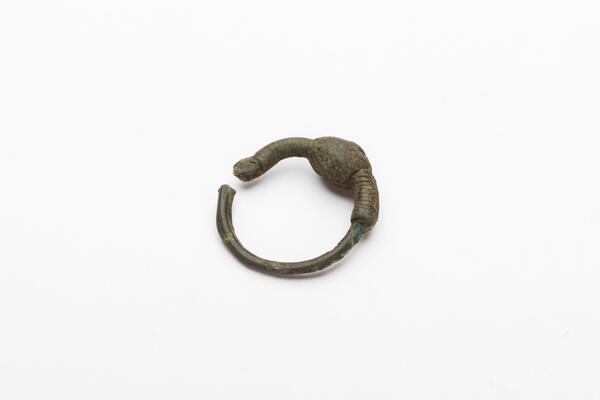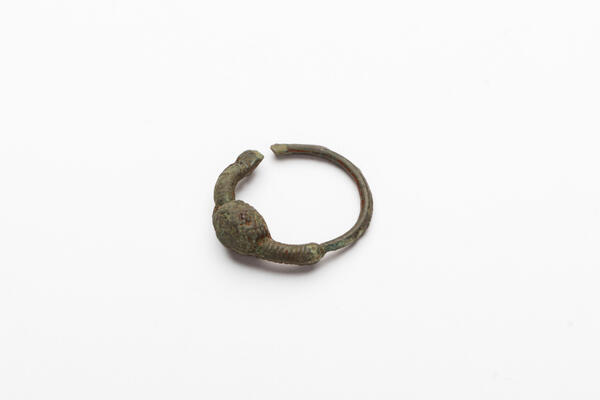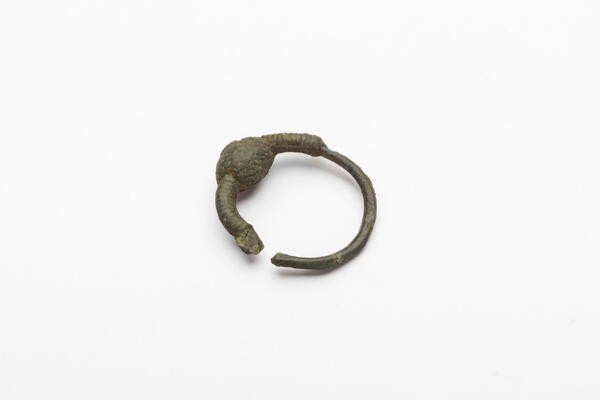
Beaded temple pendants are a distinctive type of Bulgarian products. Similar imported adornments, elegantly complemented by pyramids of granulation elements and filigree strips, are found at the Chepetsk archeological sites. They embody the skill and artistic and aesthetic tastes of Volga Bulgarian jewelers.
Volga Bulgaria was a medieval state that occupied the territory of modern Tatarstan, Chuvashia and the Samara, Ulyanovsk and Penza regions and largely influenced the Chepetsk lands. In the Middle Ages, the Udmurts were closely connected with the Bulgars through trade relations.
A ring-shaped pendant with an acorn-shaped bead was found in the Bigershay burial ground in Kuzminsky during archaeological excavations in 1982–1987. The temple pendant was decorated using the techniques of filigree and granulation.
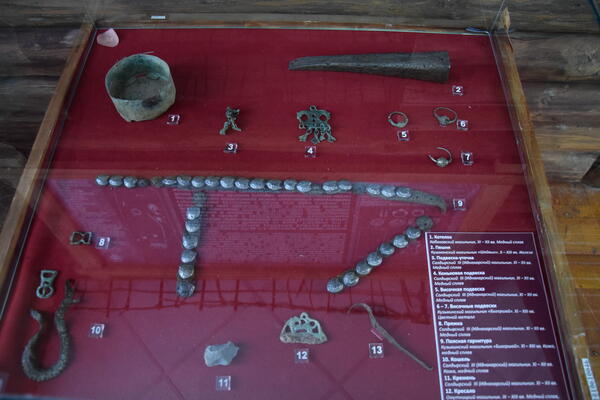
The collection of items found in the same burial ground also included local imitations of imported temple ring pendants. These were solid pendants imitating rings with one or two beads, a wire ring with a threaded glass bead and a ring with a threaded bronze bead.
Such finds prove that people in Prikamye not only used imported products in their everyday life but also adopted the best practices of foreign craftsmen. Prikamye jewelers used molds to cast coin-shaped pendants, small details and ornaments. Udmurt craftsmen mastered various technologies, such as forging, stamping, chasing, wire making and casting from wax models.
Idnakar jewelers possessed the secrets of filigree and granulation — very complicated jewelry techniques. Some of the popular products of the Prikamye region are bronze and silver earrings, rings, bracelets, belt elements, brooches, buckles and pendants. Apart from being pleasing to the eye, they were also used as amulets.
In the Middle Ages, temple pendants were the favorite jewelry in Udmurtia. They were sewn or attached to a headdress with a leather cord at the temple. Pendants, made from bronze wire with a circular cross-section, were bent in the shape of a figure eight; the ends of the wire are tightly connected in the lower wide part. The pendants were about three centimeters high. In the Middle Ages, this type of temple pendant could be worn by both women and men.