The ancestors of the Shors practiced primitive ways of terrace farming since the Bronze Age and at the end of the 19thcentury hoe-farming became almost universal. The ethnographer Johann Gottlieb (Ivan Ivanovich) Georgi wrote:


#1
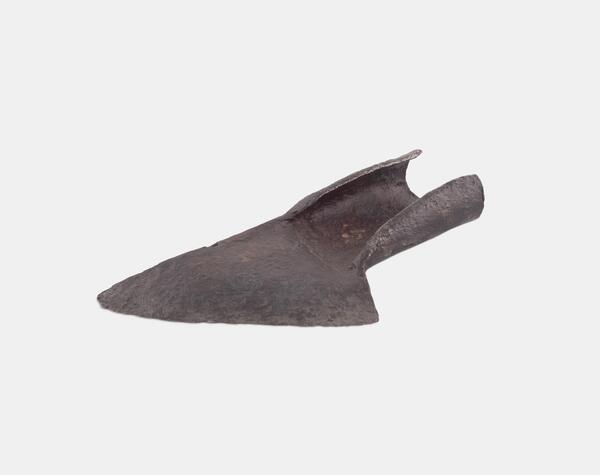
Plow tip
#2
#3
Their [Shor] arable farming is not of a high standard, few people practice it, and the arable lands of such farmers can hardly be equal in size to large vegetable gardens: and therefore they use spades instead of plows.
#4
Nevertheless, this traditional method was practiced in the taiga part of Gornaya Shoria until collectivization in the 1930s.
Arable farming, based on the use of draft power of domestic animals when cultivating the land with different types of plows and other special tools, was introduced into Shor life at the end of the 19th— beginning of the 20thcenturies.
Dmitry Vladimirovich Arzyutov notes that the inclusion of the northern (forest-steppe) group of the Shor ethnic group “in the powerful socio-economic processes that began with the arrival of the Russians” led to a significant degree of “adopting the Russian culture, ” while the southern Shors continued to represent “an example of hunters, gatherers and fishermen of the taiga.”
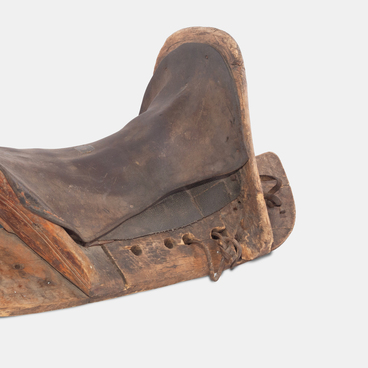
The northerners sowed cereal crops, scattering the seeds directly from birch bark boxes with their hands, then harrowed the area with the help of horses, tying a crooked bough to the saddle.
At the beginning of summer, the first stage ended. The area was fenced off from livestock with dead wood, with passages or gates left. In the second half of June the plot was weeded.
The Shors mainly planted barley and wheat, millet, oats, potatoes, and hemp. In September, they pulled out the harvest by hand, and then the rhizomes were cut off with an ax. The stems were tied in pairs into bundles, suspended on poles and dried between two pillars or under the roof of a house. After drying, the unripe ears were fried on an open fire and threshed with wooden mallets (at the beginning of the 20thcentury, a flail with a strap came into use), the grain was cleaned and winnowed.
The grain was put in leather bags, loaded onto horses, and taken to barns and storehouses. There it was put away into wooden compartments or birch bark boxes. #5
Name: Plow tip
Date of creation: the early 20th century
Place of creation: Gornaya Shoria, the Russian Empire
Technique: iron, forging
Dimensions: 31×14×6 cm
№:
#6
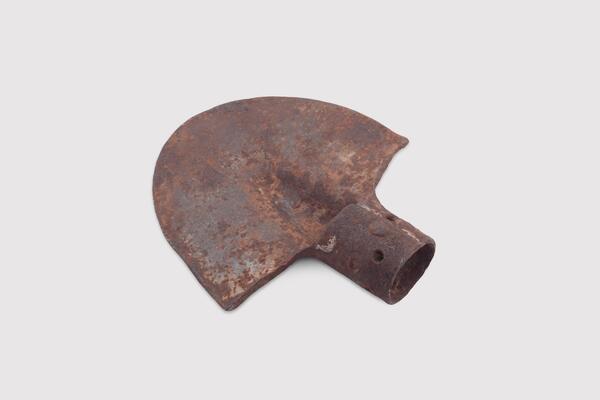
Hoe head
#7
The Shors had small-scale arable farming: they used 0.1–0.3 hectares for primitive agriculture — an area about the size of one to three pens for holding livestock.
The farming technology of the northern and southern Shors was different: in the north they practiced plowing, in the south — hoeing. The first (northern) type of soil cultivation, brought to these regions by Russian settlers, involved the use of familiar Russian tools. These included a light wooden “salda” ard with an iron tip, a wooden harrow, and sickles. At the beginning of the 20thcentury, the wealthy Shors also used iron plows and simple horse-drawn reapers.
Hoe farming, which became widespread in the taiga regions of the Kuznetsk uezd, was more primitive and appeared earlier. According to some researchers, the ancestors of the Shors practiced it back in the Bronze Age.
From the late Iron Age, the “abyl” hoe began to be used for loosening soil and getting rid of stones. Rocky soil was exclusively hoed; as for the places with relatively few stones, the soil was plowed with a horse-drawn “andazyn”, and the hoe was only used to loosen the soil.
Before hoeing, the Shors cleared the cultivated areas on the sunny slopes of the mountains from the forest by cutting and burning the plants: thanks to this, the grain ripened better and faster, before the frost appeared and damaged the crops. Those areas were cultivated for three to four years, then they were abandoned as the Shors moved to a new location. Sometimes the Shors would use territories of former dwellings, livestock camps or old forts to grow “kendyr” hemp, which was the only plant to grow in such places.
The land was cultivated throughout May, and since everyone, including children and elderly people, took part in the work, families, along with livestock, temporarily moved to arable land not far from the village. The Shors built temporary “odag” houses. The uluses were left empty, and this happened again in autumn when it was time to harvest the crops.
The “abyl” hoe head presented in the exhibition is a hand-held spade with an iron spatula mounted on a bent tree root.
#8
Name: Hoe head
Date of creation: the mid-20th century
Place of creation: Gornaya Shoria, Kemerovo Oblast, the USSR
Technique: iron, forging
Dimensions: 21×18,5×4.5 cm
№: 36727992
#9
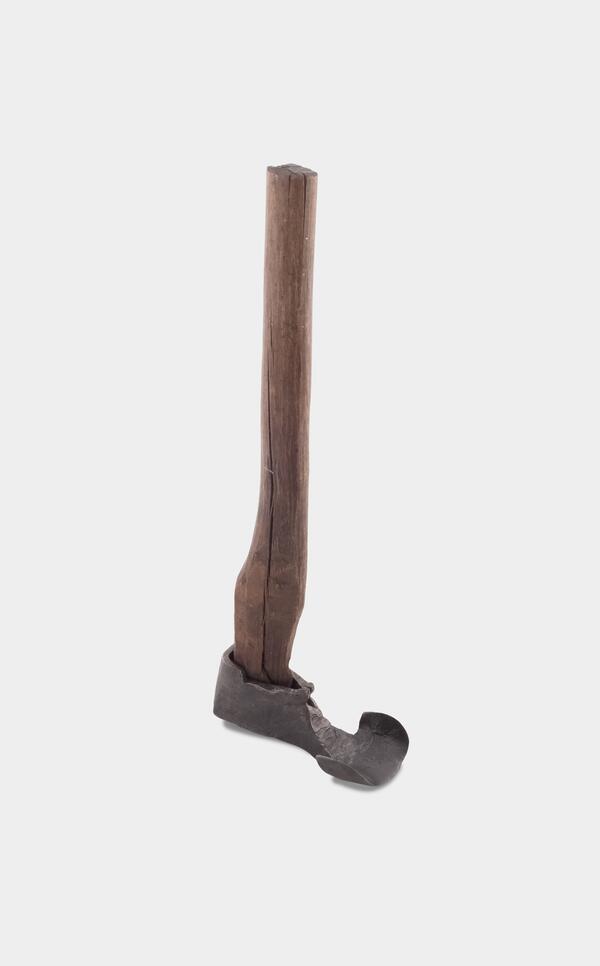
Adze
#10
The adze and the ax were, according to the historian Andrey Nikolayevich Toropov, the oldest and most popular carpentry tools. The Soviet archaeologist Boris Aleksandrovich Kolchin believed that the design of the adze, which remained unchanged until the 20thcentury, originated back in the 9th–10thcenturies.
These tools vary in weight: heavier ones are more suitable for rough rather than for fine work; depending on its function, the blade can be straight or rounded.
An adylga adze looks like an ax. The straight, round-section handle of the adze was made smooth. It gradually decreased in diameter, starting from the working part. An iron tip was attached perpendicularly to the thicker end — a forged blade with short rounded corners and convex sides. The tip gradually becomes a rectangular rod to be attached to the handle. The working edge of the blade was sharpened.
Back in the 19thcentury, the economy of the Shors seemed very ascetic, but already in the first half of the 20thcentury, their equipment, including kitchen utensils, became quite varied. In everyday life they used metal, wood, birch bark, and less often leather utensils. Wood and birch bark processing was traditionally considered an occupation for men.
Small dishes and cups were cut out of birch burl. To create larger hollow-carved dishes, the Shors cut down the trunks and roots of birch trees with axes, processed the workpiece with an adylga adze and then with a knife. For porridges and stews, hemispherical bowls were made that could have a low tray. Various containers for drinks, low wide dishes for meat or fish, ladles for pouring liquid food, spoons, smoking pipes, and troughs were in demand.
Skis and hunting sleds were made from flexible bird cherry wood. Cedar and fir were required for construction, furniture, and traps.
Strong and stable dugout boats were hollowed out from aspen trunks. Thanks to their light weight and flat bottom, they were easily dragged over the rapids of mountain rivers. The rounded blade of the adze enabled the Shors to carve out wood from the inside of the trunk carefully and accurately, without splinters.
#11
Name: Adze
Date of creation: the first half of the 20th century
Place of creation: Kemerovo Oblast, Russia
Technique: metal, wood; forging
Dimensions: 48×16,5×4,5 cm
№:
#12
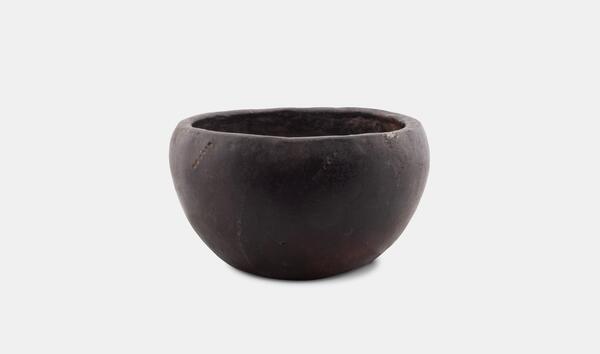
#13
Pottery originated in Siberia in the Neolithic period. The Asian Eskimos, Itelmen, Yakut and Northern Shor peoples maintained the craft up to the early 20thcentury. In ancient times, the Shors practiced agriculture and animal domestication, but over time they also engaged in trade and transportation.
The evolution of pottery designs corresponded to the changing everyday needs of people: for example, vessels with a round or egg-shaped bottom were placed on hearth stones, while those with a flat bottom were used for cooking in the oven and serving food.
The historian, ethnographer, museologist, and specialist in the history and culture of the Turkic-speaking community Valery Makarovich Kimeev mentions in “Traditional Shor Crafts” that pottery, like weaving, was done by women.
The preparation of raw materials began in the evening: wooden troughs (“karit kuman salgan”) were placed inside the odag and clay and sand were mixed. The next day, the clay was placed on a thick block and flattened with the help of a spatula (“kalek”) and a special hammer (“tokpak”). Then, holding the workpiece between the feet, the potters began to build up the walls layer by layer. The inside of the future vessel was smoothed with a small mallet (“tunduk”), and the walls were leveled with a flat spatula (“chakpysh”), which could also be used to make patterns. A potter’s wheel was not used.
To fix the shape, the walls were fastened with seven or eight willow hoops (“shiyik”) of different diameters. When the vessel became dry, those hoops were removed with a wooden knife (“keskish”).
The Shor pottery was varied, and its shape often resembled the ceramic products of Russian peasants living in the Tomsk Governorate. To prepare soups and stews, thick-walled “selek kodesh” pots were used; melted butter and oil were stored in “tapnek” pots with a round bottom and a spout. A milk bowl with a handle (“molonzyek”) for milk had the same spout. Clay frying pans, cups, and mugs with handles, as well as “paspeshnek” oil lamps were also used in everyday life.
Most of the things the Shors produced were intended for household needs. Net weaving and pottery eventually reached the level of handicrafts, but now they have totally disappeared.
#14
Name: Clay bowl
Date of creation: the early 20th century
Place of creation: Tomsk Governorate, the Russian Empire
Technique: clay, molding
Dimensions: 14,5×24,5×14 cm
№: 36728026
#15
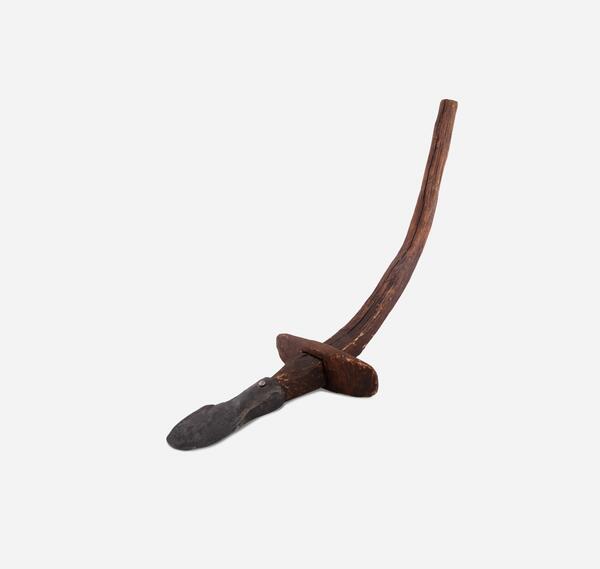
Root digger
#16
With relatively poorly developed hoe farming, gathering was of great importance in the life of the Shors. People used to eat wild plants and thus made up for the lack of nutrients vital for health.
In Gornaya Shoria, the season of collecting wild plants began in May or June: the plants had to be collected before flowering, otherwise they would get a bitter taste. The tool for digging up plant roots was an “ozup” root digger with a curved handle, a transverse crossbar for the leg, and an iron tip.
The Shors put the parts of plants they had dug out into “nandy” birch bark boxes, which were attached to their belts.
The most important food item was “kandyk”, which tasted like flour. It could be consumed as such but more often it was cooked: boiled for a while, dried on a thin wooden strip bent into a ring, and then boiled in water or milk. The Shors exchanged dried “kandyk” — they traded it with the Khakass for dairy products.
The Soviet ethnographer, who studied the life and culture of the Shors, Altaians, and Tuvans, Leonid Pavlovich Potapov, wrote that kandyk served as the raw material for preparing the brew drink called “abyrtka”. Its tubers, as well as those of peony and martagon lily, “were ground on flat stone grain grinders and flat cakes were baked from the resulting grains and baked or gruel with some talkan was cooked.”
The martagon lily bulbs were harvested in early summer, before flowering, and in the fall, baked in ash or boiled with milk. Wild garlic was collected in the summer and eaten unprocessed or added to stews. Sometimes these products were pickled for the winter. The stems of angelica, goldenrod, horsetail pods and vetch were consumed uncooked; hogweed was boiled to get rid of the bitter taste.
Instead of tea, the Shors brewed currant and raspberry leaves, meadowsweet, bergenia, rotten birch and fir bark.
Kandyk mixed with honey, as well as bird cherry berries crushed with seeds and served with milk were considered delicacies. To collect other berries, as well as pine nuts, the Shors left in groups and went into the taiga for several days.
In addition to plants that provided food, the Shors valued hemp and nettle which they used for weaving and making fabrics.
The ozup presented in the museum’s exhibition was made in Gornaya Shoria, a region located in the southern part of the Kemerovo region, at the junction of Altai, Sayan and Kuznetsk Alatau.
#17
Name: Root digger
Date of creation: the first half of the 20th century
Place of creation: Gornaya Shoria, the Russian Empire
Technique: iron, wood
Dimensions: 86×5×3,5 cm
№: 36728025
#18
Ministry of Culture of the Russian Federation
read morehide
Plow tip, Hoe head, Adze, Clay bowl, Root digger
0
 Point your smartphone camera to open in the app
Open in app
Share