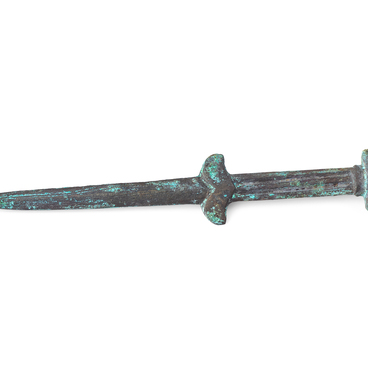
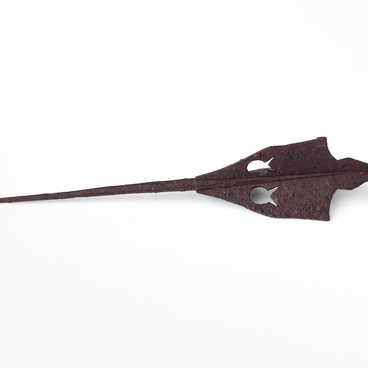
The cast button-badge with a convex floral pattern was made of bronze. The caster gave it the shape of a flower, and made an eyelet on the back. Researchers attributed this artifact to the Tes culture. The button was found among the objects of the treasure trove of the Xiongnu-Sarmatian era. It was discovered in a suburban area in the city of Sayanogorsk in the Republic of Khakassia in 2002. The button was dated from the 2nd century BCE to the 1st century CE.
The Russian researchers divided the contents of the treasure into four categories. Objects of Scythian antiquities were attributed to the first category, and objects of “Chinese” appearance — to the second. The third group consisted of Xiongnu-Tes items, which prevailed in the treasure, and the fourth — production waste, scrap and fragments of cauldrons.
In most of the treasures found in the Middle Yenisei basin, there were defective, untreated and damaged (with signs of wear), broken (fragmented) things. The presence of such a scrap in the set was considered by some researchers to be direct evidence that such treasures belonged to the casters.
The collection of the main fund of the Sayanogorsk Museum of Local Lore contains 30 buttons from the treasure trove of the Xiongnu-Sarmatian era. These are objects of various shapes: round, square flat and cone-shaped, round flat and cone-shaped, round in the form of a hat. Their size varies from 1.7 to 3.4 centimeters. The design of the buttons is geometric and floral.
In addition to buttons, rings, spoon-shaped pendants, buckles, plaques, and openwork plates were also found. Three quarters of the objects were made of arsenic bronze. Only 28 items had tin included in their composition by the caster of the Tes culture.
Buttons made of bronze
were first discovered in China. These were objects of Erlitou culture, which
were dated to the 2nd millennium BCE. According to historians, initially
buttons became widespread in the East. The main material for their manufacture
were animal bones and horns. It was only from the 13th century that the fashion
for buttons began to spread throughout Europe. They started to be made in
foundries, as well as blacksmith and jewelry workshops.