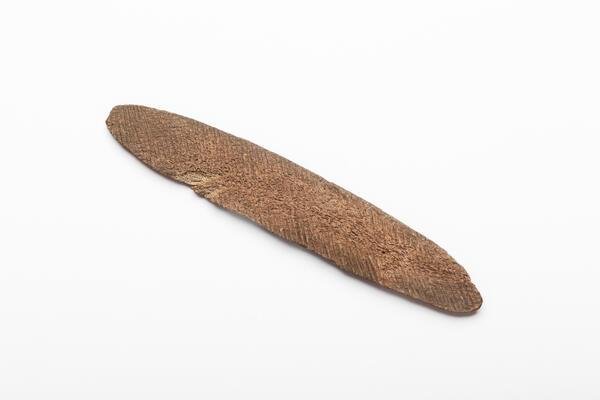
A bow-reinforcing plate is a side plate shaped like an elongated oval with rounded ends. Such plates reinforced the joints of a medieval bow and served as its handles — one on each side. Most often, the plates were cut in the form of an elongated oval or took a slightly arched shape. Their inner side was always covered with a scratch pattern so that the part got glued better to the wooden base of the bow.
The outer side of the plates is slightly convex and smooth, and the edges have scratch marks so that tendon threads could be fixed. The plates indicate that Idnakar bows were composite. They are similar to ancient Russian bows, which were made from different types of wood.
On average, the length of an old Russian bow with a bowstring was slightly under one and a half meters. The tension of medieval bows was enormous and reached 80 kilograms; however, bows with a tension between 20 and 40 kilograms were considered optimal. The excavations also revealed parts of quivers, small bone shields to protect the wrist during shooting, and arrowheads of various shapes, including blunt ones, that were used when hunters needed to keep valuable fur intact.
Bow strings were made from tendons, rawhide or catgut — fibers of animal intestines processed in a special way. The string could always be removed from the bow so that during breaks in using it, the bow did not bend too much and lose its quality. For convenience and safety, the bow was worn on a waist belt or in a quiver on a shoulder belt.
For the Udmurts in the Middle Ages, a bow was the main weapon for long-range battles and hunting. All medieval battles began with archers, including clashes on the territory of Idnakar. Excavations in the layers of the exterior slope of the rampart and the territory around the rampart of the fortress revealed heads of combat arrows. Judging by their presence in the layer, the arrows were fired from the side of the field.
The bow-reinforcing plate from the museum’s collection was made about a thousand years ago and was found during an archaeological expedition at the site of Idnakar in 1988.