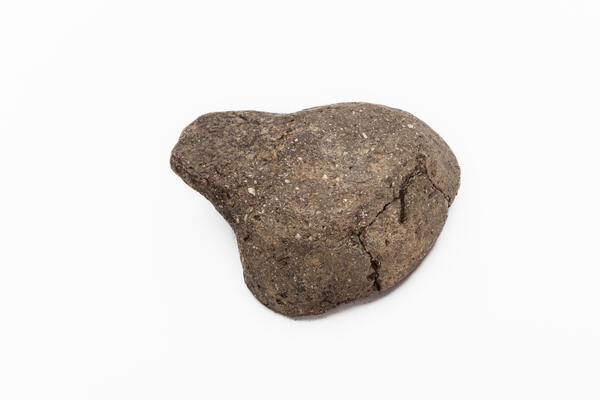
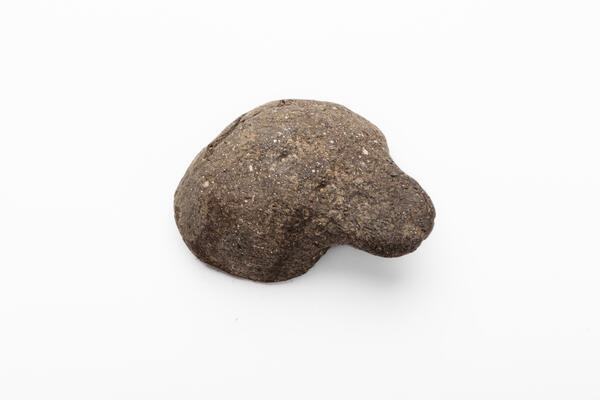
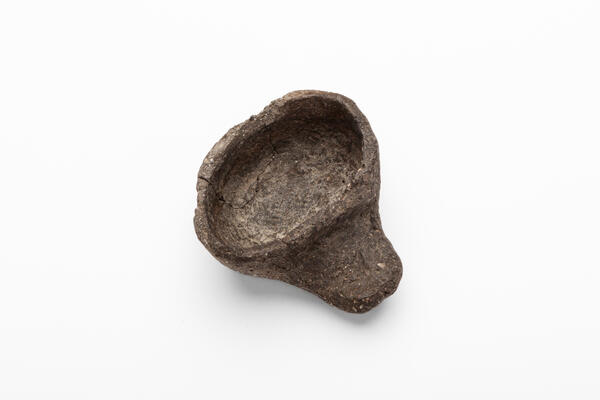
Smelting ladles are special stone or ceramic spoons often discovered in foundries. They are used to pour molten metal from crucibles — containers where it is melted — into molds. The earliest forms of smelting ladles had round bowls, used by craftsmen in the 6th–7th centuries. Chepetsk smelting ladles are different from Verkhnekamsky ones because of the flattened shape of the lug.
The Idnakar hillfort was a major metal processing center in the Prikamye region. Bronze casting was one of the oldest types of production in the region. Thousands of copper and bronze objects have been collected all over the Prikamye region — all of them are dated between the Copper Age and the late Middle Ages. A major part of metals was mined in the Ural region.
Prikamye craftsmen worked with bog iron ore, alloys and imported non-ferrous metals, such as copper, bronze, silver and brass. They made dishes, hunting and fishing gear, musical instruments, knives, axes, harnesses, fire strikers and iron tips for agricultural tools. Fragments of bronze vessels have also been found on the territory of the Idnakar hillfort.
Idnakar craftsmen achieved great success in making jewelry. They mastered complex techniques of filigree and granulation, as well as forging, stamping, chasing, wire making and casting from wax models. Prikamye jewelers made rings, earrings, amulets and noise-making pendants.
During excavations, archaeologists find blacksmithing and jewelry tools, blanks, castings and semi-finished products. Indakar smelting ladles, like casting molds, were cut out of fine-grained sandstone or sculpted from clay with an admixture, and then fired.
The oval-shaped spoon from the museum’s collection has a scoop and spout for pouring. It also has a lug for attaching a handle. This smelting ladle was made about a thousand years ago from clay with an admixture and was found during archaeological excavations in the Idnakar hillfort in 2010. The expedition, consisting of experts from the Udmurt Institute of History, Language and Literature, was led by Professor Margarita Ivanova.