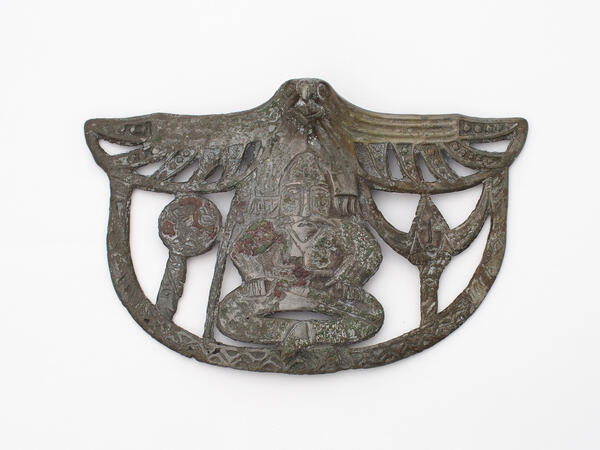
A pectoral with a plot composition was found in the burial mound of the Cherdashnyi Log-3, which is located on the left bank of the Tom River in Western Siberia. Excavations on this territory were conducted under the guidance of archaeologist Andrey Gaman in 1994.
The item dates back to the 6th-7th centuries A.D., i.e. to the period of the early Middle Ages. It was found inside the burial, the pectoral was located on the chest of the deceased who had been a warrior or even a leader. Also, a weapon, armor, and a horse harness were found. Only noble warriors were buried in this way.
The badge was cast from bronze. This is a rather complex, skillfully joined multi-figure composition; it includes five distinct images.
In the center, the ancient craftsman depicted a male figure. This is a sitting man who has a mustache and wears military clothing; he has a pointed helmet on his head, and a sword is attached to his belt. The warrior is surrounded by several symbolic images: the Sun, the Moon, a bird, and a snake.
A bird of prey with outstretched wings, which is located above the male figure, resembles an eagle. Its disproportionately large clawed paws rest on the warrior’s shoulders. The claws resemble bear claws — characters combining the features of a bear and a bird of prey were quite common in the West Siberian casting culture of that time.
In the lower part of the composition, the artisan depicted a two-headed snake or a lizard. It is curved in such a way that both its heads touch the bird’s wings. The central figure of the warrior is flanked by anthropomorphic faces: the right one symbolizes the Sun, and the left one is the Moon.
The image on the pectoral can be interpreted as a myth about the structure of the universe or as an epic heroic legend about the leader’s origin. The researchers believe that the images are most likely cosmological. The craftsman featured the Universe on the pectoral in the form of three worlds, each one associating with a certain character. The bird of prey with outstretched wings represented the Upper world, the two-headed lizard or snake stood for the Lower one, and the warrior symbolized the Middle world, where people live. The vertical axis between the man and the Sun, as a rule, symbolized a staff — an analog of the world tree. It served as a bridge that connected the heaven, the Earth, and the Underworld into one cosmic space.
The item dates back to the 6th-7th centuries A.D., i.e. to the period of the early Middle Ages. It was found inside the burial, the pectoral was located on the chest of the deceased who had been a warrior or even a leader. Also, a weapon, armor, and a horse harness were found. Only noble warriors were buried in this way.
The badge was cast from bronze. This is a rather complex, skillfully joined multi-figure composition; it includes five distinct images.
In the center, the ancient craftsman depicted a male figure. This is a sitting man who has a mustache and wears military clothing; he has a pointed helmet on his head, and a sword is attached to his belt. The warrior is surrounded by several symbolic images: the Sun, the Moon, a bird, and a snake.
A bird of prey with outstretched wings, which is located above the male figure, resembles an eagle. Its disproportionately large clawed paws rest on the warrior’s shoulders. The claws resemble bear claws — characters combining the features of a bear and a bird of prey were quite common in the West Siberian casting culture of that time.
In the lower part of the composition, the artisan depicted a two-headed snake or a lizard. It is curved in such a way that both its heads touch the bird’s wings. The central figure of the warrior is flanked by anthropomorphic faces: the right one symbolizes the Sun, and the left one is the Moon.
The image on the pectoral can be interpreted as a myth about the structure of the universe or as an epic heroic legend about the leader’s origin. The researchers believe that the images are most likely cosmological. The craftsman featured the Universe on the pectoral in the form of three worlds, each one associating with a certain character. The bird of prey with outstretched wings represented the Upper world, the two-headed lizard or snake stood for the Lower one, and the warrior symbolized the Middle world, where people live. The vertical axis between the man and the Sun, as a rule, symbolized a staff — an analog of the world tree. It served as a bridge that connected the heaven, the Earth, and the Underworld into one cosmic space.