The cast pendant was found in 2011 at Timiryazevskoye settlement IV. Researchers attribute the item to the early Middle Ages — 6th–9th centuries AD.
The indigenous peoples of Western Siberia and the Urals did not have a written language. Therefore, everything that scientists know about their mythology is based on archaeological finds, ethnographic materials, and folklore of the Khanty, Selkup, Mansi, and Komi-Permyaks.
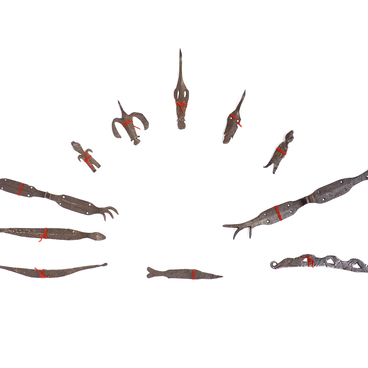
Such pendants were ritual objects. People endowed with power or sacral knowledge could wear them. Moreover, the pendants could be attached to various objects or surfaces during the rites.
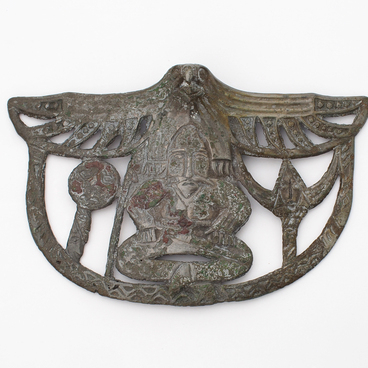
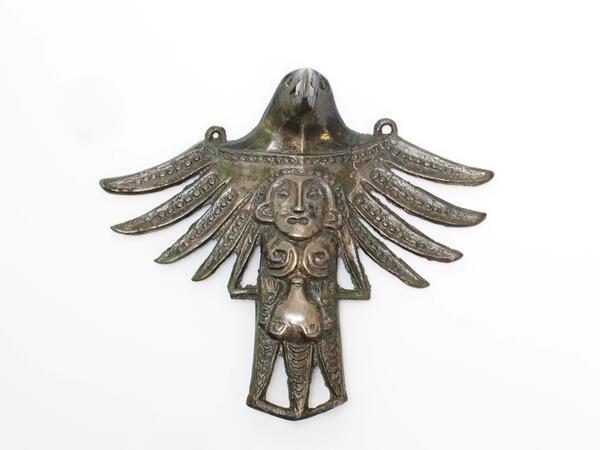
The cast pendant is made in the form of a bronze bird of prey — presumably, an eagle. It is depicted from the front view. On the eagle’s chest is a human face; below are the bird’s coil-shaped clawed paws that are pressed to its belly. The bird’s wings are wide open; they consist of eight openwork feathers. The tail has three feathers that are connected at the ends. They are decorated with a mounting ornament. There is a bear ‘in a sacrificial pose’ on the bird’s tail. The master made holes in the wings so that the eagle could be hung.
In the early Middle Ages, pendants often had a depiction of a human face on the bird’s chest. Perhaps, it symbolized the heavenly spirit taking the human soul to another world.
The bear ‘in a sacrificial pose’ is also depicted for a reason. Many Siberian peoples celebrated the bear festival. The hunters decorated the dead bear’s head and left a treat in front of its hide. It was both a plea to forgive them for their murder and a sign of worship.
All the cult pendant images are made in the Ural-Siberian animal style. In the works of this style, images of animals, birds, and people-animals are prevalent. Among popular themes were birds with a human face on their chest, animals in profile, and floating birds. There were also complex three-tiered compositions with central characters that looked like humans.
The indigenous peoples of Western Siberia and the Urals did not have a written language. Therefore, everything that scientists know about their mythology is based on archaeological finds, ethnographic materials, and folklore of the Khanty, Selkup, Mansi, and Komi-Permyaks.
Such pendants were ritual objects. People endowed with power or sacral knowledge could wear them. Moreover, the pendants could be attached to various objects or surfaces during the rites.
The cast pendant is made in the form of a bronze bird of prey — presumably, an eagle. It is depicted from the front view. On the eagle’s chest is a human face; below are the bird’s coil-shaped clawed paws that are pressed to its belly. The bird’s wings are wide open; they consist of eight openwork feathers. The tail has three feathers that are connected at the ends. They are decorated with a mounting ornament. There is a bear ‘in a sacrificial pose’ on the bird’s tail. The master made holes in the wings so that the eagle could be hung.
In the early Middle Ages, pendants often had a depiction of a human face on the bird’s chest. Perhaps, it symbolized the heavenly spirit taking the human soul to another world.
The bear ‘in a sacrificial pose’ is also depicted for a reason. Many Siberian peoples celebrated the bear festival. The hunters decorated the dead bear’s head and left a treat in front of its hide. It was both a plea to forgive them for their murder and a sign of worship.
All the cult pendant images are made in the Ural-Siberian animal style. In the works of this style, images of animals, birds, and people-animals are prevalent. Among popular themes were birds with a human face on their chest, animals in profile, and floating birds. There were also complex three-tiered compositions with central characters that looked like humans.