

The painter Alexei Khramov was born in the first quarter of the 20th century in the small town of Borisoglebsk, near Voronezh. He studied the painter’s art at the School of Arts in Gorky, nowadays Nizhny Novgorod. Since 1936, he started to regularly take part at regional exhibitions, and two years later he was admitted into the Union of Artists of the USSR. Having survived on the war fields of the entire Great Patriotic War, he was eager to return to his paintings. He was a regular participant in large-scale zonal exhibitions “Big Volga”, where many talented painters from peripheral regions were discovered. In 1960 he took part in the republican exhibition in Moscow.
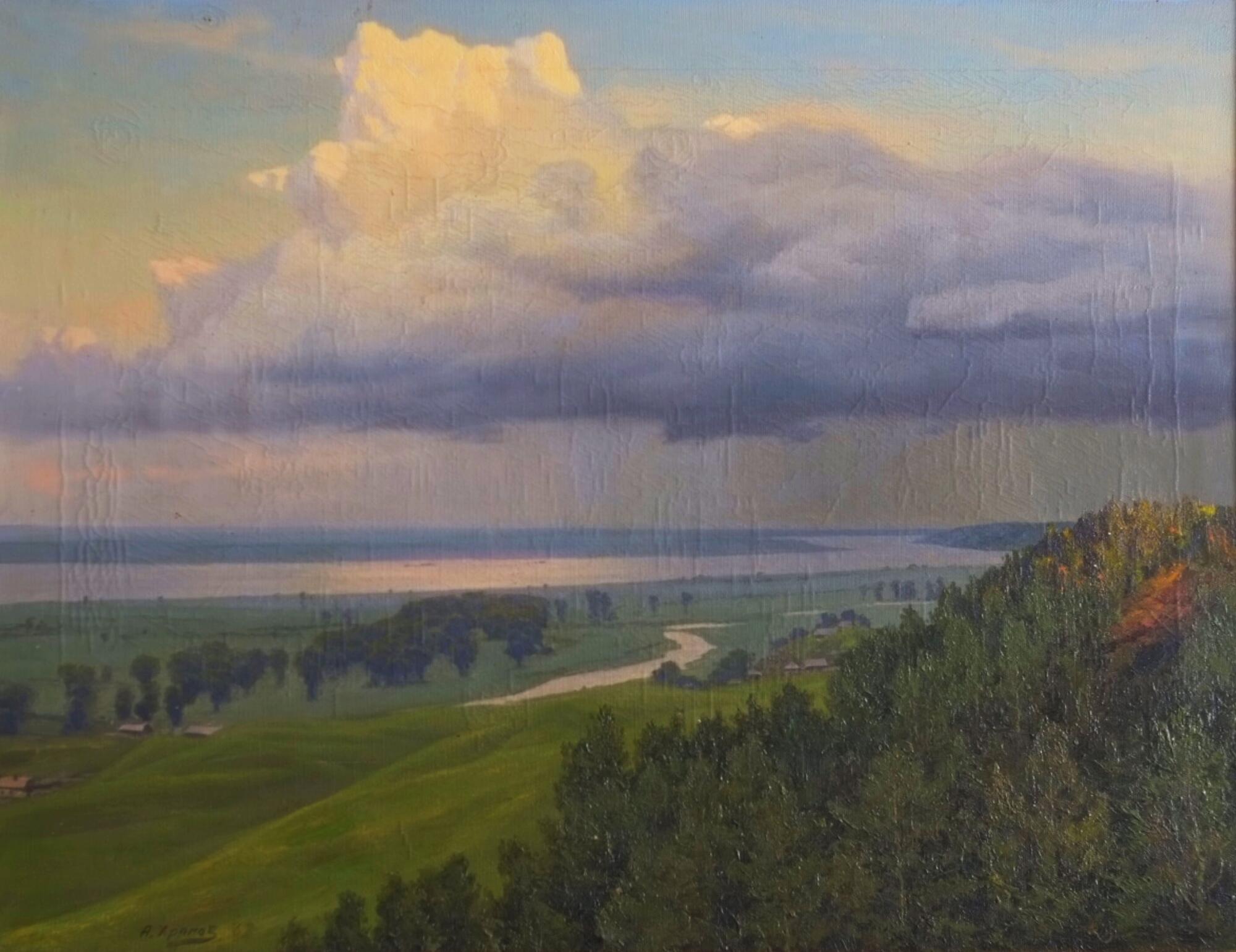
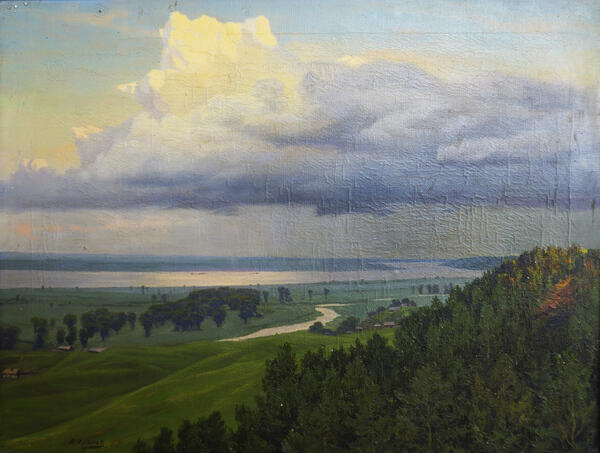
The paintings by the talented Russian painter Khramov can be seen in museums in Russia and all over the world. One of them, painted in 2000, the landscape “Over the Volga”, was donated to the collection of the Varnavino Museum of History and Art. Khramov was especially fond of landscape painting, and in this picture, he masterly conveyed the state of the Volga nature before a storm. On the one hand, the painter did not use any spectacular techniques to attract the attention of the viewer, on the other hand, his depiction of the Russian forest, dense and rich in greenery, cut through by the matt water surface of the mighty river, is very strong and convincing.
Khramov’s great skill as a painter is expressed in the fact that he was able to add the exclusively visual dramatic tension to his landscape ‘Over the Volga’, without having to resort to using a specific plot. All nature froze in anticipation of an impending thunderstorm: the sky is almost covered with thick dark clouds, but the sun rays still pass through them. Using vague and muddy color combinations to depict the horizon, the painter hints that somewhere beyond the weather is already rough. However, when the storm is over, the Volga nature will be fresh and new.
Having created the landscape ‘Over the Volga’, Khramov continued the colossal tradition of depicting this river in Russian painting. The greatest Russian painters often turned to painting Volga, because it is the largest river in the European part of Russia, and the largest river in Europe. The Volga originates in the Valdai Upland, at an altitude of 228 meters, from a spring in the village of Volgo-Verkhovje of the Tver Region and, coming throughout the territory of Central Russia, flows into the Caspian Sea. The Volga is rightfully considered one of the main symbols of Russia.
The paintings by the talented Russian painter Khramov can be seen in museums in Russia and all over the world. One of them, painted in 2000, the landscape “Over the Volga”, was donated to the collection of the Varnavino Museum of History and Art. Khramov was especially fond of landscape painting, and in this picture, he masterly conveyed the state of the Volga nature before a storm. On the one hand, the painter did not use any spectacular techniques to attract the attention of the viewer, on the other hand, his depiction of the Russian forest, dense and rich in greenery, cut through by the matt water surface of the mighty river, is very strong and convincing.
Khramov’s great skill as a painter is expressed in the fact that he was able to add the exclusively visual dramatic tension to his landscape ‘Over the Volga’, without having to resort to using a specific plot. All nature froze in anticipation of an impending thunderstorm: the sky is almost covered with thick dark clouds, but the sun rays still pass through them. Using vague and muddy color combinations to depict the horizon, the painter hints that somewhere beyond the weather is already rough. However, when the storm is over, the Volga nature will be fresh and new.
Having created the landscape ‘Over the Volga’, Khramov continued the colossal tradition of depicting this river in Russian painting. The greatest Russian painters often turned to painting Volga, because it is the largest river in the European part of Russia, and the largest river in Europe. The Volga originates in the Valdai Upland, at an altitude of 228 meters, from a spring in the village of Volgo-Verkhovje of the Tver Region and, coming throughout the territory of Central Russia, flows into the Caspian Sea. The Volga is rightfully considered one of the main symbols of Russia.