

#1

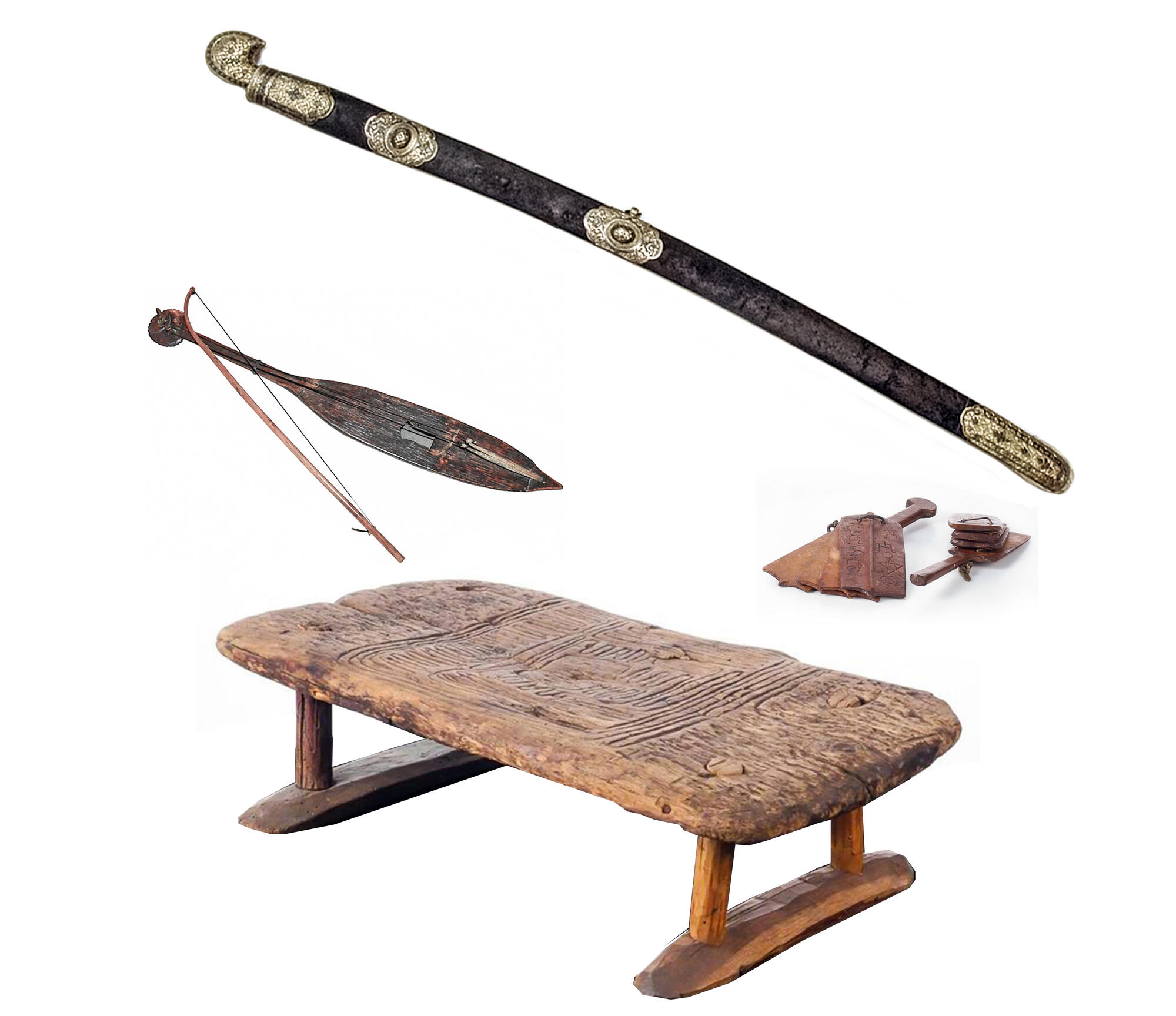
Musical instrument, Game, Hand-rattles & Shashka
#34
#35
#2
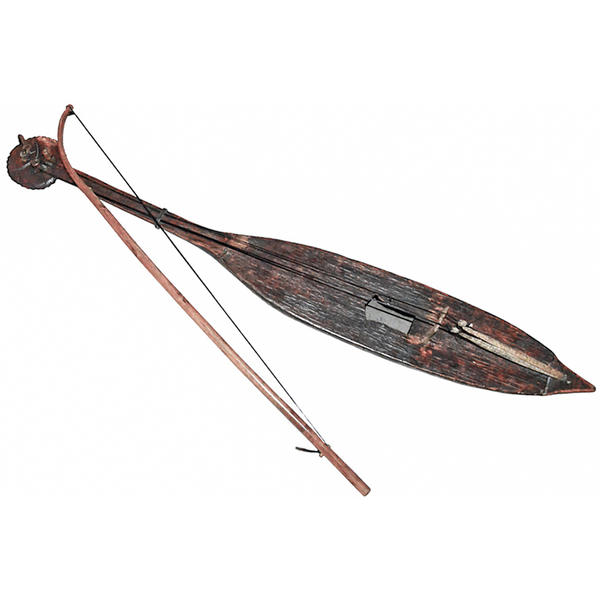
The shichepshin is an ancient stringed instrument, one of the most popular and common in Adygea. It was played with a bow which was passed over the strings made from horse-hair. For that reason, the shichepshin is often called the Circassian violin.
The traditional shichepshins had the shape of a boat or a dagger, with a convex bottom and two or three strings. Its body was made from hard wood (ash-tree, maple, pear, or nutwood). The upper soundboard of the instrument was traditionally made from fir or silver-fir wood lath, and later, from plywood. At the center of the upper soundboard, a sound hole was made. It could be of different shapes: round, diamond or even fancy-shaped. Sometimes, additional holes were made at the top and at the bottom of the instrument.
The shichepshin was usually tuned to fifths, sometimes to fourths. Its range was about two octaves, and the tune was mostly played on the string with a higher pitch. The instrument was held vertically, with the lower part leaning against the knee. The bow never moved, it was the shichepshin itself that was turned towards it.
On the whole, the design of the instrument was quite simple. To make it, one needed ordinary carpenter tools that almost any Adygei man had, so not only a good carpenter, but the musician himself was able to make it.
A person who could play the shichepshin usually became a singer storyteller. No major festivity could be held without the Circassian violin. Music also inspired Adygei warriors to heroic deeds.
Circassians often played the shichepshin at the bed of severely ill people because they thought that music had the power of healing. In the Adygei folklore, there are many stories about how even the dead were brought back to life by the sound of that musical instrument.
Circassians believed that the shichepshin could predict bad weather. This belief has a scientific description: due to the high humidity of the air, the Circassian violin sounded worse.
Shichepshins can be found in Adygea even today. There are still some artisans that keep and transmit the secrets of creation of the musical instrument, as well as musicians that still play it.
The traditional shichepshins had the shape of a boat or a dagger, with a convex bottom and two or three strings. Its body was made from hard wood (ash-tree, maple, pear, or nutwood). The upper soundboard of the instrument was traditionally made from fir or silver-fir wood lath, and later, from plywood. At the center of the upper soundboard, a sound hole was made. It could be of different shapes: round, diamond or even fancy-shaped. Sometimes, additional holes were made at the top and at the bottom of the instrument.
The shichepshin was usually tuned to fifths, sometimes to fourths. Its range was about two octaves, and the tune was mostly played on the string with a higher pitch. The instrument was held vertically, with the lower part leaning against the knee. The bow never moved, it was the shichepshin itself that was turned towards it.
On the whole, the design of the instrument was quite simple. To make it, one needed ordinary carpenter tools that almost any Adygei man had, so not only a good carpenter, but the musician himself was able to make it.
A person who could play the shichepshin usually became a singer storyteller. No major festivity could be held without the Circassian violin. Music also inspired Adygei warriors to heroic deeds.
Circassians often played the shichepshin at the bed of severely ill people because they thought that music had the power of healing. In the Adygei folklore, there are many stories about how even the dead were brought back to life by the sound of that musical instrument.
Circassians believed that the shichepshin could predict bad weather. This belief has a scientific description: due to the high humidity of the air, the Circassian violin sounded worse.
Shichepshins can be found in Adygea even today. There are still some artisans that keep and transmit the secrets of creation of the musical instrument, as well as musicians that still play it.
#36
Labyrinth Game (G’und-g’und-q’al)
#10

#15
The bench for playing the Labyrinth (G’und-g’und-q’al) game is one of the most precious and interesting pieces in the National Museum of Adyghe Republic. Only one bench of this type has survived until now.
This game was designed for developing strategic thinking. Its rules were simple: two adversaries sat at each side of the bench. One of them attacked, and the other had to defend his fortress, the game space. The fans watched the battle standing around the bench. Both players held special sticks with a cone-shaped end like that of a pointer. Inside the playing field, one stick moved towards the other, and if the chief of defense met the enemy on his way, the attack on the fortress was considered to be repelled. But if the invader reached the center of the field without clashing with the adversary, it meant that he managed to capture the fortress.
Various military games were an integral part of almost all Adyghe traditional festivities, even weddings or funeral banquets. Not only did those games allow young men to show their talents, but also helped them to practice many of the tactical maneuvers used during military operations.
The authors of works dedicated to the Adyghe way of life and culture pointed out that the amusements of those people, even the dances, had a military character to them.
This game was designed for developing strategic thinking. Its rules were simple: two adversaries sat at each side of the bench. One of them attacked, and the other had to defend his fortress, the game space. The fans watched the battle standing around the bench. Both players held special sticks with a cone-shaped end like that of a pointer. Inside the playing field, one stick moved towards the other, and if the chief of defense met the enemy on his way, the attack on the fortress was considered to be repelled. But if the invader reached the center of the field without clashing with the adversary, it meant that he managed to capture the fortress.
Various military games were an integral part of almost all Adyghe traditional festivities, even weddings or funeral banquets. Not only did those games allow young men to show their talents, but also helped them to practice many of the tactical maneuvers used during military operations.
The authors of works dedicated to the Adyghe way of life and culture pointed out that the amusements of those people, even the dances, had a military character to them.
#16
Adil-Girey Keshev, a famous Adyghe writer of the middle of the 19th century, noted:
“Circassian dances, danced in the open air, accompanied by salvo fire, with crowds of armed horsemen around, with swords and pistols on dancing men, looked like loud celebrations of victory in a military camp than like normal peaceful entertainment”.
#17
According to many written mentions of the Adyghes, they were courageous and skillful warriors. This people’s courage was stressed by all the travelers who had visited Circassia.
#18
For instance, French researcher Jean-Victor Edouard Taitbout de Marigny wrote:
‘Nothing and no one can subdue Circassians’ great love for independency and belligerency. Since early age, they are accustomed to severe discipline of the body, to using weapons and riding horses. They know no other fame than victory over the enemy, and no other disgrace than surrender to the adversary’.
#37
Hand-rattles
#19

#21
The hand-rattles - pkhachich [пхъэкIыч] - is the oldest, the most popular and favourite percussion instrument of the Adyghes, which in old times was indispensable at any festivity. The name is derived from the word пхъэ meaning ‘wood’ from which hand-rattles were made, and кIыч, imitation of the sound produced by dry wooden planks if struck together.
#22
The pkhachich consisted of dried resonant planks 10-17 centimetres long and и 5-10 centimetres wide. The hand-rattles could have three to seven such planks which were tied to the handle with a thin but strong strap. The instrument with the handle was up to 30-35 centimetres long.
#23
The musician held the hand-rattles by the handle while pulling the rope with planks strung on it onto his wrist. It enabled him to control the planks - fitting them together tighter or looser - thus changing the strength and rhythm of the sound produced.
#24
When the instrument was shaken, it rattled loudly and the sound was similar to the clatter of hooves. From time immemorial, the Adyghes used to say: We spend the whole life on horseback; we compose songs when riding a horse. The clatter of the horse’s hooves is the sound of our hearts.
Hand-rattles beat the rhythm of traditional songs and dances. Typically, the pkhachich sounded together with the kamyl (end-blown flute), the shichepshin (Adyghe violin) or the pshiney (accordion).
In the past, the phachich was made from softwood species such as alder or cedar. However, modern instruments usually deaden the sound of such rattles, that is why at present harder wood- ashwood, boxwood, and chestnut – is used for the pkhachich to sound louder and more resonant.
Hand-rattles beat the rhythm of traditional songs and dances. Typically, the pkhachich sounded together with the kamyl (end-blown flute), the shichepshin (Adyghe violin) or the pshiney (accordion).
In the past, the phachich was made from softwood species such as alder or cedar. However, modern instruments usually deaden the sound of such rattles, that is why at present harder wood- ashwood, boxwood, and chestnut – is used for the pkhachich to sound louder and more resonant.
#25
Like other musical instruments, hand-rattles were often decorated. Typically, they had carved traditional ornaments or geometrical figures. In this way, the Adyghes accentuated the bonds of the musical instruments with the world of plants as well as the bonds between music itself and fertility and abundance.
#26
The legend about the origin of the pkhachich is described in the Adyghe Nart epos. According to the lore, the instrument was invented by a Nart named Ashchamez. He tooled a few small planks made of plane wood, put them together and tied the edges on one side. The ancient hero thought that the sounds of the pkhachich complement the melodies of the Adyghe flute.
#38
Shashka in scabbard. Seshkho
#27

#29
Adyghe shashkas appeared relatively recently — in the 18th century. The name of this variety of sabre comes from the word ‘seshkho’ which in the Adyghe language meant a long knife.
#30
The interpreter and diplomat, a participant in the Caucasian War, Fyodor Tornau described the Adyghe sabre in the book Memoirs of a Caucasian Officer as follows:
‘This last, beloved and most terrible Circassian weapon consists of a sabre band, in a wooden, Morocco leather scabbard, with a handle without protection for the hand. The Circassian shashka is razor- sharp, and is used only for a blow, and not for protection; blows made with a shashka are for the most part fatal’.
#31
The Circassians themselves liked to say that ‘a shashka should be as light as a feather, as elastic as a vine, as sharp as a razor. He who carries a heavy shashka does not rely on skill’.
The length of the curved shashka blade ranged from 72 to 76 centimetres. Its handle was made lightweight, and the centre of gravity was shifted closer to the tip. The main force of the blow fell precisely on this part of the blade.
The length of the curved shashka blade ranged from 72 to 76 centimetres. Its handle was made lightweight, and the centre of gravity was shifted closer to the tip. The main force of the blow fell precisely on this part of the blade.
#32
The shashka hilt did not have a cross-guard — a bar which in other varieties of cold weapons protected the fencer’s hand. The handle consisted of two flat halves, which were attached to the blade tang with rivets. They made it from horns or wood, often decorated with carved patterns. The shape of the bent pommel resembled a bird’s beak.
#33
The Adyghes carries shashkas in a wooden scabbard that was covered with leather and decorated with carved metal on-lays. The weapon in them did not become blunt over time, and also did not rattle during movement, thanks to which soldiers could move almost silently, unnoticed by opponents. In addition, such a scabbard reliably protected the blade from moisture, so it did not rust and remained operational for a long time.
To the shashka scabbard they attached sword-belt rings, which made it possible to carry weapons on a sling. Usually they were placed on the convex side. The Adyghes carried cold weapons with the cutting edge up and not down, as was customary among other peoples. To get, for example, a sabre or broadsword out of their scabbard one had to draw his hand with a blade to the right. Thus, the fencer lost a few fractions of a second, in which the enemy could strike. The Adyghes, however, removed the sabre from the scabbard right in front of them and could instantly engage in battle.
To the shashka scabbard they attached sword-belt rings, which made it possible to carry weapons on a sling. Usually they were placed on the convex side. The Adyghes carried cold weapons with the cutting edge up and not down, as was customary among other peoples. To get, for example, a sabre or broadsword out of their scabbard one had to draw his hand with a blade to the right. Thus, the fencer lost a few fractions of a second, in which the enemy could strike. The Adyghes, however, removed the sabre from the scabbard right in front of them and could instantly engage in battle.
read morehide
00:00
00:00
1x
Musical instrument, Game, Hand-rattles & Shashka
Exhibition
7
 Point your smartphone camera to open in the app
Open in app
Share