Font
Color
Graphics
Изображение точки

To see AR mode in action:

1. Install ARTEFACT app for iOS or Android;

2. Find the exhibition «Culture and Way of Life of the Adyghes»

3. Push the «Augmented reality» button and point your phone's camera at the exhibit;

Скрыть точки интересаПоказать точки интереса
Показать в высоком качестве

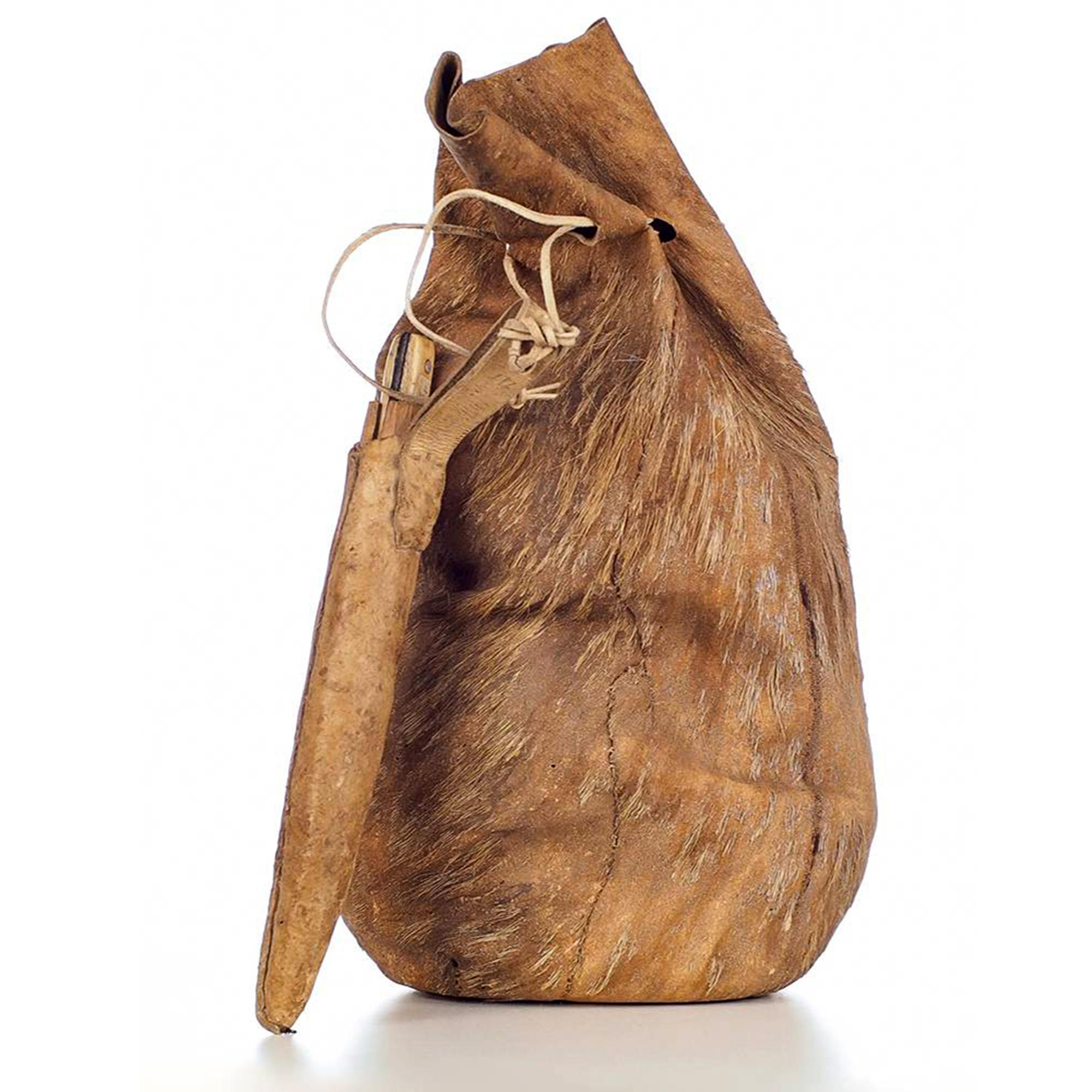
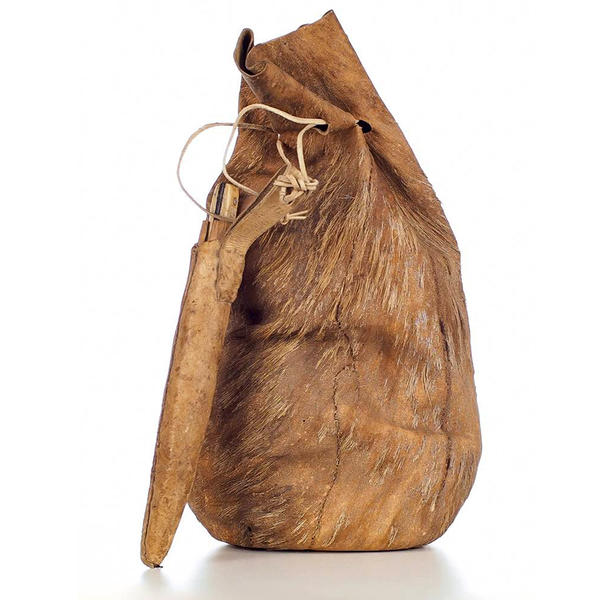
Leather Bag with a Knife

Creation period
Late 19th century
Technique
leather, bone, wood, metal
6
Open in app
#1
Кожаный мешок с ножом
#4
A leather bag with a knife (in the Adygeyan language, ‘Sh’o dzyo sh’zh’ye ig’useu’) used to be an obligatory component of the hunting gear of every hunter. Such bags were usually made from durable bull hides and used to carry everything needed to kindle a fire: flint and tinderbox (an iron bar with lip-type flanges), tinder ignited by sparks, as well as small bullets, powder flasks, and other small items. Some food stock - usually bread and dry spices - was also put into the bag before going out on the hunting trip. In the forest, the bag was used to carry home small game. 

Hunting was a major occupation of the Adyg people. For instance, in the late 18th century, about 200,000 wolf and fox hides, 5,000 marten and 3,000 bear hides were shipped from Cirkassia to sale markets.

#5
The pagan god Mezytkh was considered a divine patron of forests and hunters. He was traditionally depicted with silver-coated horns and mounted on a boar. In his research, Khan Giray, Adygeyan folklore expert said that
‘the god was usually depicted mounted on a golden-hair hog, and by his power deer gathered in meadows, and some maidens milked them there’.
#6
А Soviet ethnographer, Leonid Lavrov pointed out that
‘the horns of the god of the hunt, just like the golden-hair hog carrying the god on its back in another instance, indicate that deification of the beast itself predated the belief in Mezytkh because the hunter’s wellbeing depended upon the beast’.
#7
In order to appease the powerful Mezytkh, the hunters made him generous sacrifices and followed special rules when in the forest. If a group went hunting, the take was shared equally among all its members, and the head of the animal killed would invariably be left under a holy tree as a gift to god. Animal entrails were eaten on the spot, and the hide belonged to the hunter by whose hand the animal was killed. 

The Adygs believed that animals hear and understand human speech. Hence, they used a special language named “shekluabze” in order to keep their intentions secret from the animals. “Shekluabze” was an attribute of many male associations, including those of hunters and horse riders. 

The hunting technique was either chasing the animal down or ambushing. Snares, nets, iron and wooden traps would be set in the forest. Indications could be found in the local folklore that the Adyg hunters were assisted by dogs and hawks. In the 19th century the hunters started to use firearms, specifically, hunting rifles.
read morehide
00:00
00:00
1x

Leather Bag with a Knife

Creation period
Late 19th century
Technique
leather, bone, wood, metal
6
Point your smartphone camera to open in the app
Share
VkontakteOdnoklassnikiTelegram
Share on my website
Copy linkCopied
Copy
Open in app
To see AR mode in action:
  1. Install ARTEFACT app for 
  2. iOS or Android;
  3. Find and download the «Paintings in Details» exhibition
  4. Push the «Augmented reality» button and point your phone's camera at the painting;
  5. Watch what happens on your phone screen whilst you flip through the pictures.
 
We use Cookies
Cookies on the Artefact Website. We use cookies to ensure that we give you the best experience on our website. If you continue without changing your settings, we'll assume that you are happy to receive all cookies on the Artefact website. However, if you would like to, you can change your cookie settings at any time.
Learn more about useHide
Content is available only in Russian

X

Нашли опечатку?...

%title%%type%