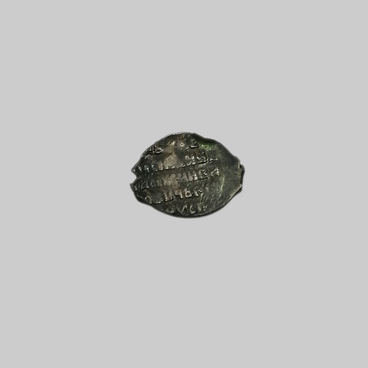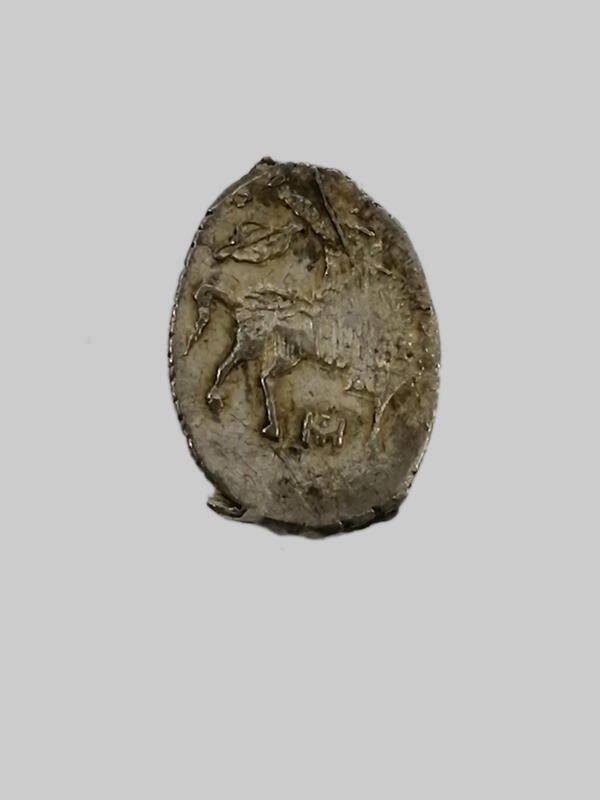
The Karasuksky Regional Museum’s collection includes a solid silver kopek, weighing 0.68 grams. It is oval-shaped, made from 950 silver. A rider in a royal mantle, with a flowing greatcoat and a downward facing spear is depicted on the coin’s obverse. The letters under the horse are ‘o/M’, signifying that the coin was minted at the Moscow Mint. The inscription on the coin’s reverse is five lines, with the name and title of the ruler: ‘Tsar and Grand Prince of all Rus’ Boris Feodorovich’.
Due to the scuffs on the reverse, part of the text has been worn away, but it is still possible to determine the year of issuance from Alla Melnikova’s catalogue. This is a coin issued in 1600, making it relatively rare. The obverse side was stamped by stamp No. 1, whilst stamp No. 2 was used on the reverse, according to Kleschinov and Grishin’s ‘Catalogue of Russian Medieval Coins.’
Kopeks with Boris Godunov’s name were only produced for a little over seven years, but these were the coins minted the most during the existence of the three ruble coin to silver ratio. This ratio meant that a 200 gram ingot of silver would be turned into 300 kopeks. After Ivan the Terrible’s coins, Godunov’s coins take second place in terms of how many of the coins have been found buried, most likely before 1613.
There are four stages to the story of Godunov’s coins. The first step starts after the death of Feodor Ivanovich on 7 January 1598, and ends with Boris Godunov’s coronation at the Assumption Cathedral, Moscow, at the beginning of September 1598. During this period, the old stamps were used to mint new kopeks, with the name of the last ruler of the Rurik dynasty - Feodor Ivanovich. The second stage is only four to five months long, from September 1598 until January 1599.
The third and most important stage, takes place between 1599 and 1603. This period represents the heyday of minting under Boris Godunov. Since 1599 onwards, mass-production of coins with the name of the Tsar and Grand Duke of all Rus’ Boris Feodorovich took place in all three of the country’s mints - in Moscow, Novgorod and Pskov. Boris Godunov’s coins are still the only reliable source which can give an objective representation of the organization of fiscal affairs at the turn of the 16th and 17th century.
The fourth stage starts in 1604 and lasted until April 1605. During this period, there were plans to improve the Russian monetary system by issuing a standardized kopek at all three of the country’s mints. They planned to also shut the mints in Novgorod and Pskov. The tragic events during the Time of Troubles, including the death of Boris Godunov, the murder of his son Feodor and the Polish- Swedish intervention, put an end to these reforms.
Due to the scuffs on the reverse, part of the text has been worn away, but it is still possible to determine the year of issuance from Alla Melnikova’s catalogue. This is a coin issued in 1600, making it relatively rare. The obverse side was stamped by stamp No. 1, whilst stamp No. 2 was used on the reverse, according to Kleschinov and Grishin’s ‘Catalogue of Russian Medieval Coins.’
Kopeks with Boris Godunov’s name were only produced for a little over seven years, but these were the coins minted the most during the existence of the three ruble coin to silver ratio. This ratio meant that a 200 gram ingot of silver would be turned into 300 kopeks. After Ivan the Terrible’s coins, Godunov’s coins take second place in terms of how many of the coins have been found buried, most likely before 1613.
There are four stages to the story of Godunov’s coins. The first step starts after the death of Feodor Ivanovich on 7 January 1598, and ends with Boris Godunov’s coronation at the Assumption Cathedral, Moscow, at the beginning of September 1598. During this period, the old stamps were used to mint new kopeks, with the name of the last ruler of the Rurik dynasty - Feodor Ivanovich. The second stage is only four to five months long, from September 1598 until January 1599.
The third and most important stage, takes place between 1599 and 1603. This period represents the heyday of minting under Boris Godunov. Since 1599 onwards, mass-production of coins with the name of the Tsar and Grand Duke of all Rus’ Boris Feodorovich took place in all three of the country’s mints - in Moscow, Novgorod and Pskov. Boris Godunov’s coins are still the only reliable source which can give an objective representation of the organization of fiscal affairs at the turn of the 16th and 17th century.
The fourth stage starts in 1604 and lasted until April 1605. During this period, there were plans to improve the Russian monetary system by issuing a standardized kopek at all three of the country’s mints. They planned to also shut the mints in Novgorod and Pskov. The tragic events during the Time of Troubles, including the death of Boris Godunov, the murder of his son Feodor and the Polish- Swedish intervention, put an end to these reforms.