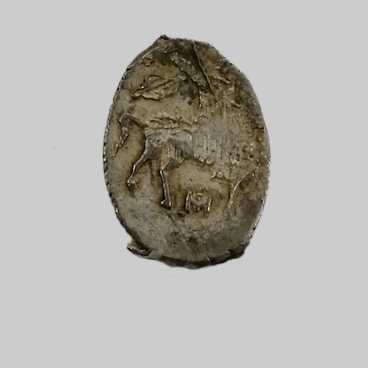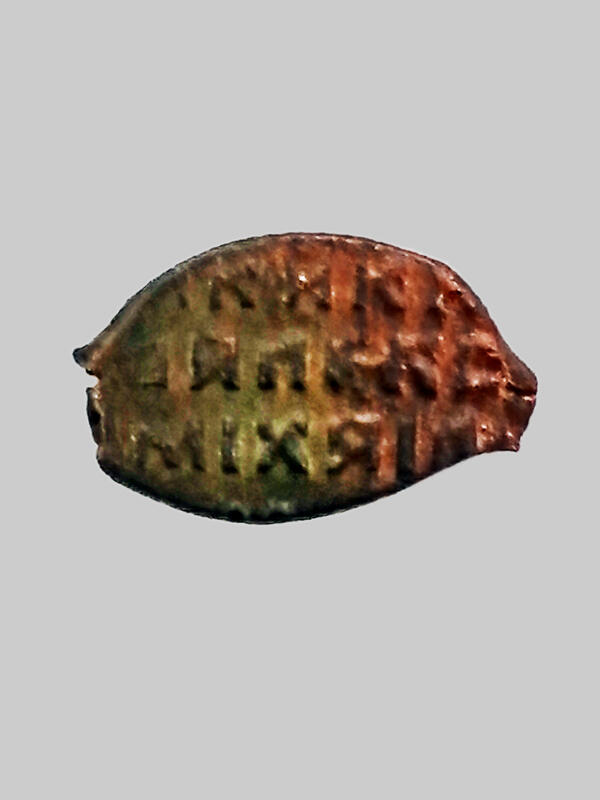
The numismatic collection of the Karasuksky Regional Museum includes an oval-shaped solid coin, with a face value of a kopek. It weighs 0.47 grams and is minted from a base metal - copper. An image of a horse’s head and parts of its harness is visible on the coin’s obverse, whilst a three-line (rather than five-line) inscription lies on the coin’s reverse, formed of the name and title of the ruler: ‘Tsar Alexey Mikhailovich’. The five-line version would read: ‘Tsar and Grand Prince of all Rus’ Alexey Mikhailovich’.
There are three categories of kopeks minted under Alexey Mikhailovich. The first category are the early kopeks, which were minted from his coronation onwards. The first category includes all coins minted between 1645 and 1650. The early kopeks stick out for the very low relief, and this explains the poor condition of the majority of those coins - they were worn down with use.
The second category includes the kopeks minted between 1650 and 1655, before the monetary reforms enacted in 1654. These kopeks look different to the first category. The schematic image of the rider is replaced by a detailed drawing of his face and clothes. The inscriptions are more and more individual, making it far easier to differentiate between each coin.
To help domestic trade, in the autumn of 1655, the government decided to start issuing copper wire kopeks, but their design, coin to metal ratio and minting process was completely identical to the silver kopeks. These kopeks had a mandatory exchange rate, in other words, they were officially fixed to foreign currencies. Their circulation was restricted to the European part of Russia - they were not allowed to be used to trade with foreign merchants or in Siberia.
This restriction and the huge number of coins produced let to a depreciation of the new coins. By 1662, one silver kopek was equal in value to 15 copper kopeks. The depreciation of copper coins upset the monetary circulation in the country: prices started to rise and a famine began. Soon after the Copper Riot in Moscow, copper coins ceased to be minted, copper coin mints were shut down and silver kopeks continued to be minted at the Old Moscow Mint.
The third category of kopeks are those that were issued after the official completion of production. Their design and inscription are raised higher above the surface of the coin. Coins in the third category were minted between 1663 and 1676.
As a result of only the horse’s head being visible, it is possible to determine which stamp was used on the museum’s exhibit. Only three-lines of text, instead of the usual five, are visible on the reverse, but they are very similar to the reverse stamp No. 15, according to Grishin and Kleschinov’s ‘Catalogue of Russian Medieval Stamps 1533-1717’. The obverse side of these coins was embossed by stamps No. 4, 5, 6. Stamp No. 6 has the same head position as the museum’s coin, with the ears flattened. Generally, the drawing is very similar. This would mean that it is possible to say that the museum’s coin was produced at the Old Moscow Mint and would have been part of the first issuance of copper coins during the 1655 to 1663 reforms, perhaps being issued in 1655. The coins produced at the Old Mint mimic the design of the silver kopeks.
There are three categories of kopeks minted under Alexey Mikhailovich. The first category are the early kopeks, which were minted from his coronation onwards. The first category includes all coins minted between 1645 and 1650. The early kopeks stick out for the very low relief, and this explains the poor condition of the majority of those coins - they were worn down with use.
The second category includes the kopeks minted between 1650 and 1655, before the monetary reforms enacted in 1654. These kopeks look different to the first category. The schematic image of the rider is replaced by a detailed drawing of his face and clothes. The inscriptions are more and more individual, making it far easier to differentiate between each coin.
To help domestic trade, in the autumn of 1655, the government decided to start issuing copper wire kopeks, but their design, coin to metal ratio and minting process was completely identical to the silver kopeks. These kopeks had a mandatory exchange rate, in other words, they were officially fixed to foreign currencies. Their circulation was restricted to the European part of Russia - they were not allowed to be used to trade with foreign merchants or in Siberia.
This restriction and the huge number of coins produced let to a depreciation of the new coins. By 1662, one silver kopek was equal in value to 15 copper kopeks. The depreciation of copper coins upset the monetary circulation in the country: prices started to rise and a famine began. Soon after the Copper Riot in Moscow, copper coins ceased to be minted, copper coin mints were shut down and silver kopeks continued to be minted at the Old Moscow Mint.
The third category of kopeks are those that were issued after the official completion of production. Their design and inscription are raised higher above the surface of the coin. Coins in the third category were minted between 1663 and 1676.
As a result of only the horse’s head being visible, it is possible to determine which stamp was used on the museum’s exhibit. Only three-lines of text, instead of the usual five, are visible on the reverse, but they are very similar to the reverse stamp No. 15, according to Grishin and Kleschinov’s ‘Catalogue of Russian Medieval Stamps 1533-1717’. The obverse side of these coins was embossed by stamps No. 4, 5, 6. Stamp No. 6 has the same head position as the museum’s coin, with the ears flattened. Generally, the drawing is very similar. This would mean that it is possible to say that the museum’s coin was produced at the Old Moscow Mint and would have been part of the first issuance of copper coins during the 1655 to 1663 reforms, perhaps being issued in 1655. The coins produced at the Old Mint mimic the design of the silver kopeks.