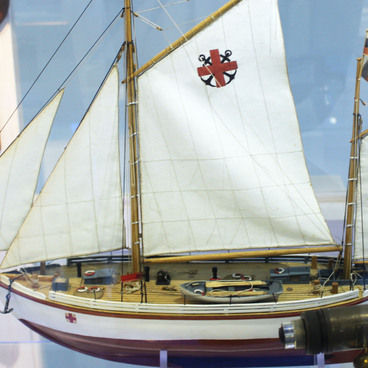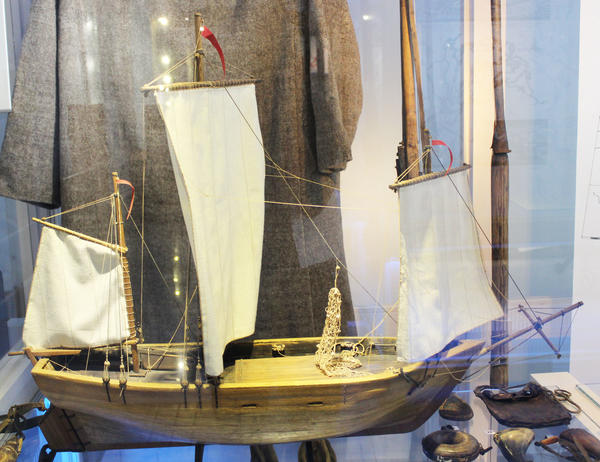
Galley boats with two or three masts used by Pomors in the 11th — 19th centuries was called ranshinas. These boats were irreplaceable for fishing in polar waters difficult for navigation. The name comes from Russian ‘ranshe’ (earlier), because on ranshina, fishermen put out to sea in early spring long before they began to operate other water craft.
The ranshina had the same dimensions as those of koch. The difference was found in the specifics of her hull. Possible cargo carrying capacity of the boat ranged from 25 to 74 tons and depended on her size. The draft remained light, up to 1.3 meters. Stems were notably angled outside, fore stem in particular. In cross-section, the boat hull narrowed down closer to keel.
In the process of construction, Pomors used pine and fir, twisted trunks of young trees, moss, tar and oakum. No or minimum of metal was practically used.
The building of ranshina started with the formation of her hull according to moulds prepared in advance, and holding the hull together with ropes or vitsas. For rigidity, kokoras were inserted (kokoras – lower part of pine or fir with root). Outer plated planking was stitched with vitsas, and there was no inner planking made at all.
Timber selected for deck planking was short, halfway the boat breadth. One end of it was placed on upruga (support) and fixed with vitsa or moot, and another one rested on a beam extending throughout the length of the boat from stem to stern.
Deck and planking seams of the boat were caulked with moss. More expensive oakum was used now and then. The hull was thoroughly tarred from both sides. Six-pood (1 pood = 40 pounds) drag-hook took on the role of anchor. It was tied to oakum rope up to 140 meter long. The drag-hook was pulled out manually.
More often than not, there were three masts with sails on ranshina. Some vessels had mainmast and short foremast only. Oars were used if needed. The vessel always towed a small rowboat with a crew of three. The service life of a thoroughly built ranshina was about 20 years.
The principle ranshina design dissimilarity from other vessels was a specific shape of submerged part of her hull. Being egg-shaped, it significantly reduced the risk of ranshina destruction in case of ice nip. The vessel trapped by ice was squeezed up on the ice and got afloat again when the ice dispersed.
There were sledges fixed to the ship bottom and making it possible to drag ranshina over the ice. They were also useful when the vessel made sail. In that case the sledges worked in concert with keel and reduced the kick (side-drift) caused by winds and currents. Fore and aft of the vessel were canted at the angle of about 30° and this made it easier to beach ranshina.
The ranshina had the same dimensions as those of koch. The difference was found in the specifics of her hull. Possible cargo carrying capacity of the boat ranged from 25 to 74 tons and depended on her size. The draft remained light, up to 1.3 meters. Stems were notably angled outside, fore stem in particular. In cross-section, the boat hull narrowed down closer to keel.
In the process of construction, Pomors used pine and fir, twisted trunks of young trees, moss, tar and oakum. No or minimum of metal was practically used.
The building of ranshina started with the formation of her hull according to moulds prepared in advance, and holding the hull together with ropes or vitsas. For rigidity, kokoras were inserted (kokoras – lower part of pine or fir with root). Outer plated planking was stitched with vitsas, and there was no inner planking made at all.
Timber selected for deck planking was short, halfway the boat breadth. One end of it was placed on upruga (support) and fixed with vitsa or moot, and another one rested on a beam extending throughout the length of the boat from stem to stern.
Deck and planking seams of the boat were caulked with moss. More expensive oakum was used now and then. The hull was thoroughly tarred from both sides. Six-pood (1 pood = 40 pounds) drag-hook took on the role of anchor. It was tied to oakum rope up to 140 meter long. The drag-hook was pulled out manually.
More often than not, there were three masts with sails on ranshina. Some vessels had mainmast and short foremast only. Oars were used if needed. The vessel always towed a small rowboat with a crew of three. The service life of a thoroughly built ranshina was about 20 years.
The principle ranshina design dissimilarity from other vessels was a specific shape of submerged part of her hull. Being egg-shaped, it significantly reduced the risk of ranshina destruction in case of ice nip. The vessel trapped by ice was squeezed up on the ice and got afloat again when the ice dispersed.
There were sledges fixed to the ship bottom and making it possible to drag ranshina over the ice. They were also useful when the vessel made sail. In that case the sledges worked in concert with keel and reduced the kick (side-drift) caused by winds and currents. Fore and aft of the vessel were canted at the angle of about 30° and this made it easier to beach ranshina.