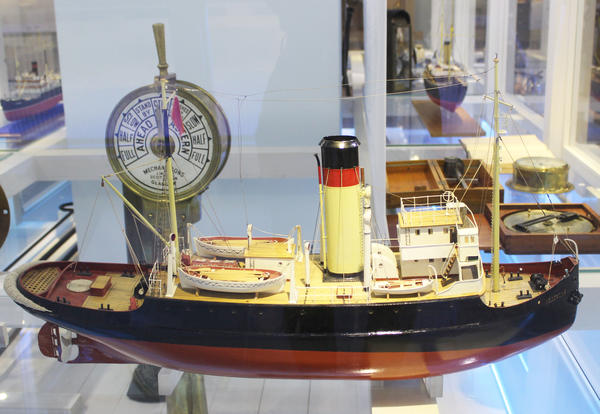
The model of one of so-called ‘numbered’ icebreakers was assembled by ship model maker Georgy Semakov in the 80s of the last century.
The history of these icebreakers began in 1914, when the Russian government purchased two small icebreakers: Milner in Norway and Horn in Canada for the Port of Arkhangelsk. To tell the truth, the name ‘Horn’ could be considered as adapted because at launching, the boat was christened ‘J. T. Horne’. She was built in Port Arthur in 1913 and initially registered with Fort William.
Being small by icebreaker standards, Horn performed the tasks assigned to her by the Port of Arkhangelsk so effectively that the Russian government took a decision to order a few more vessels of this type. It was a standard American tugboat used in cold seas and freezing lakes.
In 1915, the Ministry of Trade and Ports decided to build five icebreakers of Horn type for servicing ports. An attempt was made to place the order with American specialists but it turned out that shipbuilders in America were so loaded with work that they could build the vessels for Russia not earlier than 2 years later. That is why the icebreakers were ordered in Britain. The Ministry had neither experts nor time to develop drawings, therefore it was decided to use the Russian icebreaker Vladimir as a basis and reinforce her construction with advantageous specific features of Horn. Technical characteristics of the ordered icebreakers are shown in documents as follows: engine output 1300 indicated horsepower, breadth 9.1 meters, type Vladimir.
It was planned to receive the vessels in October 1916, and with the aim to accelerate the process of production, the order for 5 vessels was distributed among three companies: Ferguson Bros. and Murdoch & Murray in Glasgow, and Rennoldson & Co in Newcastle. As a consequence of such a distribution, distinctions between the vessels appeared, and their cost was different, too. All of them were ready in 8 months and cost the Ministry 3 million rubles.
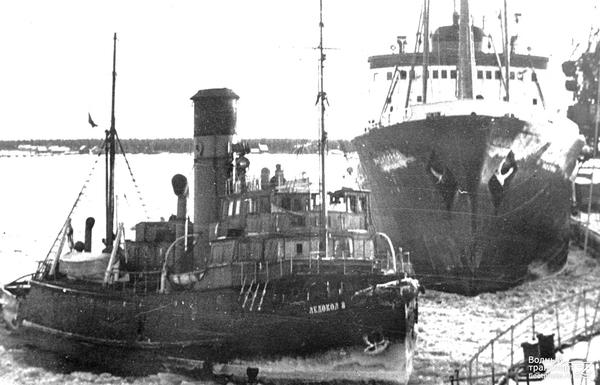
Right from the wharf of Ferguson Bros., Ledokol № 8 in a company of two cousins, Ledokols № 7 and № 9, arrived in the Port of Murmansk in the fall. All three vessels worked in the Kola Bay until spring in the capacity of tug and rescue boats.
Number ‘8’ appeared to be a lucky number, unlike Ledokol № 9 that sank with all her crew in the White Sea in 1932, and the icebreakers lost in Great Patriotic War: Ledokol № 5 that was blown up by a mine in the Dnieper estuary; Ledokol № 7 that impaled her upon a floating mine near Kerch. And Ledokol № 6 also stayed in service less than the ‘eighth’ did – she was used as a tug boat in the White Sea until the 50s of the last century and was cut for scrap then.
Ledokol № 8 was decommissioned in 1961 and was cut for scrap in 1962.
The history of these icebreakers began in 1914, when the Russian government purchased two small icebreakers: Milner in Norway and Horn in Canada for the Port of Arkhangelsk. To tell the truth, the name ‘Horn’ could be considered as adapted because at launching, the boat was christened ‘J. T. Horne’. She was built in Port Arthur in 1913 and initially registered with Fort William.
Being small by icebreaker standards, Horn performed the tasks assigned to her by the Port of Arkhangelsk so effectively that the Russian government took a decision to order a few more vessels of this type. It was a standard American tugboat used in cold seas and freezing lakes.
In 1915, the Ministry of Trade and Ports decided to build five icebreakers of Horn type for servicing ports. An attempt was made to place the order with American specialists but it turned out that shipbuilders in America were so loaded with work that they could build the vessels for Russia not earlier than 2 years later. That is why the icebreakers were ordered in Britain. The Ministry had neither experts nor time to develop drawings, therefore it was decided to use the Russian icebreaker Vladimir as a basis and reinforce her construction with advantageous specific features of Horn. Technical characteristics of the ordered icebreakers are shown in documents as follows: engine output 1300 indicated horsepower, breadth 9.1 meters, type Vladimir.
It was planned to receive the vessels in October 1916, and with the aim to accelerate the process of production, the order for 5 vessels was distributed among three companies: Ferguson Bros. and Murdoch & Murray in Glasgow, and Rennoldson & Co in Newcastle. As a consequence of such a distribution, distinctions between the vessels appeared, and their cost was different, too. All of them were ready in 8 months and cost the Ministry 3 million rubles.
Right from the wharf of Ferguson Bros., Ledokol № 8 in a company of two cousins, Ledokols № 7 and № 9, arrived in the Port of Murmansk in the fall. All three vessels worked in the Kola Bay until spring in the capacity of tug and rescue boats.
Number ‘8’ appeared to be a lucky number, unlike Ledokol № 9 that sank with all her crew in the White Sea in 1932, and the icebreakers lost in Great Patriotic War: Ledokol № 5 that was blown up by a mine in the Dnieper estuary; Ledokol № 7 that impaled her upon a floating mine near Kerch. And Ledokol № 6 also stayed in service less than the ‘eighth’ did – she was used as a tug boat in the White Sea until the 50s of the last century and was cut for scrap then.
Ledokol № 8 was decommissioned in 1961 and was cut for scrap in 1962.