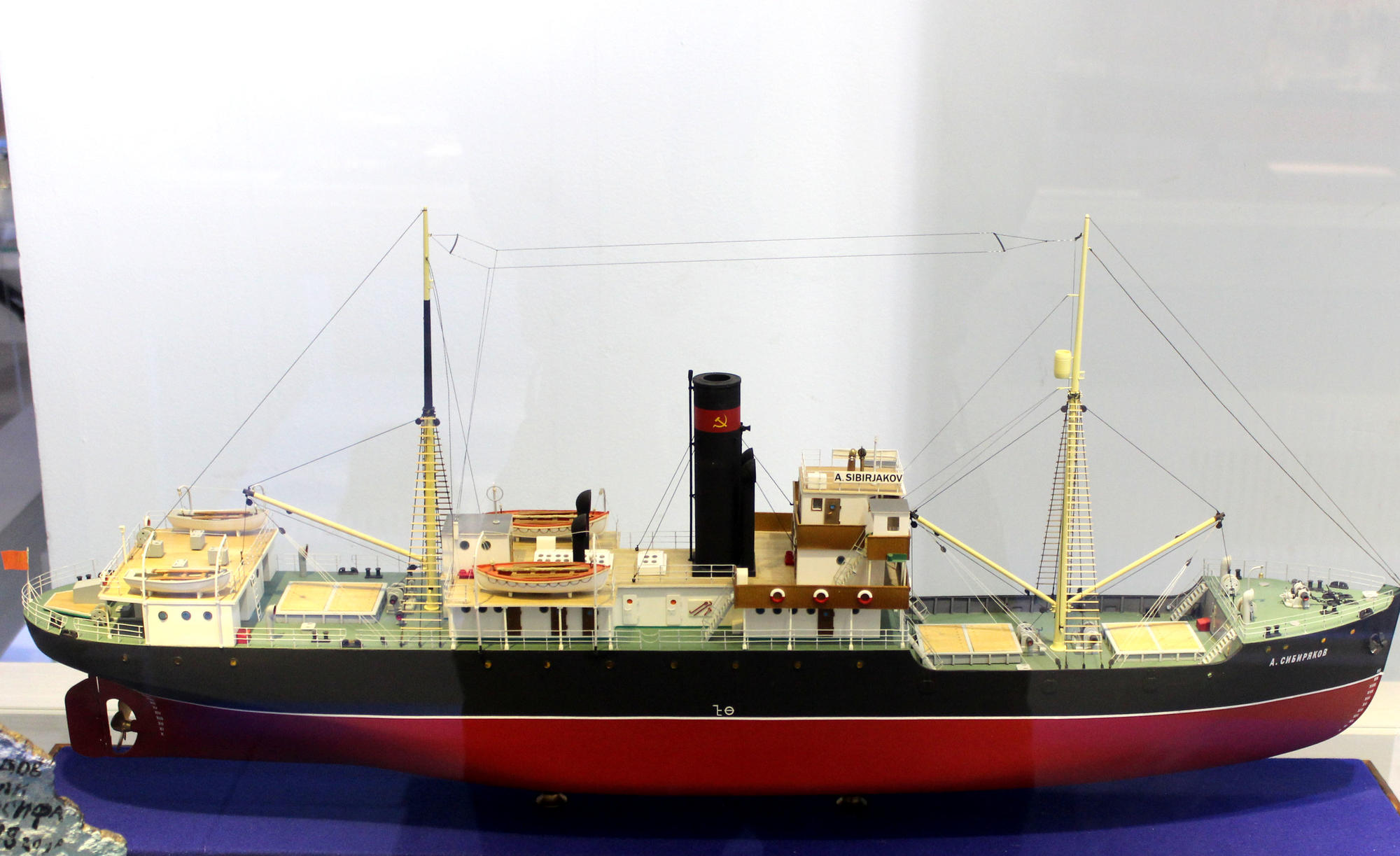


Ice-breaking Steamer Alexander Sibiryakov was the first ship that overpassed the full distance of Northern Sea Route in one season of navigation. The vessel was built in 1909 году on the order placed by Englishmen, christened Bellaventure initially, and used for offshore operations. The steamer also worked against the governmental orders in construction of port installations, and transported corpses of the steam ship Newfoundland deceased crew in 1914.
Five years after her launching, steam ship Bellaventure was purchased by the Russian Empire and renamed one year later into Alexander Sibiryakov after a famous entrepreneur and traveler Alexander Mikhailovich Sibiryakov. During World War One, the steamship was used for transportation of military cargoes, and in peacetime performed functions of harvesting and cargo ship in the water areas of northern seas.
In 1932, the vessel completed her legendary voyage along Northern Sea Route. The steamer was under the command of a captain of the Soviet icebreaking fleet Vladimir Ivanovich Voronin, and the expedition was headed by Otto Yulyevich Shmidt, a mathematician, geographer and astronomer. At the end of June the steamer sailed from the Arkhangelsk Sea Port, set a course for the islands of Severnaya Zemlya, and having rounded the archipelago, reached Chukchee Sea. A serious ship failure took place on the passage as a result of which the vessel went adrift, but thanks to the crew resourcefulness and courage she managed to reach Bering Strait where the ship was taken in tow and pulled up to the Kamchatka coast. For this voyage the vessel was awarded Order of the Red Banner of Labour, a high government decoration.
Four years later the steamship being out at Kara Sea suffered a breakdown and sustained heavy damages of her hull and engine. However, structural designers were able to repair the vessel and in 1939 Alexander Sibiryakov put to sea again.
After the attack of Hitler’s army against the Soviet Union the vessel was assigned to the White Sea Warship Flotilla. The ship was equipped with battle guns and her captain Anatoli Alexeyevich Kacharava obtained lieutenancy.
In August 1942, the ship was on a northern voyage with a view to replenishing the construction and provision supplies for the members of polar expeditions. In 24 hours after the commencement of this sea passage, Alexander Sibiryakov encountered German cruiser Admiral Scheer. That encounter became fatal for the Russian ship. After a brief dialogue between the two captains the unequal battle began and lasted for about forty minutes. The icebreaker was badly damaged, part of the crew was killed, and the rest of the seamen evacuated in two boats, one of which fell to the guns of the Germans. Those crewmembers who survived were captured and sent to concentration camps. 13 crewmembers of Alexander Sibiryakov outlived the captivity and were freed after the victory against fascists.
Attempts to find the wrecks of Alexander Sibiryakov were made way back in the Soviet period, but the vessel was located by a research expedition five years ago only. In August 2015 the explorers fixed to the ship hull a memorial tablet as a tribute to the deceased seamen.
Five years after her launching, steam ship Bellaventure was purchased by the Russian Empire and renamed one year later into Alexander Sibiryakov after a famous entrepreneur and traveler Alexander Mikhailovich Sibiryakov. During World War One, the steamship was used for transportation of military cargoes, and in peacetime performed functions of harvesting and cargo ship in the water areas of northern seas.
In 1932, the vessel completed her legendary voyage along Northern Sea Route. The steamer was under the command of a captain of the Soviet icebreaking fleet Vladimir Ivanovich Voronin, and the expedition was headed by Otto Yulyevich Shmidt, a mathematician, geographer and astronomer. At the end of June the steamer sailed from the Arkhangelsk Sea Port, set a course for the islands of Severnaya Zemlya, and having rounded the archipelago, reached Chukchee Sea. A serious ship failure took place on the passage as a result of which the vessel went adrift, but thanks to the crew resourcefulness and courage she managed to reach Bering Strait where the ship was taken in tow and pulled up to the Kamchatka coast. For this voyage the vessel was awarded Order of the Red Banner of Labour, a high government decoration.
Four years later the steamship being out at Kara Sea suffered a breakdown and sustained heavy damages of her hull and engine. However, structural designers were able to repair the vessel and in 1939 Alexander Sibiryakov put to sea again.
After the attack of Hitler’s army against the Soviet Union the vessel was assigned to the White Sea Warship Flotilla. The ship was equipped with battle guns and her captain Anatoli Alexeyevich Kacharava obtained lieutenancy.
In August 1942, the ship was on a northern voyage with a view to replenishing the construction and provision supplies for the members of polar expeditions. In 24 hours after the commencement of this sea passage, Alexander Sibiryakov encountered German cruiser Admiral Scheer. That encounter became fatal for the Russian ship. After a brief dialogue between the two captains the unequal battle began and lasted for about forty minutes. The icebreaker was badly damaged, part of the crew was killed, and the rest of the seamen evacuated in two boats, one of which fell to the guns of the Germans. Those crewmembers who survived were captured and sent to concentration camps. 13 crewmembers of Alexander Sibiryakov outlived the captivity and were freed after the victory against fascists.
Attempts to find the wrecks of Alexander Sibiryakov were made way back in the Soviet period, but the vessel was located by a research expedition five years ago only. In August 2015 the explorers fixed to the ship hull a memorial tablet as a tribute to the deceased seamen.


