

Perseus was a research ship initially built as a trapping schooner. She was ordered in 1916 by an Onega entrepreneur Yepimakh Vasilyevich Moguchiy (Petrov), the most baffling person among the businessmen of Arkhangelsk Province in the early XX century.
In the summer of 1918 nearly half of the steam motor vessel’s hull was built heightwise. In spite of the October Revolution and the Civil War outbreak, the hull had been prepared for heave off by June, 1919. But the celebration was scuttled. First the bottle of wine, traditionally smashed on the hull of “christened” ship, failed – it did not break, pure and simple. After that, the hand winch spike broke, the launching was stopped and the banquette abandoned.
The unlucky owner was never to take the steamer out for a spin. After the Bolshevik rule had been determinately established, Moguchiy intended to run Perseus to Norway but then disappeared without a trace and the uncared-for vessel just idled in wait for her fate.
Three years after, she was towed to Arkhangelsk for fitting-out and re-equipping for further use as a research ship. The work was headed by a shipwright V.F. Gostev, with active participation of Moscow State University Professor Ivan Illarionovich Mesyatsev, director of Floating Marine Research Institute (Plavmornin) and one of the Soviet oceanography founders. He learnt about Perseus by chance, urged that she should be handed over to Plavmornin, and was literally obsessed with the idea of putting the steamship in operations as early as possible.
The ship was equipped with trawl and electric winches, the scientists came into full possession of five laboratories, a library and a meteorological station. The Perseus hull, strengthened with an oak strake, enabled her to sail amidst ice, and her shallow draft made it possible to approach the coast safely. This experience of practically by-hand creation of an expedition vessel in a situation of shortage of funds and materials turned out a rare success.
On February 1, 1923 a blue flag featuring the Perseus Constellation and symbolizing the Northern Hemisphere, was hoisted to the gaff. The pattern was suggested by Vladimir Mikailovich Golitsyn, who participated in the first voyage and became a famous artist later.
On August 19, 1923 the vessel put to sea at last. She completed nearly 90 expeditions in northern offshore zones, was at the coast of Novaya Zemlia and Spitsbergen, and spent on the high seas 6 years altogether. Perseus took part in search of the Nobile polar expedition, carried out hydrological and fishery research.
During Great Patriotic War, Perseus was mobilized and re-equipped into a patrol ship. On July 10, 1941, while executing the order to take aboard the families of frontiersmen in the Eina Bay near the Rybachy Peninsula, she was sunk with strikes by the enemy bombers.
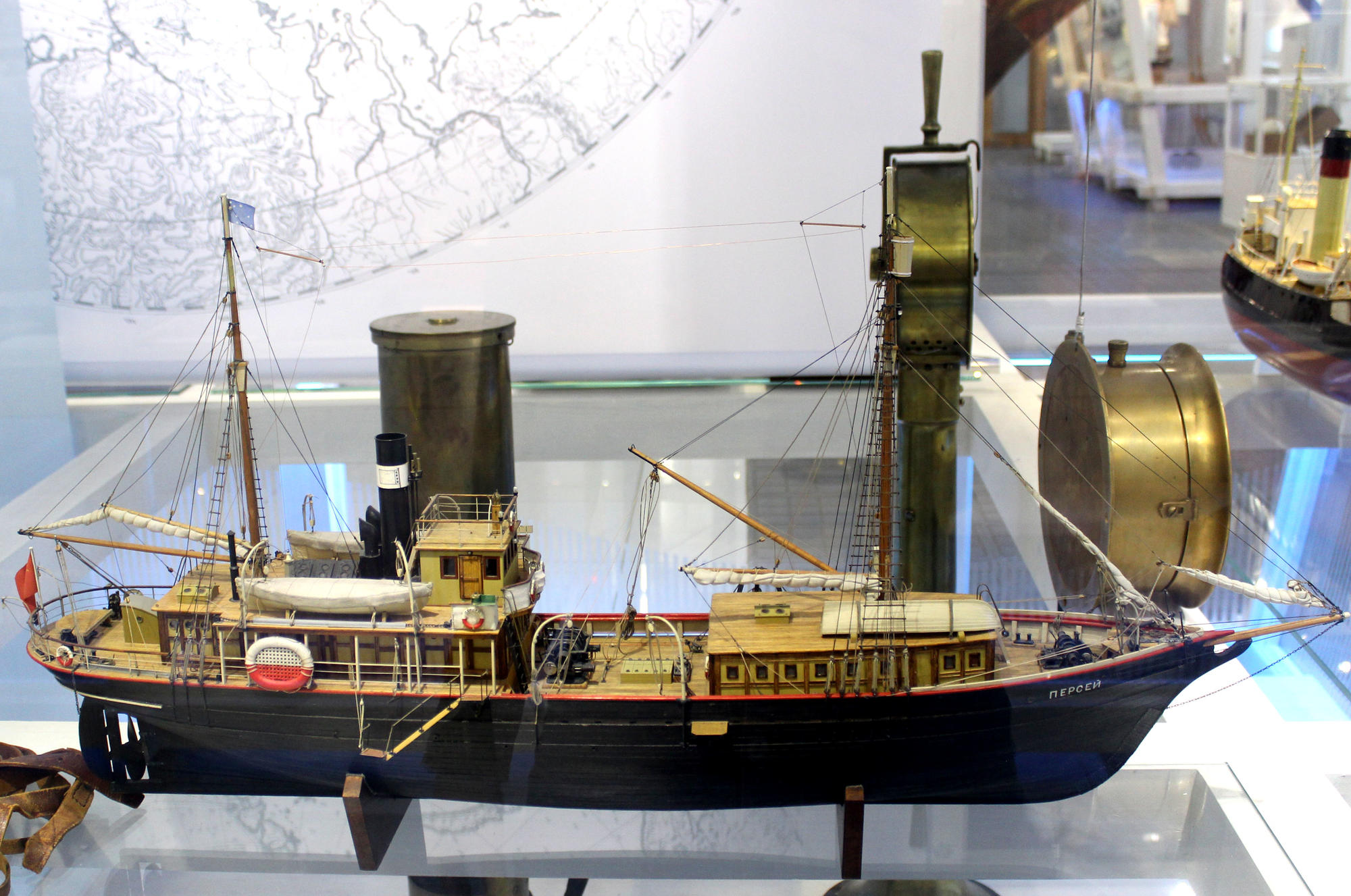
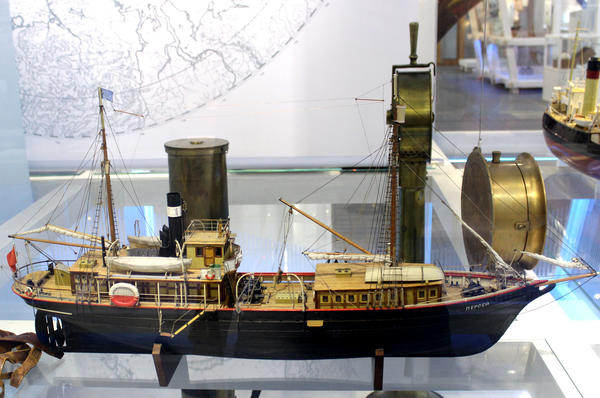
Model of the vessel on a scale of 1:50 was made by Valery Petrovich Dubensky, an outstanding classical style maker of ship models. Upon retirement he singlehandedly made nearly 20 miniature copies of famous ships, such as Poltava, Goto Predestinatsia Neva, Zarya, and, of course, Perseus.
In the summer of 1918 nearly half of the steam motor vessel’s hull was built heightwise. In spite of the October Revolution and the Civil War outbreak, the hull had been prepared for heave off by June, 1919. But the celebration was scuttled. First the bottle of wine, traditionally smashed on the hull of “christened” ship, failed – it did not break, pure and simple. After that, the hand winch spike broke, the launching was stopped and the banquette abandoned.
The unlucky owner was never to take the steamer out for a spin. After the Bolshevik rule had been determinately established, Moguchiy intended to run Perseus to Norway but then disappeared without a trace and the uncared-for vessel just idled in wait for her fate.
Three years after, she was towed to Arkhangelsk for fitting-out and re-equipping for further use as a research ship. The work was headed by a shipwright V.F. Gostev, with active participation of Moscow State University Professor Ivan Illarionovich Mesyatsev, director of Floating Marine Research Institute (Plavmornin) and one of the Soviet oceanography founders. He learnt about Perseus by chance, urged that she should be handed over to Plavmornin, and was literally obsessed with the idea of putting the steamship in operations as early as possible.
The ship was equipped with trawl and electric winches, the scientists came into full possession of five laboratories, a library and a meteorological station. The Perseus hull, strengthened with an oak strake, enabled her to sail amidst ice, and her shallow draft made it possible to approach the coast safely. This experience of practically by-hand creation of an expedition vessel in a situation of shortage of funds and materials turned out a rare success.
On February 1, 1923 a blue flag featuring the Perseus Constellation and symbolizing the Northern Hemisphere, was hoisted to the gaff. The pattern was suggested by Vladimir Mikailovich Golitsyn, who participated in the first voyage and became a famous artist later.
On August 19, 1923 the vessel put to sea at last. She completed nearly 90 expeditions in northern offshore zones, was at the coast of Novaya Zemlia and Spitsbergen, and spent on the high seas 6 years altogether. Perseus took part in search of the Nobile polar expedition, carried out hydrological and fishery research.
During Great Patriotic War, Perseus was mobilized and re-equipped into a patrol ship. On July 10, 1941, while executing the order to take aboard the families of frontiersmen in the Eina Bay near the Rybachy Peninsula, she was sunk with strikes by the enemy bombers.
Model of the vessel on a scale of 1:50 was made by Valery Petrovich Dubensky, an outstanding classical style maker of ship models. Upon retirement he singlehandedly made nearly 20 miniature copies of famous ships, such as Poltava, Goto Predestinatsia Neva, Zarya, and, of course, Perseus.