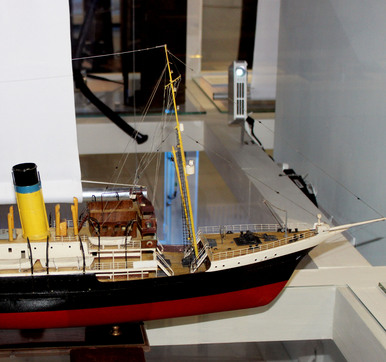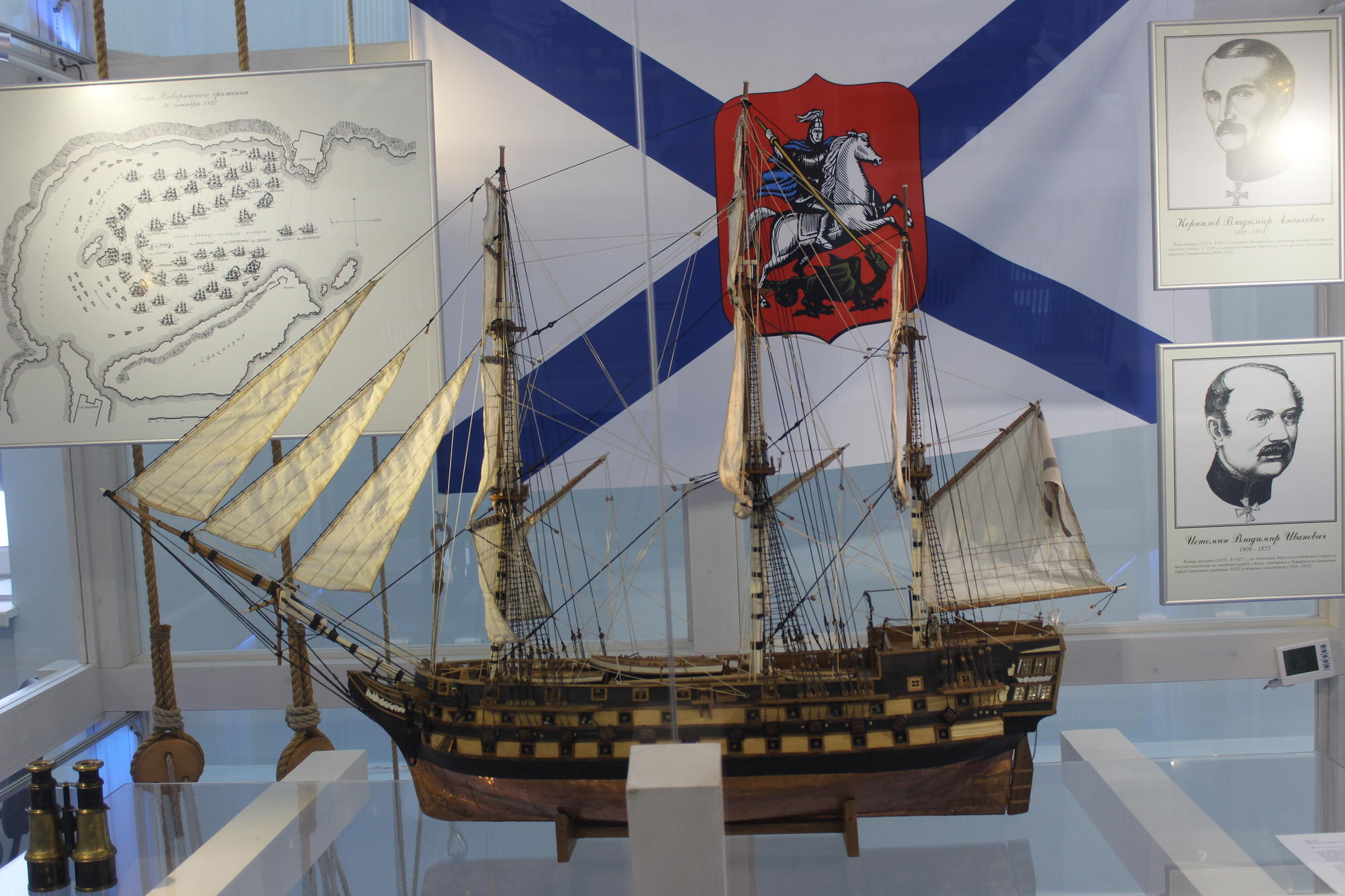


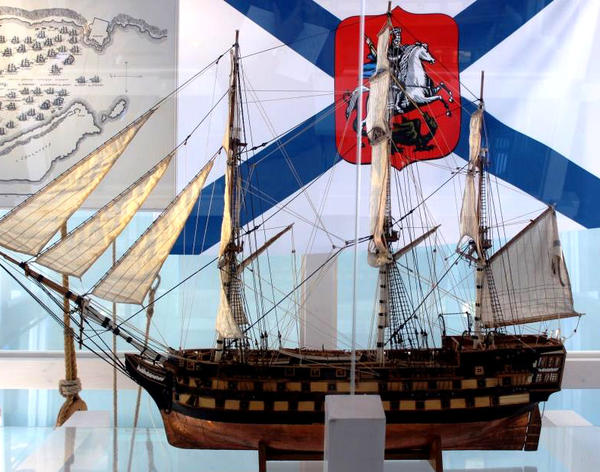
Model of sailboat Azov that was the first ship in the fleet history awarded the Saint George ensign is a reduced copy of one of the ships from the last series of large Russian sailboats. Its representatives stood out for good maneuverability, thought out to the last detail and comfortable lay out, strong and rugged hull.
The construction of the vessel started in the fall of 1825; the work was headed by famous at that time shipwright Andrey Kurochkin assisted by shipbuilder Vasily Yershov who rose into distinction later. The ship design was traditional for capital ships of those days: three masts, consisting of two parts bowsprit with martingale boom, fore-and-aft sails: staysails and jib, and 10 four-sided sails.
The ship was launched in May, 1826 already christened Azov after the victorious battles of Peter the Great with Turks in the Azov Sea. The ship was taken under command by vanquisher of Antarctic Mikhail Lazarev who participated to the extent possible in developing the ship design layout. Future great admirals served on board Azov: victor of Sinop Battle Pavel Nakhimov, hero of the Crimean War Vladimir Kornilov, hero of Defense of Sevastopol Vladimir Istomin.
Tatiana Matveyeva, the author of a monograph on rigging and appearance of Russian sailing ships, called her the most beautiful Russian sailboat. Carving on the hull, double-headed eagle on taffrail with arrows-lightnings and torch in his claws, three-meter tall warrior as a head figure, elaborate ornamental design on the aft end composed of military paraphernalia, garlands with bowknots between ports were not strategically important for a warship but made her recognizable and aesthetically attractive.
In addition to the victorious battle with Turkish-Egyptian fleet in the Bay of Navarino, there are other feats of Azov: participation in Russo-Turkish War of 1828-1829 and triumphant return to Kronshtadt through ice blockade in the Gulf of Finland.
According to the instructions, St. George (Georgiyevsky) Flag, the award by Tsar Nicolas, was handed over to the 86-gun ship Pamyat Azova (Commemoration of Azov) named so after the hero-sailboat. When in 1848 all equipment of Pamyat Azova was dismantled and she was turned into a customs warehouse, the flag was hoisted abaft a new ship with the same name but at that time armed with 74 guns. That ship took part in the Crimean War, transported cargoes from Kronshtadt later, and was decommissioned in 1863. The award flag 14×9.5 meters in size was donated to the Central Naval Museum and today it is kept there.
The construction of the vessel started in the fall of 1825; the work was headed by famous at that time shipwright Andrey Kurochkin assisted by shipbuilder Vasily Yershov who rose into distinction later. The ship design was traditional for capital ships of those days: three masts, consisting of two parts bowsprit with martingale boom, fore-and-aft sails: staysails and jib, and 10 four-sided sails.
The ship was launched in May, 1826 already christened Azov after the victorious battles of Peter the Great with Turks in the Azov Sea. The ship was taken under command by vanquisher of Antarctic Mikhail Lazarev who participated to the extent possible in developing the ship design layout. Future great admirals served on board Azov: victor of Sinop Battle Pavel Nakhimov, hero of the Crimean War Vladimir Kornilov, hero of Defense of Sevastopol Vladimir Istomin.
Tatiana Matveyeva, the author of a monograph on rigging and appearance of Russian sailing ships, called her the most beautiful Russian sailboat. Carving on the hull, double-headed eagle on taffrail with arrows-lightnings and torch in his claws, three-meter tall warrior as a head figure, elaborate ornamental design on the aft end composed of military paraphernalia, garlands with bowknots between ports were not strategically important for a warship but made her recognizable and aesthetically attractive.
In addition to the victorious battle with Turkish-Egyptian fleet in the Bay of Navarino, there are other feats of Azov: participation in Russo-Turkish War of 1828-1829 and triumphant return to Kronshtadt through ice blockade in the Gulf of Finland.
In the downside of participation and numerous victories in battles, there were long stays far from Russian naval bases, impossibility of quality repairs and as a result, a number of disablements which the crew had no way of eliminating. On the basis of expert opinion, it was decided to decommission and disassemble the heroic ship. She was disjointed in 1831.
According to the instructions, St. George (Georgiyevsky) Flag, the award by Tsar Nicolas, was handed over to the 86-gun ship Pamyat Azova (Commemoration of Azov) named so after the hero-sailboat. When in 1848 all equipment of Pamyat Azova was dismantled and she was turned into a customs warehouse, the flag was hoisted abaft a new ship with the same name but at that time armed with 74 guns. That ship took part in the Crimean War, transported cargoes from Kronshtadt later, and was decommissioned in 1863. The award flag 14×9.5 meters in size was donated to the Central Naval Museum and today it is kept there.