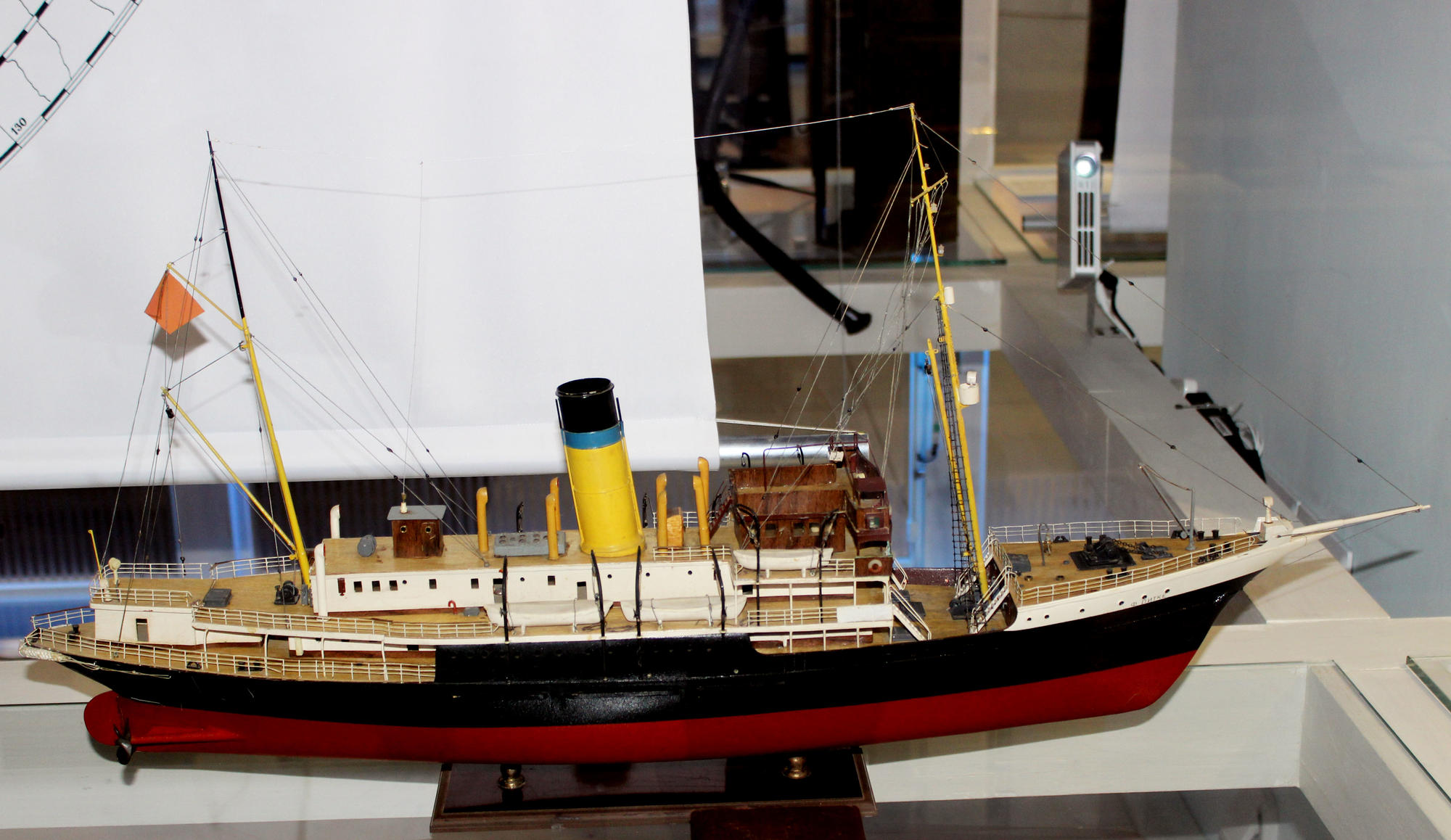


The model of the vessel exhibited in the museum case was assembled by an experienced ship model maker Vladimir Khudyakov in 1988.
The ice-cutter designed by Canadian naval engineers was launched at Vickers Wharf of Britain in 1909 but her name was different then - Earl Grey, after Albert Grey, Governor General of Canada. The ship was intended for servicing Saint Lawrence River.
In her design, the ice-cutter significantly differed from icebreaking vessels of those days. Conventional icebreakers were short and broad (the ship length was 3 to 4 times her breadth) and not only they cut the ice with their fore body but also crushed it with their weight. Earl Grey was ‘longer’ (her length was 5.5 times her breadth) and, therefore, more maneuverable. In addition, the beam of a conventional icebreaker at its upper part is vertical but at its lower section is sharply skewed enabling the vessel not only crush the ice with her beam but also jam the ice floe by moving over it with all her weight.
The bow section of Earl Grey was sharpened while board sides were straight; as a consequence, she could only cut the ice and that is why its name is ‘ice-cutter’. She was not good for fighting massive multiyear layers of ice because she was built for other purposes. The vessel was and remains the only one of its kind in history of global icebreaking fleet.
In 1914, Earl Grey was purchased by the Russian government, renamed Canada and escorted military cargoes in the White Sea. Early in 1917, the vessel came close to perishing when she sank at Yokohama roads after collision with one of numerous rocks there. However, in autumn of the same year the ship was refloated, repaired, equipped, and included in the Northern Flotilla.
During the Civil War, the ice-cutter was in possession of the White Guards and in 1920, it was used by Bolsheviks as a cruiser. That was also when she got her new name III International. In the summer of that year, the ice-cutter took part in a rescue operation in the Kara Sea: passengers of the Solovey Budimirovich steam ship just escaped a grave amidst the ice.
In 1921, the iсe-cutter was renamed once again, that time she obtained the name after a famous seafarer and scientist-geographer. Friedrich Benjamin Graf von Lütke known in Russia as Fedor Litke was a navigator and Arctic explorer, headed the Academy of Science and Geographic Society. More than twenty arctic geographic features bear his name.
For 13 years, the vessel was used only for servicing works in the Arctic, Baltic and Black Seas. And in June 1934, the expedition of Dmitry Duplitsky on board the ice-cutter F. Litke completed the first through voyage along the Northern Sea Route.
When the Great Patriotic War broke, the ice-cutter was armed and assigned to White Sea Flotilla where she made ice leads for Arctic convoys on their way to Arkahangersk. After the end of WWII, the vessel was used for hydrographic expeditions only. In 1955, the ice-cutter even set a world record of free navigation among ice: she was only 810 km short of the North Pole.
The ice-cutter was decommissioned in 1958 and cut for scrap in 1959.
The ice-cutter designed by Canadian naval engineers was launched at Vickers Wharf of Britain in 1909 but her name was different then - Earl Grey, after Albert Grey, Governor General of Canada. The ship was intended for servicing Saint Lawrence River.
In her design, the ice-cutter significantly differed from icebreaking vessels of those days. Conventional icebreakers were short and broad (the ship length was 3 to 4 times her breadth) and not only they cut the ice with their fore body but also crushed it with their weight. Earl Grey was ‘longer’ (her length was 5.5 times her breadth) and, therefore, more maneuverable. In addition, the beam of a conventional icebreaker at its upper part is vertical but at its lower section is sharply skewed enabling the vessel not only crush the ice with her beam but also jam the ice floe by moving over it with all her weight.
The bow section of Earl Grey was sharpened while board sides were straight; as a consequence, she could only cut the ice and that is why its name is ‘ice-cutter’. She was not good for fighting massive multiyear layers of ice because she was built for other purposes. The vessel was and remains the only one of its kind in history of global icebreaking fleet.
In 1914, Earl Grey was purchased by the Russian government, renamed Canada and escorted military cargoes in the White Sea. Early in 1917, the vessel came close to perishing when she sank at Yokohama roads after collision with one of numerous rocks there. However, in autumn of the same year the ship was refloated, repaired, equipped, and included in the Northern Flotilla.
During the Civil War, the ice-cutter was in possession of the White Guards and in 1920, it was used by Bolsheviks as a cruiser. That was also when she got her new name III International. In the summer of that year, the ice-cutter took part in a rescue operation in the Kara Sea: passengers of the Solovey Budimirovich steam ship just escaped a grave amidst the ice.
In 1921, the iсe-cutter was renamed once again, that time she obtained the name after a famous seafarer and scientist-geographer. Friedrich Benjamin Graf von Lütke known in Russia as Fedor Litke was a navigator and Arctic explorer, headed the Academy of Science and Geographic Society. More than twenty arctic geographic features bear his name.
For 13 years, the vessel was used only for servicing works in the Arctic, Baltic and Black Seas. And in June 1934, the expedition of Dmitry Duplitsky on board the ice-cutter F. Litke completed the first through voyage along the Northern Sea Route.
When the Great Patriotic War broke, the ice-cutter was armed and assigned to White Sea Flotilla where she made ice leads for Arctic convoys on their way to Arkahangersk. After the end of WWII, the vessel was used for hydrographic expeditions only. In 1955, the ice-cutter even set a world record of free navigation among ice: she was only 810 km short of the North Pole.
The ice-cutter was decommissioned in 1958 and cut for scrap in 1959.